Part 1: EVs as Part of the Storage Ecosystem
June 9, 2026
The energy transition is no longer a distant policy aspiration. It is now showing up in interconnection queues, utility load forecasts, customer adoption trends, and the daily operating realities of the electric grid. According to the latest Solar Market Insight report from SEIA and Wood Mackenzie, solar and energy storage accounted for 79 percent of all new U.S. electric generating capacity added in 2025, with solar leading new capacity additions for the fifth consecutive year. This reflects the rapid shift toward lower-cost, modular, and increasingly flexible clean energy resources. At the same time, electricity demand is growing again after decades of relatively flat load, driven by data centers, manufacturing, building electrification, transportation electrification, and broader economic development.
This creates a very different electric system than the one utilities planned around for most of the past century. The future grid will have more low-cost variable renewable generation, more distributed energy resources, more flexible loads, more localized constraints, and more pressure to maintain affordability while investing in reliability and resilience. The central challenge is not simply how to build more infrastructure. It is how to use the infrastructure we already have more intelligently while adding new flexible resources that can respond to changing system conditions.
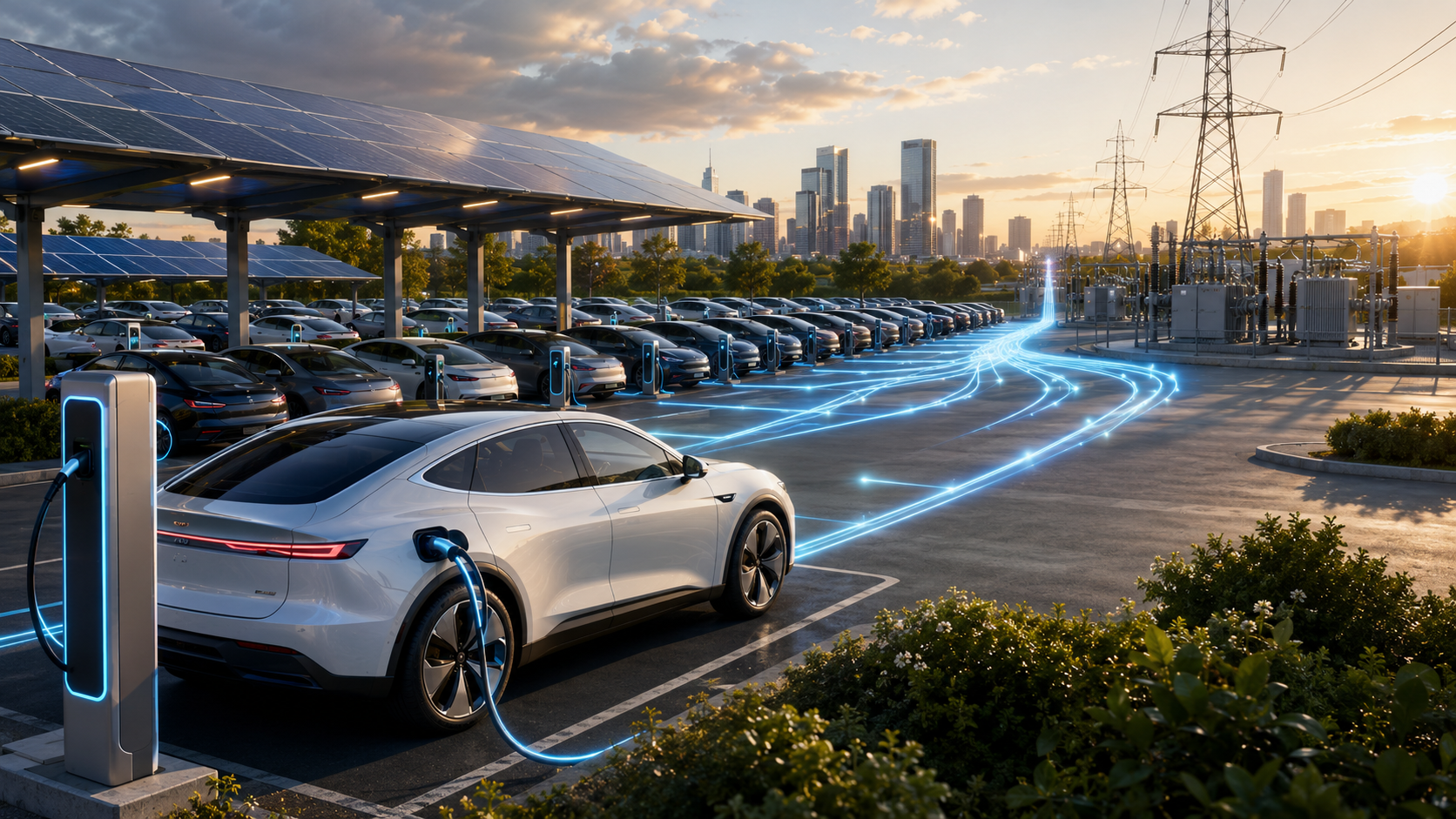
That is where bidirectional charging enters the energy transition. Electric vehicles are often discussed as a source of new electricity demand, and they are. If unmanaged, EV charging can increase customer peak demand, stress local distribution equipment, and contribute to the need for new grid investments. But that is only half the story. EVs are also large batteries on wheels, purchased primarily for transportation but capable of providing flexibility when parked and connected. With managed charging, they can shift demand away from peak periods and toward times when renewable energy is abundant. With bidirectional charging, they can go further by sending power back to a home, building, fleet facility, or the grid. In this way, EVs can become part of an integrated storage strategy that combines stationary and mobile batteries to provide flexibility across the bulk power system, distribution grid, customer sites, and mobility sector.
This article is the first in a two-part series on the role of bidirectional charging in the energy transition. The first part focuses on EVs as a rapidly emerging grid resource, including the scale of the mobile battery fleet, the role of medium- and heavy-duty vehicles, and how mobile batteries fit within a broader storage ecosystem that also includes utility-scale, distribution-connected, and customer-sited stationary storage. The second part will examine how to understand and manage the availability of the V2G resource. A single EV may be highly variable, depending on where it is parked, whether it is plugged in, its state of charge, and the driver’s mobility needs. But as vehicles are aggregated across homes, workplaces, depots, schools, and fleets, individual variability can be smoothed into more predictable performance. Emerging platforms that combine telematics, charger controls, aggregation, forecasting, and customer preferences reduce uncertainty and turn large portfolios of vehicles into a firm grid resource.
The Resource Is Already Emerging Everywhere
The first reason bidirectional charging matters is the sheer size of the resource. EV adoption is no longer limited to early adopters or a handful of leading markets. While U.S. sales softened following the elimination of federal clean vehicle tax credits, recent data suggest the market may be stabilizing, with sales beginning to plateau and showing a slight rebound in March 2026. Rising gasoline prices may also help renew consumer interest in EVs by strengthening the fuel-savings proposition. Even so, EVs continue to enter the vehicle fleet, and global adoption continues to grow rapidly. Every new EV adds electricity demand for charging, but it also adds a flexible battery that, under the right conditions, can help manage that demand and support the grid.
The scale becomes clear with simple math. In the first quarter of 2026, Americans purchased more than 216,000 new EVs. If every one of those vehicles had a 60 kWh battery, that would represent roughly 13 GWh of new mobile battery storage added to the U.S. vehicle fleet in just three months. March alone accounted for more than 82,000 new EV sales, equal to roughly 5 GWh of potential battery capacity using the same assumption. Not all of that capacity will be available to the grid, and not every vehicle will be bidirectional. But even a small portion of a rapidly growing battery fleet represents a meaningful energy storage resource.
The grid has never had access to a distributed storage resource of this scale. Stationary batteries are growing quickly and will play an essential role in the energy transition, but EV batteries are different because customers buy them primarily for mobility. The battery is already embedded in an asset the customer wants and needs. Once that battery exists, the question becomes whether the electric system can make productive use of a portion of its flexibility without compromising the driver’s transportation needs.
Medium- and Heavy-Duty Vehicles Expand the Opportunity
This is not only a light-duty vehicle story. Medium- and heavy-duty vehicles may become some of the most important early bidirectional charging resources because many operate in fleets, return to depots, follow predictable duty cycles, and use much larger batteries. Electric school buses, transit buses, delivery vans, refuse trucks, port vehicles, municipal fleets, and commercial trucks can represent hundreds of kilowatts or even megawatts of controllable load and storage at a single site. These vehicles may be challenging to electrify from a grid planning perspective, but they also create concentrated opportunities for managed charging, depot optimization, resilience, and V2G.
The concentration of MHD charging can create real grid challenges, especially where depots require high-capacity charging infrastructure or where multiple vehicles charge at the same time. But that concentration is also what makes the opportunity so significant. A depot is not just a load center. It can become a flexible energy hub. With the right rates, controls, interconnection rules, and compensation structures, fleets can manage when they charge, reduce demand during constrained periods, use onsite solar and stationary storage more effectively, and provide grid services when vehicles are parked and available.
Fleets often have more predictable schedules than personal vehicles, centralized charging infrastructure, professional energy management, and a stronger economic incentive to optimize operating costs. School buses are the clearest example: they have large batteries, predictable routes, long dwell times, and are often parked during summer afternoons when the grid is under stress. But similar logic can apply to transit buses, delivery fleets, municipal vehicles, and other commercial fleets with regular operating patterns.
Mobile and Stationary Storage Are Complementary
Mobile storage and stationary storage should not be treated as competing technologies. They are part of a larger storage construct that will be essential for grids with high levels of variable renewable generation. Stationary batteries can be sited and operated specifically for grid needs, providing fast response, renewable integration, capacity, and local reliability benefits. Mobile batteries add a different kind of value: they are distributed across the system, paid for primarily by the transportation sector, and located at homes, workplaces, schools, depots, parking lots, and commercial facilities.
Storage provides value at different points in the electric system. Transmission-connected batteries can support the bulk power system by providing capacity, ramping support, ancillary services, and congestion relief. In regions where renewable generation is constrained by transmission limits, storage can help make solar and wind more deliverable by storing energy when it is abundant and discharging it when the grid can use it. That makes utility-scale storage a critical tool for turning low-cost renewable generation into reliable system capacity.
Distributed batteries, including EV batteries, can also provide bulk system benefits when aggregated, but their location gives them an additional advantage. Because they sit closer to customers and distribution infrastructure, they are especially well suited to address local constraints on feeders, transformers, substations, and customer sites. This is becoming increasingly important as rooftop solar, heat pumps, EV charging, fleet electrification, and new commercial loads change how power flows across the distribution system. A flexible battery located at the grid edge can help manage those pressures in ways that distant bulk system resources cannot always provide.
EV batteries are particularly important because they are already justified by their transportation function. Customers buy EVs to move people and goods, not primarily to provide grid services. If a portion of that battery’s flexibility can be accessed without compromising mobility, bidirectional charging can create incremental grid value from an asset that is already being deployed. This does not eliminate the need for stationary batteries, but it can reduce the need to build dedicated stationary storage for every use case.
That also matters from a supply-chain and environmental perspective. Stationary batteries require materials, manufacturing capacity, land, interconnection, permitting, and capital investment. EV batteries require many of the same upstream inputs, but they are being deployed as part of the transportation transition regardless of whether they provide grid services. Using some of their capability for homes, buildings, fleets, and the grid increases the value derived from each battery already placed into service and can reduce pressure to build additional stationary batteries where mobile storage can provide the needed flexibility.
Speed is another advantage. Traditional grid infrastructure and utility-scale resources can take years to plan, permit, interconnect, finance, and build. EVs are being purchased now. Chargers are being installed now. Fleets are electrifying now. With the right tariffs, interconnection rules, compensation structures, and aggregation platforms, EV batteries can be enrolled and coordinated at scale much faster than many conventional grid assets can be developed.
The result is a layered storage ecosystem rather than a single technology pathway. Utility-scale batteries can help make renewable energy deliverable at the bulk system level. Stationary batteries on the distribution system can be placed at substations, feeders, community sites, or customer locations to address known local constraints. EV batteries add a more dynamic layer of distribution-level flexibility because they are mobile, highly distributed, and available wherever vehicles are parked and plugged in. Together, these resources can help absorb more renewable energy, manage load growth, reduce infrastructure costs, and improve resilience. The future storage system will depend on a portfolio of stationary and mobile resources deployed where each can provide the greatest value.
From Forecasted Load to Planned Resource
The next step is for utilities and regulators to stop treating EVs only as a source of future load growth and start treating them as part of the storage strategy needed to manage the energy transition. Forecasting EV adoption is necessary, but it is not sufficient. If utilities assume EV charging will be unmanaged, they will plan for a more expensive system than may actually be needed. If they recognize that a portion of EV charging can be shifted, shaped, or discharged back to homes, buildings, fleets, and the grid, the planning problem changes.
That does not mean every EV will export power or that bidirectional charging will be available everywhere at once. It means utilities should integrate EVs into their storage strategies in a way that optimizes value across different layers of the electric system. Utility-scale batteries, distribution-connected storage, customer-sited batteries, and EV batteries each provide different capabilities. The opportunity is to determine where each resource can provide the greatest value.
Managed and bidirectional charging must be incorporated into distribution planning, integrated resource planning, non-wires alternatives, demand response programs, virtual power plant strategies, resilience planning, and rate design. Utilities should be asking where EV flexibility can complement stationary storage, where mobile batteries can defer or reduce infrastructure needs, and where aggregated vehicles can provide dependable performance during constrained periods. Regulators should be asking whether existing tariffs, interconnection rules, program designs, and compensation structures allow that value to be captured and shared with participating customers and all ratepayers.
This shift is becoming more practical because the market architecture needed to manage EVs at scale is emerging. Automakers, telematics providers, charger networks, aggregators, fleet management platforms, and virtual power plant operators are developing the ability to enroll customers, forecast availability, control charging, dispatch flexible load, measure performance, and compensate participants. These capabilities are not yet seamless, and interoperability remains a major barrier. But the basic model is increasingly clear: utilities do not need to manage millions of individual vehicles directly. They can procure reliable performance from platforms that aggregate and coordinate those vehicles.
Bidirectional charging is not just an EV technology; it is part of the flexibility and storage layer needed to make the energy transition work. Solar, wind, and stationary storage are changing the supply side of the grid. Data centers, manufacturing, buildings, and EVs are changing the demand side. DERs are proliferating at the edge of the system. In that environment, coordinating mobile batteries should become a core part of a broader, holistic storage strategy, not an afterthought. EVs should be planned alongside utility-scale batteries, distribution-connected storage, and customer-sited storage so each resource is deployed where it can provide the greatest value. The sooner utilities and regulators treat EVs as flexible storage assets within this larger storage ecosystem, the better positioned they will be to manage load growth, integrate renewable energy, protect affordability, and improve resilience.
