June 9, 2026
Valuing Vehicle-Grid Integration Programs: A Tool for Improving Energy Affordability through EV Grid Services
The recently released VGI value report was produced jointly by the Smart Electric Power Alliance (SEPA) and the Vehicle-Grid Integration Council (VGIC) and published in May 2026. The report grew out of the SEPA and VGIC Utility Collaboration Forum, a peer learning and industry collaboration effort that brought together utilities, load-serving entities, automakers, charging providers, software firms, and research organizations. Throughout 2025, the forum held eight roundtable discussions focused on one of the most important questions facing the electric vehicle and utility sectors: how should the value of vehicle-grid integration programs be assessed, measured, and translated into action?
The report’s central goal is to help utilities, regulators, and industry stakeholders assess and operationalize the value of vehicle-grid integration, or VGI. It defines VGI as the set of technologies, policies, and strategies that change the timing, power level, and location of EV charging or discharging in ways that benefit the grid while still meeting drivers’ mobility needs.
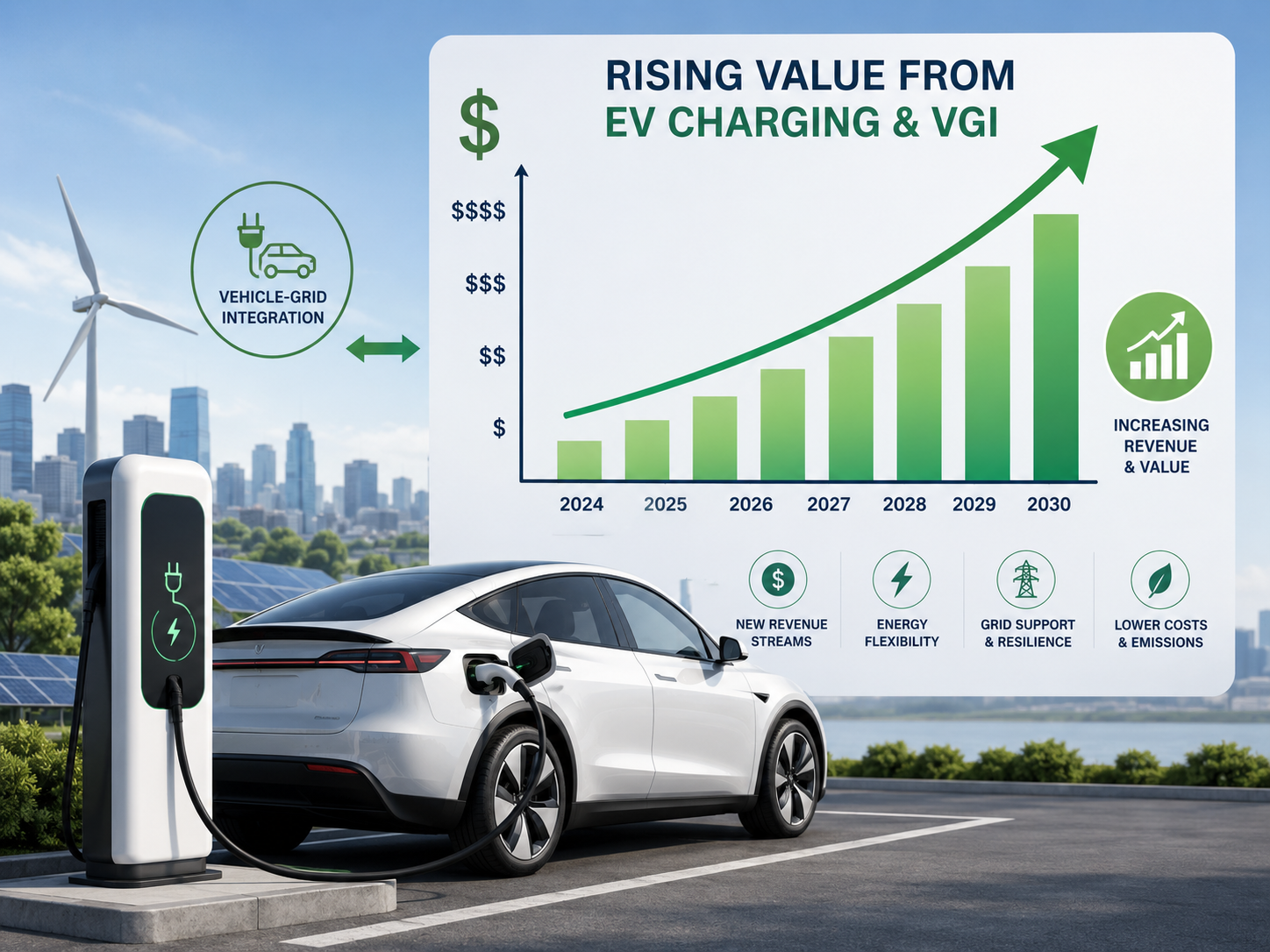
Its core argument is that valuing VGI is not simply an EV program design exercise. It is a grid planning and affordability exercise aimed at managing accelerating load growth, reducing avoidable infrastructure costs, and turning EVs from a potential grid burden into a flexible system asset.
The report arrives at an important moment for the V2G community because it reframes EVs as one of the most significant new distributed energy resources available to utilities. In the United States, the elimination of federal clean vehicle tax credits under the current administration has disrupted the market, contributing to a pull-forward of sales in 2025 followed by weaker demand in early 2026. But the EV market has not collapsed. After a difficult start to the year, U.S. EV sales rebounded in March 2026 on a month-over-month basis, and first-quarter data suggest the post-credit decline may be leveling out. More importantly, EV sales remain strong by historical standards, and the global adoption story is even more compelling. The International Energy Agency reports that electric car sales exceeded 20 million vehicles in 2025, representing roughly one-quarter of all new cars sold worldwide, with continued growth expected in 2026.
This matters for V2G because the scale of the potential resource is no longer theoretical. Even if U.S. adoption becomes more uneven in the near term, the broader direction of travel is clear: more batteries are being deployed in driveways, depots, parking lots, and fleet yards every year. At the same time, the report is careful not to treat EV adoption as uniform. California remains far ahead of most other states, while many jurisdictions are still at much lower levels of penetration. This uneven adoption pattern is one reason the report repeatedly emphasizes that every utility must conduct its own assessment of VGI value based on its own system conditions, customer mix, load growth, charging behavior, and regulatory environment.
Why VGI Is an Affordability and Grid Planning Tool
from other forms of load growth, such as data centers. EVs can significantly increase customer peak demand, especially when Level 2 charging is added to a home or when fleets install higher-capacity charging infrastructure. But unlike many large new loads, EV charging is highly flexible because vehicles are often parked for many hours while needing only a few hours of charging to meet daily mobility needs. This creates a large window for managed charging, dynamic pricing, flexible connection agreements, and, where available, discharge to buildings and the grid using bidirectional charging equipment.
The report organizes VGI strategies into three broad categories. The first is passive behavioral approaches, such as time-of-use rates and dynamic pricing, that encourage customers to shift charging or discharging in response to price signals. The second is active managed programs, where utilities or third-party platforms control or optimize charging and discharging in response to grid conditions. The third is flexible connection agreements, which allow customers, including fleets in constrained areas, to connect more quickly by agreeing to managed charging limits tied to local grid conditions.
The report’s treatment of VGI as an affordability strategy is one of its most important contributions. Utilities are facing a rising cost environment driven by aging infrastructure, extreme weather, wildfire mitigation, electrification, data centers, manufacturing growth, and transportation electrification. Without more flexible use of the grid, these pressures will translate into higher capital spending and, ultimately, higher rates for all customers. VGI offers a different path. By shifting charging away from peak periods, using existing grid assets more efficiently, and enabling EVs to provide capacity, demand response, resilience, and other grid services, managed and bidirectional charging can help reduce the need for traditional infrastructure upgrades.
The report places particular emphasis on distribution system costs. It cites California analysis estimating that traditional distribution infrastructure investments associated with electrification could reach tens of billions of dollars by 2035. It also explains that bulk system benefits, such as reducing system peak demand, are often easier to quantify than distribution system benefits, which depend on feeder, transformer, substation, and customer-panel constraints.
Program designed only to reduce bulk system peaks can unintentionally create new local peaks. For example, a simple time-of-use rate may push many EV drivers to begin charging at the same time when the off-peak period starts, creating a secondary spike on local distribution infrastructure. By contrast, a distribution-optimized managed charging program can smooth charging across the off-peak window staying within distribution system constraints. This is one of the report’s most practical insights: not all load shifting is equally valuable, and poorly designed load shifting can simply move a problem from one part of the system to another.
The Key Findings: There Is No Single Value of VGI
The report’s most important conceptual point is that there is no single “value of VGI.” VGI produces a value stack, and that value varies by utility, location, customer class, program design, and grid need. Attempting to reduce VGI to one number can obscure the very differences that matter most for good policy and program design.
The report distinguishes between customer value and utility system value. Customer value includes bill savings, incentives, performance payments, and resilience benefits from using an EV for backup power. Utility system value includes avoided generation capacity, lower energy procurement costs, avoided transmission and distribution investments, ancillary services, and improved system operations. The report also identifies aggregators and virtual power plant platforms as a critical third layer because they translate individual EV flexibility into dispatchable, measurable grid resources.
For the V2G community, this two-perspective framework recognizes that customers need clear, bankable value propositions to participate, while utilities and regulators need evidence that programs deliver measurable system benefits. A VGI program can fail if either side of that equation is weak. If compensation is too uncertain or too complex, customers and fleets may not enroll. If system value is not measured rigorously, regulators may hesitate to approve ratepayer funding.
The report therefore ties valuation directly to compensation design, settlement, data quality, and program durability. VGI value is not just about what a vehicle can technically do. It is about whether that capability can be enrolled, dispatched, measured, verified, compensated, and integrated into utility planning.
The report highlights several recurring VGI value streams:
- Resource value: whether EVs can provide dependable capacity, load reduction, or discharge when and where the grid needs it.
- Economic value: the avoided costs or savings associated with that flexibility, often expressed in dollars per kilowatt or dollars per kilowatt-hour.
- Customer value: bill savings, direct incentives, performance compensation, and resilience benefits.
- Distribution value: avoided or deferred upgrades on local circuits, substations, transformers, or customer-side infrastructure.
- Market and operational value: the ability of aggregators, OEMs, chargers, and platforms to make EVs visible, controllable, measurable, and dispatchable.
The literature review in the report reinforces the scale of the opportunity. It summarizes 25 recent studies and highlights findings from organizations including the Union of Concerned Scientists, Brattle, national laboratories, Energy and Environmental Economics, EPRI, and others. Several examples are especially compelling. The Union of Concerned Scientists found that managed charging in California could save $4.2 billion in system costs by 2045, with bidirectional charging unlocking an additional $3.5 billion at modest participation levels. Brattle and ev.energy estimated roughly $30 billion in nationwide avoided costs by 2035 from passive managed charging, active managed charging, and bidirectional charging. Energy and Environmental Economics’ Massachusetts “Peak Potential” study found that EVs could become the largest source of flexible grid capacity in the state, with up to 6.5 GW of peak load reduction potential.
The report does not overstate the case. It repeatedly cautions against one-size-fits-all conclusions. VGI value depends on local avoided costs, marginal system conditions, load shapes, customer behavior, technology availability, and program design. A bidirectional charging program that creates high value in one utility territory may produce lower value in another if the local system does not need capacity at the same times vehicles are available to export. Likewise, a managed charging program that reduces bulk system peaks may not produce distribution value unless it is targeted to the right circuits or designed with local constraints in mind.
Critical Insights for the V2G Community
One of the report’s more practical insights is that data quality is not optional. Valuation and compensation require accurate measurement of availability, charging behavior, state of charge, event performance, exports, curtailment, baselines, and settlement. The report points to vehicle telematics, charger data, and advanced metering infrastructure as complementary data streams. Each has strengths and limitations. Vehicle telematics can provide information about state of charge and vehicle availability. Charger data can measure activity at the plug. AMI data can provide settlement-grade information at the customer meter.
The report also stresses that interoperability alone does not guarantee data quality. Programs need clear requirements for validation, retention, auditing, measurement, and verification from the beginning. This is especially important as third-party aggregators, automakers, charging providers, and utilities all play roles in collecting and transmitting data. If regulators are going to approve VGI programs at scale, they need confidence that performance can be measured accurately and that customer compensation reflects actual grid value.
The report’s recommendations are directed at commissions, utilities, and industry. Commissions should establish clear valuation frameworks, authorize programs at meaningful scale, allow adaptive implementation, and update interconnection rules for bidirectional charging systems. Utilities should assess VGI value in their own territories, pair deployments with system-specific analysis, integrate VGI into planning, and build technology partnerships that support interoperability over time. Industry should align vehicles, chargers, software, and aggregation platforms around grid-enabled capabilities, standardize measurement and verification, reduce soft costs, and support modular integration that avoids vendor lock-in.
A key takeaway for the V2G community is that the industry cannot wait for perfect data, perfect standards, or fully mature markets before deploying programs. The report argues that real data comes from deployment, not endless theoretical analysis. Small pilots can help, but meaningful scale is necessary to understand customer behavior, operational performance, distribution impacts, and long-term value. This is especially important for bidirectional charging because the business case depends not only on hardware capability but also on compensation structures, interconnection pathways, reliable dispatch, customer trust, and settlement-grade data.
The report ultimately positions managed charging and bidirectional charging as mutually reinforcing, not competing, pathways. Managed charging can scale quickly and deliver immediate peak reduction, load factor improvements, and distribution benefits. Bidirectional charging builds on that foundation by adding discharge, resilience, and capacity value where customer economics and technology readiness support it. For the V2G community, this is a strong strategic message: V2G should not be framed as a niche add-on to EV charging, but as the next layer of a broader VGI framework that begins with load flexibility and evolves toward dispatchable mobile storage.
The report also helps clarify why compensation design will be central to scaling V2G. Customers and fleets need to understand how they will be paid, how often they may be dispatched, how their mobility needs will be protected, and whether the value stream is durable enough to justify investment in bidirectional equipment. Regulators and utilities, in turn, need to ensure that compensation reflects measurable system benefits and does not overpay for services that are not needed or not delivered. The best programs will likely combine simplicity for the customer with sufficient performance measurement for the utility.
In conclusion, Valuing Vehicle-Grid Integration Programs is less a narrow technical report than a strategic roadmap for making VGI part of mainstream utility planning. Its most important contribution is the argument that VGI valuation must be rigorous, local, data-driven, and tied to affordability. The report makes clear that EVs will either add stress to the grid or become one of the most important flexible resources available to utilities. Which path emerges will depend on the program design, valuation methods, compensation structures, interconnection rules, and deployment decisions made over the next several years.
