May 26, 2026
A new March 2026 research report prepared for the Massachusetts Clean Energy Center offers a timely and practical look at the emerging vehicle to everything market and the lessons that early projects can provide for the next stage of deployment. The report, titled Vehicle-to-Everything Research Report: MassCEC Vehicle-To-Everything Demonstration Program, was prepared by Converge Strategies and the Vehicle Grid Integration Council for MassCEC as part of the state’s V2X Demonstration Program.
The report is not intended to be a comprehensive survey of every V2X project underway around the world. Instead, it is designed as a practical resource for V2X installers, utilities, customers, school districts, policymakers, and other market participants who are trying to understand what it takes to implement real projects. Its purpose is to draw lessons from national and international V2G and V2X pilot programs, identify pain points and opportunities, and inform the next phase of the MassCEC demonstration effort.
That practical orientation is one of the report’s strengths. The V2X sector has no shortage of high-level claims about electric vehicles becoming “batteries on wheels.” What the industry needs now is a clearer understanding of how projects actually get built, who has to be involved, what compensation structures are available, how data is managed, and which regulatory pathways make deployment easier or harder. Notably, compensation remains particularly unsettled — several of the pilots reviewed offer little to no public information on how participants were paid, suggesting the economics of V2X are not yet resolved, not merely uncoordinated. The report moves the conversation in that direction.
A Report Built Around Implementation
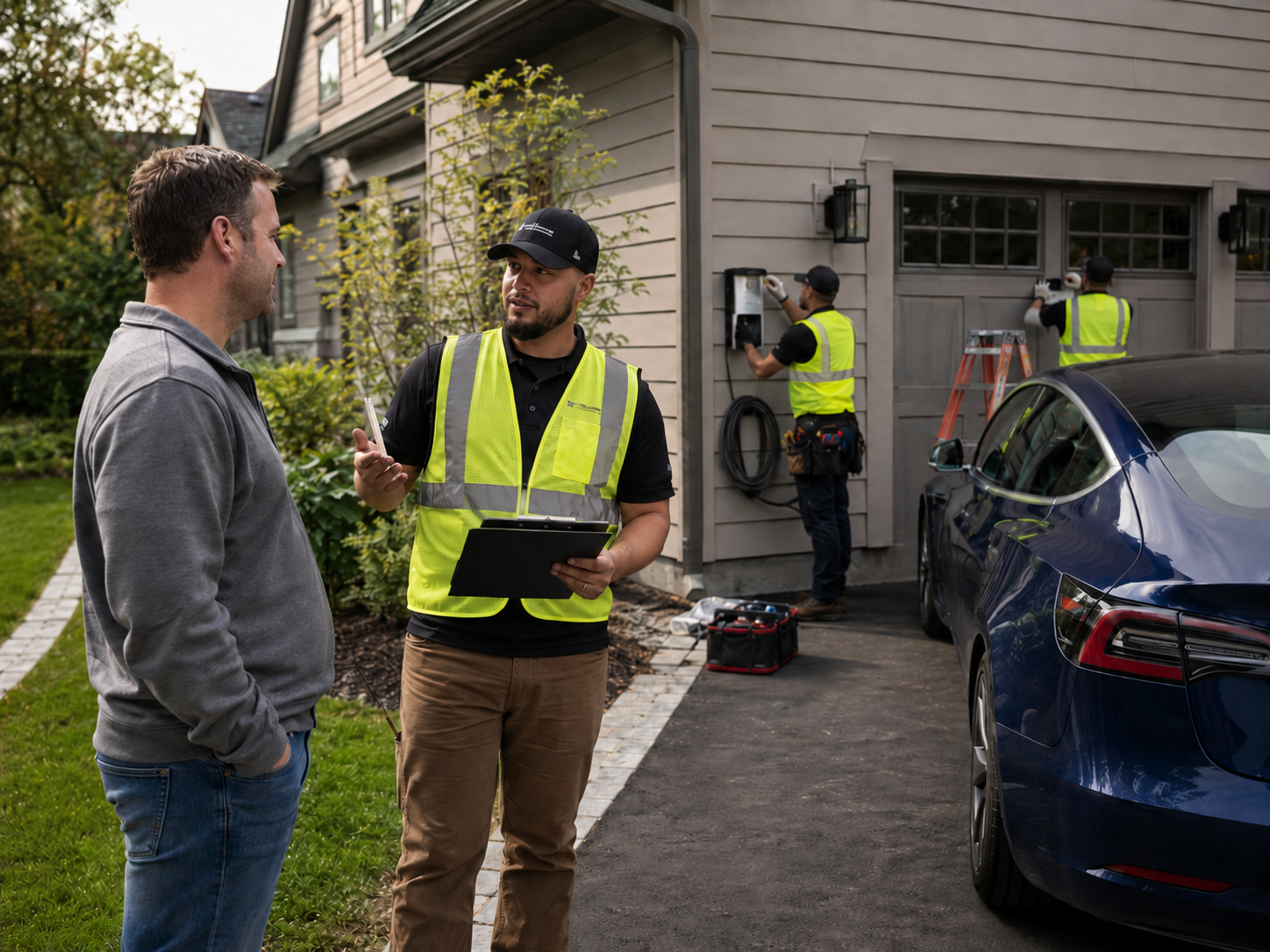
MassCEC launched its V2X Demonstration Program in February 2025 to increase the adoption of bidirectional charging among residential customers, commercial customers, municipalities, and school districts. The program covers the cost of bidirectional EV charging equipment and installation for selected participants, while gathering data and lessons learned on both V2X deployment and grid impacts. As of March 2026, the project team was in the process of deploying V2X charging across 30 residential sites, four municipal sites, and five school sites in Massachusetts. The installations were not yet fully complete, and the team was still working through site implementation, documenting deployment challenges, and preparing to collect additional operational data during summer 2026. The program is expected to culminate in a guidebook, planned for release at the end of the year, that will summarize lessons learned and provide guidance for future V2X deployment.
The methods are straightforward but useful. The authors reviewed publicly available information and external resources on five V2X pilot programs, selected because they vary by geography, vehicle type, scale, use case, and program structure. The cases were chosen for their relevance to the MassCEC program and to future V2X deployment in Massachusetts. Each case was examined across five domains: program funding, compensation and economics, standards and policy, data management, and stakeholder coordination.
Those five domains are exactly the right lens for this stage of the market. They shift attention away from whether bidirectional charging can work technically and toward whether it can be deployed repeatedly, financed sustainably, integrated into utility operations, and made worthwhile for customers.
The Case Studies
The report reviews five projects: Baltimore, Maryland; Beverly, Massachusetts; Fremont, California; Utrecht, Netherlands; and Exmouth, Australia. Together, they provide a useful cross section of the emerging V2X market.
The Baltimore case focuses on a residential V2G pilot involving Ford F-150 Lightning trucks, Sunrun, and Baltimore Gas and Electric. The pilot began with grid parallel, non-export vehicle-to-home capability and expanded in 2025 to grid-parallel exports from vehicle batteries to the grid. Participants earned payments for discharging electricity during weekday evening peak hours, with annual payments capped at $1,000. The report also notes the importance of Maryland’s new V2G interconnection rules, adopted through COMAR 20.50 following passage of the DRIVE Act.
The Beverly, Massachusetts case examines one of the earliest electric school bus V2G projects in the country. Beverly Public Schools, Highland Electric Fleets, National Grid, and technology partners demonstrated how school buses can use long dwell times and predictable schedules to support the grid during summer peak periods. The report notes that National Grid’s ConnectedSolutions program can provide up to $200 per kW for qualifying performance and that a single bus discharged 10.78 MWh to the Massachusetts grid across the summers of 2021 and 2022, generating $23,500 in revenue.
The Fremont, California case highlights a school bus V2G deployment supported by the California Energy Commission’s Replicable V2X Deployment for Schools funding opportunity. The project uses bidirectional chargers, The Mobility House’s ChargePilot and Cascade platforms, and participation in California’s Emergency Load Reduction Program. The report identifies ELRP as an important compensation pathway because VGI aggregations can receive up to $2 per kWh for reducing load or exporting stored energy during grid events, with a minimum dispatch guarantee that improves revenue predictability.
The Utrecht case broadens the frame beyond the United States. It focuses on a large scale V2G car sharing network involving Hyundai IONIQ 5s, Renault 5s, We Drive Solar, MyWheels, and the City of Utrecht. The project is especially valuable because it shows how bidirectional EVs can be integrated into dense urban environments with high rooftop solar penetration and constrained distribution grids. However, the report also flags the limits of public information on funding, compensation, and data management.
The Exmouth, Australia case focuses on Horizon Power’s Vehicle-to-Grid Orchestration Trial in a remote microgrid. This project used Nissan Leafs, Wallbox Quasar chargers, Jet Charge equipment, and Horizon Power’s DERMS platform to test how EVs can help stabilize a regional grid with variable demand and distributed energy resources. Its most useful lesson may be that V2X can support not only large utility systems, but also smaller grids where resilience, customer flexibility, and distributed control are especially valuable.
Key Findings
The report’s core finding is that V2X is technically feasible and increasingly relevant, but still difficult to scale because the institutional and market structures around the technology remain incomplete. The case studies show that successful projects require more than vehicles and chargers. They require aligned stakeholders, clear interconnection pathways, workable compensation, sufficient funding, and credible data management systems.
Several findings stand out:
- Stakeholder coordination is essential because V2X projects sit at the intersection of vehicles, buildings, chargers, utilities, software platforms, regulators, and customers.
- Program funding remains a major risk, especially when pilots depend on one time grants but lack a clear path to ongoing operations.
- Compensation structures are still uneven, with only some projects offering transparent revenue opportunities for participants.
- Data management is critical, but public information on data collection, ownership, reporting, and integration remains limited.
- Vehicle use patterns matter because V2X only works when customer mobility needs and grid service availability can be aligned.
The report is particularly strong in emphasizing that V2X deployment is a coordination challenge. The technology may be installed at a customer site, but the value depends on many actors working together. Utilities need visibility and operational confidence. Customers need assurance that their vehicles will be available when needed. Aggregators and software providers need workable communications pathways. Regulators need confidence that interconnection, safety, and compensation rules are clear.
The report also usefully identifies information gaps. Many public case studies do not provide enough detail on financial structures, participant compensation, data governance, or long-term program management. This is not a weakness of the report so much as a reflection of where the market stands. Much of the most important implementation knowledge remains embedded in private project experience, utility processes, and early-stage program administration. The report also surfaces a finding that deserves more attention: vehicle usage patterns are a fundamental constraint, not just a logistical detail. V2X only delivers value when customer mobility needs and grid service windows can be aligned, and high daily mileage users are less likely to participate. School buses work well precisely because their schedules are predictable, a condition that does not transfer easily to residential or general fleet contexts.
Value for Industry Participants
For industry participants, the report’s value lies in its focus on practical deployment conditions. Equipment vendors can use it to better understand the importance of interoperability, utility coordination, and data reporting. Installers and project developers can use it to anticipate the range of stakeholders and approvals that V2X projects require. Utilities can use it to compare different program models and identify the operational questions that must be answered before moving from pilots to larger programs. Policymakers and regulators can use it to see how unclear rules, insufficient compensation, and fragmented funding can slow an otherwise promising technology.
The report also provides a useful reminder that not all V2X use cases are the same. Residential backup power, school bus V2G, urban car sharing, commercial fleet operations, and microgrid support each raise different questions. A program design that works for a school bus depot may not work for a residential customer. A compensation model designed for emergency events may not be enough to support daily grid services. A DERMS enabled microgrid trial may offer valuable lessons, but not all of them will transfer neatly to a large investor owned utility territory.
That is why the MassCEC program is important. By deploying bidirectional charging across residential, municipal, and school sites, Massachusetts has an opportunity to generate more detailed, locally relevant evidence about what works, what does not, and what needs to change. The report notes that the program will include regional workshops and culminate in a guidebook intended to help stakeholders in Massachusetts and beyond implement V2X programs more effectively.
Why This Report Matters
The report arrives at an important moment for the V2X market. Electric vehicles are becoming a more significant part of the transportation system, and their batteries represent a growing source of flexible capacity. At the same time, utilities are facing rising peak demand, increasing electrification loads, distribution constraints, and growing resilience needs. V2X sits directly at the intersection of these challenges.
The report does not overstate the case. It recognizes that V2X is still emerging, that many programs remain small, and that public data is limited. But it also shows that early building blocks are beginning to emerge. Real vehicles are being discharged to homes, buildings, grids, school districts, and microgrids, though often in pilots of very limited scale, including one that enrolled just three residential customers. Customers are receiving payments in some programs. Utilities are learning how to dispatch mobile batteries. Regulators are beginning to clarify interconnection rules. Software platforms are coordinating charging and discharging across real assets.
The report is particularly strong in emphasizing that V2X deployment is both a coordination challenge and an economics challenge. Utilities need visibility and operational confidence. Customers need assurance that their vehicles will be available when needed. But customers also need confidence that the compensation on offer is worth the tradeoff, and across several of the pilots reviewed, that question remains genuinely open.
For V2X to scale, the next phase will need to move beyond isolated demonstrations toward repeatable program models. That means clear rules, durable compensation, transparent data, and sustained funding. The MassCEC report does not solve all of those questions, but it provides a valuable framework for asking them in the right way.
