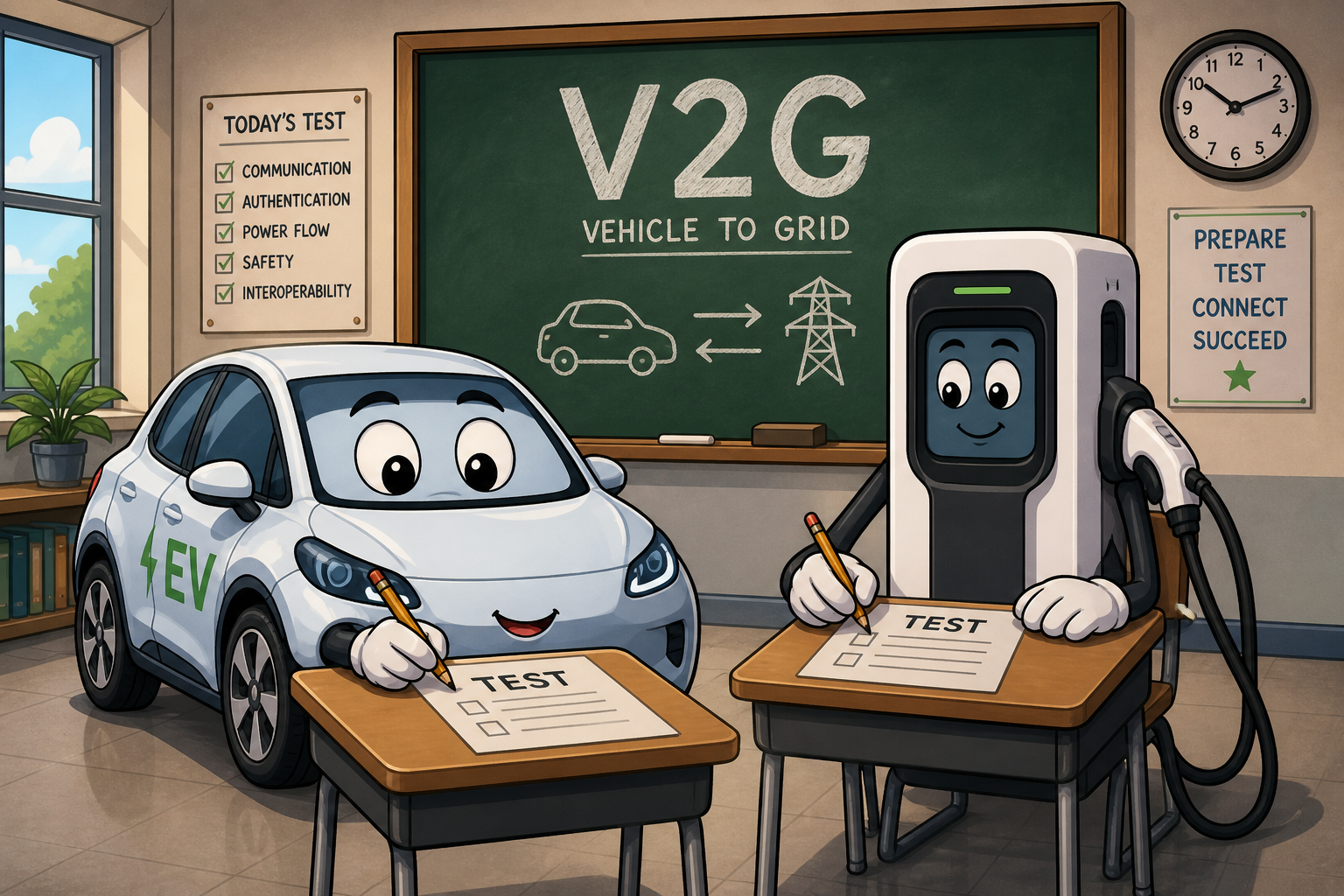
Why Testing Infrastructure Is Emerging as the Critical Path to Scaling Bidirectional Charging
May 12, 2026
The bidirectional charging industry is entering a new phase. For years, critical work has focused on building the technical and regulatory foundation for vehicle grid integration: ISO 15118, SAE J3072, UL certifications, grid codes, OCPP, and the broader architecture required to enable electric vehicles to function as grid resources. That focus has been essential. Without common standards, there is no credible pathway to scale.
But a more practical understanding is beginning to take hold. Standards are essential, but they do not translate automatically into systems that work together in the field. They establish a shared technical language, but they do not guarantee that every vehicle, charger, backend system, and grid interface will interpret and implement that language in the same way.
That distinction is now emerging as one of the most important barriers to scaling vehicle-to-grid. Products can be designed around the same standard and still fail to operate together in the field. The issue is not simply whether ISO 15118-20 exists, but whether manufacturers implement it consistently enough for real-world, multi-vendor systems to work together reliably in the field.
This is where interoperability testing becomes critical. As one industry expert explained, bidirectional charging issues do not fully appear when testing occurs with a single vendor or in a tightly controlled lab setting. They emerge when different OEMs, chargers, and system components are brought together and asked to operate as they would in the field.
The Limits of Standards in a Complex System
At a high level, interoperability sounds straightforward. If a vehicle and charger are both designed around ISO 15118-20, they should be able to communicate, authenticate, exchange power, and coordinate charging and discharging. In practice, the standard leaves room for interpretation, especially around message sequencing, optional versus mandatory fields, timing, error handling, and the treatment of different use cases.
That flexibility is not a flaw. Standards often need room to accommodate different architectures and market conditions. But in a complex ecosystem, flexibility creates variation. Engineers working for different manufacturers make different implementation choices. Those differences may be technically defensible within the standard, but they can still create failures when equipment is connected in real operating environments.
Bidirectional charging adds another layer of complexity. Unidirectional charging is largely about transferring power from the charger to the vehicle. V2G requires coordinated communication among the vehicle, charger, backend systems, aggregators, and grid operators. The system must understand not only whether a vehicle can charge, but when it can discharge, how much energy can be exported, what grid conditions allow, and how the driver’s mobility needs will be protected.
This complexity highlights a critical distinction between conformance and interoperability. Conformance testing asks whether a product complies with a standard. Interoperability testing asks whether products from different manufacturers actually work together. Both are necessary, but they are not the same.
CharIN’s Role: Convening the Ecosystem and Testing Real Implementations
CharIN is a global industry association focused on advancing interoperable electric vehicle charging. Founded to promote the Combined Charging System (CCS) and now also supporting the development of the Megawatt Charging System (MCS), CharIN brings together automakers, charging providers, equipment manufacturers, and other stakeholders to align around common technical frameworks.
CharIN’s role in this ecosystem is best understood as a convening and implementation platform. Its mission is to promote harmonized, safe, and reliable charging systems and to support certification, working groups, and on-site testing events known as Testivals. CharIN plays a central role in conformance testing, integrating V2X testing into Testivals, translating Testival outcomes into working group discussions, and driving actions that support standardization, regulation, and broader industry alignment.
For bidirectional charging, CharIN is working on the practical bridge between standards and implementation. Its Interoperability Guide 2.0 provides a minimum implementation scope for ISO 15118-20 DC bidirectional power transfer in dynamic control mode. Importantly, the document is not intended as a substitute for ISO 15118-20 or for series production. Instead, it provides a simplified functional implementation to support development and interoperability testing.
That matters because it narrows the problem. ISO 15118-20 is large and complex. CharIN’s guide identifies the minimum communication sequence and message handling needed to begin testing DC bidirectional power transfer in a common way. It intentionally excludes certain features, including Plug and Charge, service renegotiation, scheduled control mode, grid-forming mode, pause and standby, and certificate revocation checks.
That kind of simplification is essential for early market development. It gives manufacturers a more concrete starting point and creates a shared testing baseline before the industry expands into more complex functionality.
Inside a CharIN Testival
CharIN’s Testivals are not traditional conferences. They are intensive, hands-on engineering events where OEMs, charging station manufacturers, backend providers, PKI providers, and other ecosystem participants bring equipment and test real interactions over several days.
The point is not just to demonstrate that products work under ideal conditions. It is to uncover the gaps that only appear when different companies connect real systems. The primary value is bringing engineers together in person so they can test, observe failures, debug problems, and resolve implementation differences directly. The Testival creates a neutral environment where companies can work through issues that would be difficult to solve through email or isolated lab testing.
The testing can include unidirectional charging, bidirectional charging, Plug and Charge, multi-PKI testing, and broader ecosystem interactions. Participants may bring specific issues they want to investigate, or they may test against prescribed use cases. In some cases, CharIN has used structured test cases and published reports. In other cases, participants have more freedom to focus on what matters most to their product development cycle.
For bidirectional charging, the Testival model is evolving toward more complete system testing. CharIN is not only looking at the vehicle-to-charger interaction. It is also extending the scope toward grid simulators and more end-to-end testing, because V2G requires the system to respond to grid conditions as well as vehicle and charger behavior.
This is why Testivals are so valuable. They compress learning. Instead of discovering interoperability failures after deployment, companies can identify them in a concentrated testing environment, with the right technical teams present and the ability to iterate quickly.
Task 53’s Role: Building the Path to Multiparty Interoperability
Task 53 is an international, multi-stakeholder research initiative that brings together national laboratories, industry participants, and government representatives to advance interoperability for bidirectional charging. It plays a different but highly complementary role to CharIN. Launched in April 2024 within the International Energy Agency’s Hybrid and Electric Vehicle Technology Collaboration Program, it focuses on advancing multiparty interoperability for bidirectional charging. Its work centers on testing upcoming ISO 15118-20 amendments related to AC bidirectional charging to help ensure these evolving standards are implemented consistently across the industry.
Task 53 was born out of a frustration shared by many in the industry: there have been hundreds of V2G trials around the world, but very few have scaled. Many pilots worked because they relied on tightly controlled equipment pairings or proprietary integrations. Add a new vehicle or a new charger, and the system often stops working. At its core, the challenge is moving beyond “pairs” toward true multi–party interoperability.
Multiparty interoperability means more than proving that one car works with one charger. It means proving that different vehicles, chargers, and distribution grid interfaces can operate across a broader set of combinations. Task 53 identifies two main objectives: interoperability between bidirectional charging stations and vehicles, and interoperability between charging stations and distribution grids.
Task 53 is also explicit that the largest barriers are the non-interoperable protocol and non-standardized grid codes. Without solving those issues, economies of scale are limited, competition remains constrained, bidirectional charger costs stay higher, and mass introduction of V2X is delayed.
From Temporary Events to Permanent Testing Infrastructure
One of the most important distinctions between CharIN and Task 53 is how they approach testing infrastructure.
CharIN Testivals are more like concentrated interoperability events. They bring the ecosystem together for intensive testing, debugging, and alignment. Task 53 is working toward a more permanent testing model, using specialized labs and a structured two-phase process.
It is helpful to think of CharIN Testivals as somewhat like “speed dating,” where many companies come together for short, focused testing interactions. Task 53, by contrast, is building a model around permanent labs, distributed pre-testing, and centralized laboratory validation.
The first phase is distributed testing. Companies test in their own labs or in partner labs, using shared profiles and test concepts. The results are then fed into a continuous improvement process. A key requirement is that participating companies must share results within the Task 53 process, rather than keeping findings private. This is intended to accelerate learning across the consortium.
The second phase is centralized testing in permanent labs. Task 53 has identified labs including DEKRA, ElaadNL, the Joint Research Centre in Ispra, and the Grid Integration Lab in India as part of this broader testing ecosystem. The goal is not to use these labs for basic debugging. Participants must meet entry criteria before testing, because lab time and specialized equipment are expensive.
Task 53’s work includes testing at Argonne National Laboratory and the Joint Research Centre, covering solutions that feed energy back to the grid through single-phase or three-phase systems, whether chargers are onboard or off-board.
This permanent testing infrastructure matters because V2G cannot scale on ad hoc demonstrations alone. The industry needs repeatable test environments where equipment can be evaluated against common profiles, grid conditions, and implementation expectations before it reaches the market.
A concrete example of this shift is now emerging in California. The California Energy Commission recently awarded $4 million to launch the Capital Charge Yard, a publicly accessible EV charging testing and interoperability lab in Sacramento. The facility is designed to provide a permanent environment where manufacturers can validate interoperability, test conformance to evolving standards, and evaluate advanced capabilities such as vehicle-to-grid.
CharIN will play a central role in leading interoperability testing at the site, applying its global conformance framework and convening structured testing events that bring vehicles, chargers, and backend systems together. More broadly, the project reflects a growing recognition that interoperability cannot rely solely on periodic events or isolated lab work. It requires dedicated, accessible infrastructure that connects technical validation with real-world deployment and policy development.
Golden Guidelines and the Search for a Common Profile
Task 53 is not trying to write new standards. Its role is to operate inside the existing standards framework and create practical guidance for implementation and testing. Task 53 North America Representative, Bjoern Christensen, described two major deliverables: “golden guidelines” for implementing the protocol stack and corresponding “golden guidelines” for testing it. These are intended to be practical handbooks, not academic reports.
That practical orientation reflects a broader industry challenge. The problem is not simply the absence of standards. It is the lack of common implementation profiles within those standards. The Task 53 interview described ISO 15118-20 as not yet fully “ready for prime time” for bidirectional charging without additional hardening. The work includes making key parameters mandatory, reducing room for interpretation, improving error handling, and aligning timing between EVSE and EV communication.
In other words, Task 53 is working to translate a broad technical standard into a more repeatable operational framework that can function consistently across manufacturers.
CharIN and Task 53 are not competing efforts. They are complementary pieces of the same interoperability puzzle. V2G News recently examined the complementary roles of CharIN and Task 53 in more detail, including their differing approaches to interoperability testing and standards implementation.
A memorandum of understanding between the two organizations formalizes that relationship. CharIN brings a large global industry network, Testivals, conformance testing development, and a focus on bilateral testing. Task 53 is supported by 18 countries, bringing a focused international effort on multiparty bidirectional charging interoperability, including gaps in standards, grid code alignment, specialized lab testing, and knowledge transfer into standards and legal frameworks.
That coordination includes collaboration around research, workshops, interoperability testing, and public communications. The agreement also references coordination around V2G Testivals, JRC and Argonne lab testing, and use-case-based testing methods.
This division of labor is useful. CharIN can mobilize the industry. Task 53 can focus deeply on the technical and grid-facing barriers that must be resolved for multiparty interoperability. Together, they create a feedback loop between real equipment testing, lab validation, standards refinement, and industry implementation.
Testing Is Becoming Core Market Infrastructure
The broader lesson is that testing is no longer a side activity. It is becoming core market infrastructure for bidirectional charging.
V2G has already proven that it can work in pilots. The remaining challenge is whether it can work across products, markets, grid codes, customer types, and operating conditions. That requires a shift from one-off demonstrations to repeatable validation.
For regulators and policymakers, this matters. If bidirectional charging is going to become a grid resource, the industry needs confidence that equipment will operate safely and reliably across a multi-vendor ecosystem. That confidence will not come from standards documents alone. It will come from testing facilities, Testivals, conformance programs, shared implementation profiles, and transparent feedback loops that identify and resolve problems before deployment.
The bidirectional charging industry has spent years building the standards foundation. The next phase is about proving that foundation works in practice. CharIN and Task 53 are helping define that next phase. CharIN is creating the convening, testing, and certification pathways that allow industry participants to align around practical implementation. Task 53 is building the deeper lab-based process needed to move from paired solutions to multi–party interoperability.
That work may sound technical, but it is central to the commercial future of V2G. Without interoperability, the market remains fragmented. Costs stay high. Pilots remain isolated. Customers face uncertainty. Utilities hesitate to plan around EVs as grid resources.
With robust interoperability testing, the industry can begin to move from custom integration to common infrastructure. That transition is what will determine whether bidirectional charging remains a promising technology or becomes a scalable part of the clean energy system.
The author gratefully acknowledges CharIN Technical Project Manager Semih Tetik and Task 53 North America Representative Bjoern Christensen for their insights on interoperability testing and the efforts of their respective organizations. Any errors or omissions in this article remain the sole responsibility of the author.
