In this edition of V2G News, we look at EVs not simply as new electric load, but as part of a much larger storage ecosystem. Our V2G Insights article launches a two-part series on bidirectional charging in the energy transition, beginning with the idea that EV batteries can become an essential layer of grid flexibility alongside utility-scale, distribution-connected, and customer-sited stationary batteries.
We also review the new SEPA and VGIC report on valuing vehicle-grid integration, which gives utilities, regulators, and policymakers a practical framework for understanding how managed and bidirectional charging can reduce costs, improve grid utilization, and deliver system-wide benefits.
And, as always, we bring you the latest V2G news readers rely on: residential pilots, heavy-duty demonstrations, emerging V2X platforms, automaker updates, and market developments from across the bidirectional charging ecosystem.

V2G Insights
The Role of Bidirectional Charging in the Energy Transition
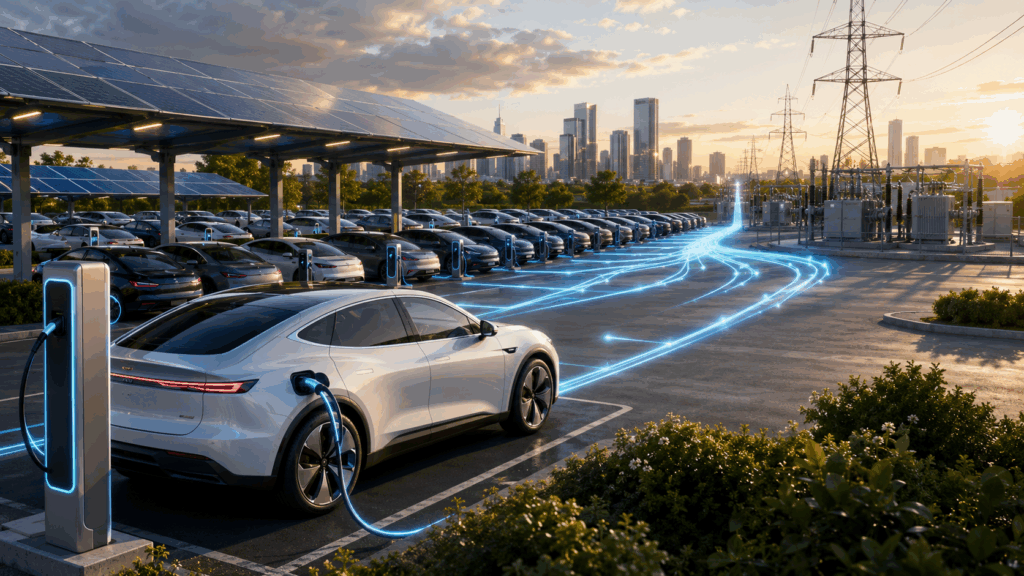
Part 1: EVs as Part of the Storage Ecosystem
June 9, 2026
The energy transition is no longer a distant policy aspiration. It is now showing up in interconnection queues, utility load forecasts, customer adoption trends, and the daily operating realities of the electric grid. According to the latest Solar Market Insight report from SEIA and Wood Mackenzie, solar and energy storage accounted for 79 percent of all new U.S. electric generating capacity added in 2025, with solar leading new capacity additions for the fifth consecutive year. This reflects the rapid shift toward lower-cost, modular, and increasingly flexible clean energy resources. At the same time, electricity demand is growing again after decades of relatively flat load, driven by data centers, manufacturing, building electrification, transportation electrification, and broader economic development.
This creates a very different electric system than the one utilities planned around for most of the past century. The future grid will have more low-cost variable renewable generation, more distributed energy resources, more flexible loads, more localized constraints, and more pressure to maintain affordability while investing in reliability and resilience. The central challenge is not simply how to build more infrastructure. It is how to use the infrastructure we already have more intelligently while adding new flexible resources that can respond to changing system conditions.
That is where bidirectional charging enters the energy transition. Electric vehicles are often discussed as a source of new electricity demand, and they are. If unmanaged, EV charging can increase customer peak demand, stress local distribution equipment, and contribute to the need for new grid investments. But that is only half the story. EVs are also large batteries on wheels, purchased primarily for transportation but capable of providing flexibility when parked and connected. With managed charging, they can shift demand away from peak periods and toward times when renewable energy is abundant. With bidirectional charging, they can go further by sending power back to a home, building, fleet facility, or the grid. In this way, EVs can become part of an integrated storage strategy that combines stationary and mobile batteries to provide flexibility across the bulk power system, distribution grid, customer sites, and mobility sector.
V2G Intelligence
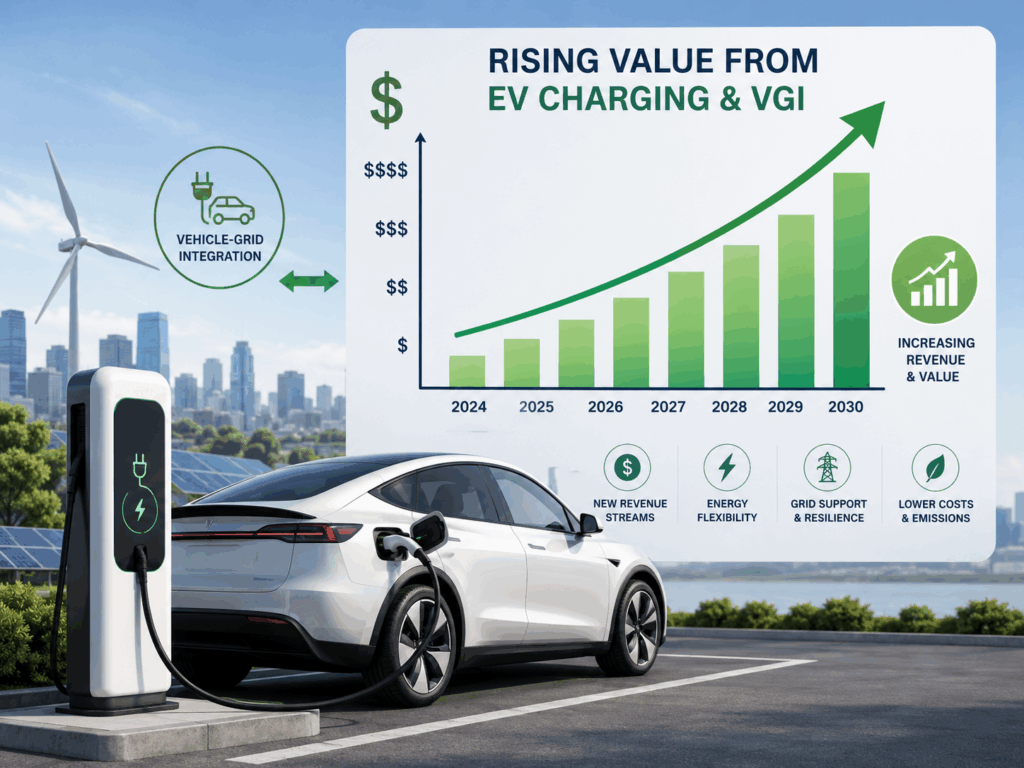
New SEPA and VGIC Report Makes the Case for Valuing VGI as a Grid Affordability Tool
June 9, 2026
The recently released VGI value report was produced jointly by the Smart Electric Power Alliance (SEPA) and the Vehicle-Grid Integration Council (VGIC) and published in May 2026. The report grew out of the SEPA and VGIC Utility Collaboration Forum, a peer learning and industry collaboration effort that brought together utilities, load-serving entities, automakers, charging providers, software firms, and research organizations. Throughout 2025, the forum held eight roundtable discussions focused on one of the most important questions facing the electric vehicle and utility sectors: how should the value of vehicle-grid integration programs be assessed, measured, and translated into action?
The report’s central goal is to help utilities, regulators, and industry stakeholders assess and operationalize the value of vehicle-grid integration, or VGI. It defines VGI as the set of technologies, policies, and strategies that change the timing, power level, and location of EV charging or discharging in ways that benefit the grid while still meeting drivers’ mobility needs.
Its core argument is that valuing VGI is not simply an EV program design exercise. It is a grid planning and affordability exercise aimed at managing accelerating load growth, reducing avoidable infrastructure costs, and turning EVs from a potential grid burden into a flexible system asset.
V2G Finds—US
GM Highlights V2H and V2G Capabilities Across Its EV Lineup
General Motors is continuing to position bidirectional charging as a core part of its GM Energy strategy, with V2H backup power available through GM Energy hardware and V2G framed around participation in utility programs where available. The company says bidirectional capability is built into several EVs, including the Chevrolet Equinox EV, GMC Sierra EV, and Cadillac LYRIQ, while the GM Energy V2H system pairs a bidirectional charger with an enablement kit to allow a properly equipped home to draw power from the vehicle during an outage. On the V2G side, GM describes a future in which compatible EVs can send energy back to the local grid through participating utility programs, potentially helping customers reduce bills in time-of-use markets and helping utilities manage peak demand. While the piece does not announce a new deployment or partnership, it is useful as a sign that GM is continuing to bring bidirectional charging into mainstream consumer messaging, linking home backup, grid support, customer savings, and distributed energy flexibility under the GM Energy platform.
June 4, 2026
Tesla Signals Lower-Cost Path for V2G Using Onboard Inverters
Tesla Energy Asia Pacific head Josef Tadich says the company’s vehicle-to-grid strategy is likely to rely on a factory-integrated onboard inverter, which could make V2H and V2G significantly cheaper than approaches that require a separate third-party inverter connected to the vehicle over DC. In an interview highlighted by The Driven, Tadich said the lowest-cost path is to build the inverter into the vehicle during serial production and then use Tesla’s existing charging technology, software, and app ecosystem to manage vehicle-to-home and vehicle-to-grid functions. The comments come as Tesla begins rolling out vehicle-to-load capability in Australia with the new six-seat Model Y L, following the earlier introduction of Power Share on the Cybertruck in the U.S. While Tadich did not say whether V2G could be enabled retrospectively in existing models, he noted that regulatory requirements remain a key barrier, particularly rules governing how a vehicle inverter can connect to the grid.
6/5/2026
V2G Finds—Global
Valeo Debuts V2G-Ready Ineez AC Charger with ISO 15118-20 Support
Valeo has unveiled its new Ineez AC charging station with native vehicle-to-grid capability and ISO 15118-20 support at Drive to Zero in Paris. The charger uses technology from IoTecha, which Valeo now owns, and is managed through the cloud-based IoT.ON platform to coordinate communication among the vehicle, charger, and grid. The product is notable not only as new V2G hardware, but also because Valeo’s acquisition of IoTecha gives the company a deeper software and interoperability platform for bidirectional charging. With support for country-specific grid-code implementation, automatic authentication, and automaker-specific V2G configurations, the Ineez launch points to the increasing importance of integrated hardware, software, and protocol stacks in scaling bidirectional charging.
June 2, 2026
Scania Demonstrates Heavy-Duty V2G Using Megawatt Charging System
Scania has demonstrated bidirectional power transfer for heavy commercial vehicles using the Megawatt Charging System, reaching 1,000 amps and 750 kW through a single charging interface. The demonstration is notable because it extends MCS beyond high-power charging into vehicle-to-grid applications for electric trucks, allowing the truck, charger, and energy management system to communicate in real time and dynamically manage charging and discharging based on transport schedules and grid conditions. Scania expects the technology to be most relevant first in depot environments, where trucks have predictable schedules and extended dwell times. The demonstration reinforces the growing view that medium- and heavy-duty EVs may become especially valuable early V2G resources because they combine large batteries, concentrated charging infrastructure, and the potential to provide depot optimization, peak shaving, renewable integration, and future grid flexibility services.
May 26, 2026
Hyundai, Kia, and Vattenfall Launch Residential V2G Pilot in the Netherlands
Hyundai Motor Group and Vattenfall plan to launch a residential bidirectional charging pilot in the Netherlands in the second half of 2026, enrolling up to 80 households with Kia EV9 or Hyundai Ioniq 9 vehicles for a six-month field trial. Participants will receive bidirectional charging equipment and installation, while Vattenfall will manage automated charging and discharging to test how EVs can serve as flexible energy storage and help balance electricity supply and demand. The pilot will allow vehicles to discharge to the grid during the 4 p.m. to 9 p.m. peak window while preserving customer control over departure times and minimum state of charge. The project is another sign that European automakers and energy companies are moving residential V2G from demonstration toward real-world market testing, especially in regions like the Netherlands where grid congestion, renewable integration, and flexible demand are becoming increasingly important.
5/29/2026
Amber Electric Expands Australian Residential V2G Trial to 1,000 Homes
Amber Electric has secured an additional $13.6 million from the Australian Renewable Energy Agency to expand its residential V2G trial to 1,000 homes, making it the largest residential V2G rollout in Australia. The expanded project builds on Amber’s initial 50-charger trial with BYD and will allow participating households to use V2G-capable vehicles, including the BYD Atto 3, to charge when wholesale prices are low and export power during peak periods. Amber says participants could save up to $2,500 per year, while ARENA sees the project as a step toward a longer-term vision of one million V2G-enabled EVs on Australian roads by 2035. The project is notable because it combines wholesale price exposure, smart automation, customer control, and grid support, offering a real-world test of whether residential V2G can scale from promising pilot to commercially viable distributed energy resource.
5/31/2026
Polestar and Clever Launch Danish V2X Pilot with Polestar 4
Polestar and Danish charging company Clever have launched a residential bidirectional charging pilot in Denmark to test V2H, V2G, and backup power applications using the Polestar 4. The project will run through late 2026 and will allow selected households to explore how an EV battery can power the home during high-price periods, export electricity back to the grid, and provide backup power during outages through islanding mode. Clever says the pilot is intended to move V2X from concept toward everyday use, with the company aiming to launch commercial V2X solutions in 2027. The project adds to a growing wave of European residential V2G pilots and reinforces the idea that automakers and energy companies are increasingly testing bidirectional charging as both a customer savings tool and a grid flexibility resource.
6/1/2026
