V2G Intelligence
V2G Intelligence offers in-depth analysis of emerging research, industry reports, and real-world pilot projects to unpack the latest insights driving the evolution of vehicle-to-grid technology.
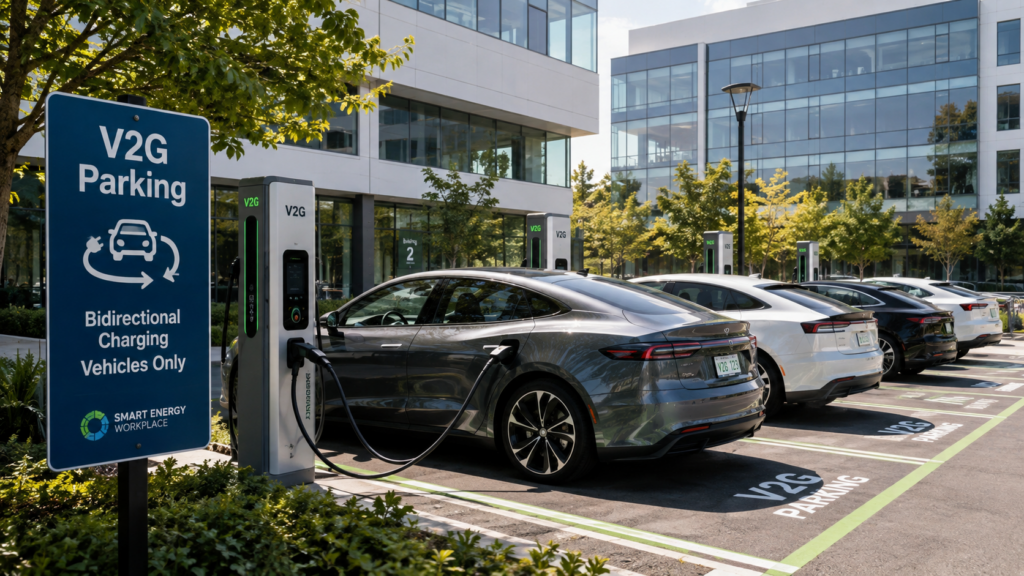
Workplace Bidirectional Charging Could Become an Important V2G Use Case
California Flexible Load Blueprint Sees Major Role for V2G
What Will Move V2G From Technical Possibility to Consumer Acceptance?
More Headlines
New SEPA and VGIC Report Makes the Case for Valuing VGI as a Grid Affordability Tool
June 9, 2026 Valuing Vehicle-Grid Integration Programs: A Tool for Improving Energy Affordability through EV Grid Services The recently released VGI value report was produced jointly by the Smart Electric Power Alliance (SEPA) and the Vehicle-Grid Integration Council (VGIC) and published in May 2026. The report grew out of the SEPA and VGIC Utility Collaboration…
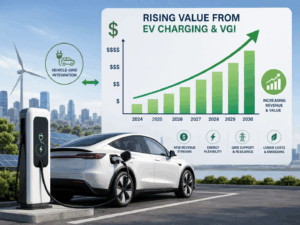
New MassCEC Report Shows What It Will Take to Move V2X from Pilots to Programs
May 26, 2026 A new March 2026 research report prepared for the Massachusetts Clean Energy Center offers a timely and practical look at the emerging vehicle to everything market and the lessons that early projects can provide for the next stage of deployment. The report, titled Vehicle-to-Everything Research Report: MassCEC Vehicle-To-Everything Demonstration Program, was prepared…
Canada’s V2G Reality Check: Why Bidirectional Charging Still Struggles to Scale
A new CSA Group report shows that the barriers to scaling V2G are not technological, but systemic—and increasingly well understood May 12, 2026 The transition from electric vehicles as passive load to active grid resources is no longer theoretical. Across multiple markets, pilot programs and early deployments have demonstrated that EVs can shift load, provide…

California’s Roadmap to Scaling Bidirectional Charging
The California Energy Commission’s (CEC's) newly released report, A Roadmap to Unlocking the Benefits of Bidirectional Charging, arrives at an important, but still uncertain, moment for vehicle-to-grid and broader vehicle-grid integration. Automakers are beginning to introduce bidirectional-capable vehicles, and utilities are increasingly focused on managing electrification-driven load growth. At the same time, the commercial, regulatory,…

Texas: The Market Where V2G Could Scale First?
April 14, 2026 This is the third installment in V2G News’ State Profile Series, following Connecticut and California. Each state tells a different story about what it will take to move vehicle-to-grid from pilots to scale. This is not dissimilar to the early days of rooftop solar, where adoption varied widely across states based on…
What It Takes to Scale V2G Infrastructure: Insights from a Recent Academic Study
March 31, 2026 Zhang, F., Tang, J., Qian, B., Xiao, Y., Lin, X., & Feng, X. (2025). V2G Charging Stations: A Comprehensive Review of Technology and Infrastructure. China Journal of Electrical Engineering (forthcoming). Study Purpose This paper takes a different approach than most V2G research. Instead of focusing on market value or system-level benefits, it…

Will Consumers Participate: New Study Highlights the Behavioral Side of V2G Adoption
March 17, 2026 Zhang, C., Takahashi, K., Iwafune, Y., & Shibata, Y. (2025). Understanding user acceptance and behavioral determinants of vehicle-to-grid participation: Evidence from a large-scale survey in Japan. Renewable and Sustainable Energy Reviews, 228, 116603. https://doi.org/10.1016/j.rser.2025.116603 Much of the vehicle-to-grid literature focuses on engineering feasibility and market economics. Researchers have spent years estimating the…
California’s V2G Dilemma: National Leadership, Perpetual Pilots
March 3, 2026 This article is the second installment in our new State Profile Series, examining where bidirectional charging and V2G are most likely to move beyond demonstrations and into durable market structures. If Connecticut offered a model for how to experiment and then integrate, California presents a different case study: a state that has…

New Berkeley-Led Study Quantifies Where V2G Value Comes From, and What Could Erase It
February 17, 2026 Soomin Woo, Leo Strobel, Yuhao Yuan, Marco Pruckner, Timothy E. Lipman, Exploring bidirectional charging strategies for an electric vehicle population, Applied Energy, Volume 397, 2025, 126361, ISSN 0306-2619, https://doi.org/10.1016/j.apenergy.2025.126361. A November 2025 paper in Applied Energy by researchers at UC Berkeley’s Transportation Sustainability Research Center and collaborating institutions tackles a question V2G…

The Huskies Are Warming Up: Why Connecticut Is Poised to Scale V2G
February 3, 2026 In our 2026 predictions, V2G News forecast that five states are likely to break out of the pilot phase and begin scaling vehicle-to-grid (V2G) and bidirectional charging in a durable, programmatic way. Connecticut was high on that list, not because it has the most electric vehicles or the largest utilities, but because…

Bidirectional Charging in Theory and Practice: What an Industry White Paper Gets Right, and What Still Remains Unproven
As bidirectional charging moves from pilot projects toward early commercialization, the conversation around vehicle-to-grid (V2G) is increasingly shaped by industry-authored white papers. These documents play an important role: they help organize technical concepts, clarify emerging standards, and articulate how V2G could integrate into energy markets at scale. At the same time, they inevitably reflect the…
What The Recent UC Davis Study Reveals About the Real Economics and Limits of Bidirectional Charging
January 6, 2026 Tayarani, H., Rabinowitz, A., Jenn, A., & Tal, G. (2025). Assessment of vehicle-grid integration profitability subject to real-world driver behavior and electricity tariff. Energy, 341, 139302. https://doi.org/10.1016/j.energy.2025.139302. As bidirectional charging moves from demonstrations toward early commercialization, the industry continues to grapple with a fundamental question: under real-world conditions, does vehicle-to-grid participation deliver…

Enrich Your Understanding