June 23, 2026
Bidirectional charging is moving from an early-stage technology conversation to a standards, certification, and grid integration conversation. For years, the industry has focused on what vehicle-to-grid can do: provide backup power, reduce peak demand, support resilience, absorb renewable energy, and turn parked electric vehicles into flexible storage resources. Those use cases remain central, but the next phase of market development depends on something less visible and just as important: the standards architecture that allows utilities, automakers, charger manufacturers, aggregators, regulators, and customers to trust that these systems can operate safely and reliably at scale.
A new UL Solutions report, Vehicle-one-Grid and Vehicle-to-Everything Standards: New Requirements for Smart and Bidirectional EV Charging, provides a useful snapshot of that emerging architecture. The report is not a market forecast or a policy roadmap. It is more valuable as a technical guide to the standards, certification pathways, and grid-code requirements that are beginning to define how smart charging and bidirectional charging systems will be evaluated in different markets.
The industry does not lack enthusiasm for bidirectional charging. It lacks common, scalable pathways for moving from pilots to repeatable deployment. Standards are not the only barrier, but they are quickly becoming one of the central market-enabling conditions.
From Smart Charging to Bidirectional Charging
One of the strengths of the report is that it starts with the distinction between V1G and V2X. V1G, or unidirectional smart charging, allows power to flow only from the grid to the vehicle. The value comes from managing when, how fast, and under what conditions EVs charge. That can support time-of-use optimization, demand response, renewable energy integration, and customer convenience.
Bidirectional charging adds a second layer of complexity and value. Once power can flow from the vehicle back to a home, building, load, or grid, the EV becomes more than flexible load. It becomes a distributed storage resource. That shift creates new opportunities, but it also creates new requirements. A charger or vehicle that simply reduces charging demand during a peak period does not raise the same operational questions as a system that exports power in parallel with the electric grid.
The report helps clarify those differences by laying out use cases for load management, self-consumption, demand response, frequency response, and off-grid service continuity. This framing is important because bidirectional charging is often discussed as one technology, when in practice the use case matters. A vehicle providing backup power to a home during an outage may require a different pathway than a fleet exporting capacity into a utility program or a commercial site using EV batteries for peak shaving.
Standards as Commercialization Infrastructure
The most important insight from the report is that standards should be understood as commercialization infrastructure. They are not just technical documents sitting in the background. They determine whether products can be certified, whether utilities can approve interconnection, whether customers can participate in programs, and whether aggregators can combine resources across vehicles and charger platforms.
For bidirectional charging, the standards challenge is especially complicated because the system spans multiple domains. The EV, charger, inverter, communication protocol, site equipment, utility interface, and aggregation platform all need to work together. The industry needs confidence that power export can be controlled, that utility requirements can be met, that equipment will respond properly during grid disturbances, and that noncompliant systems will not be allowed to export.
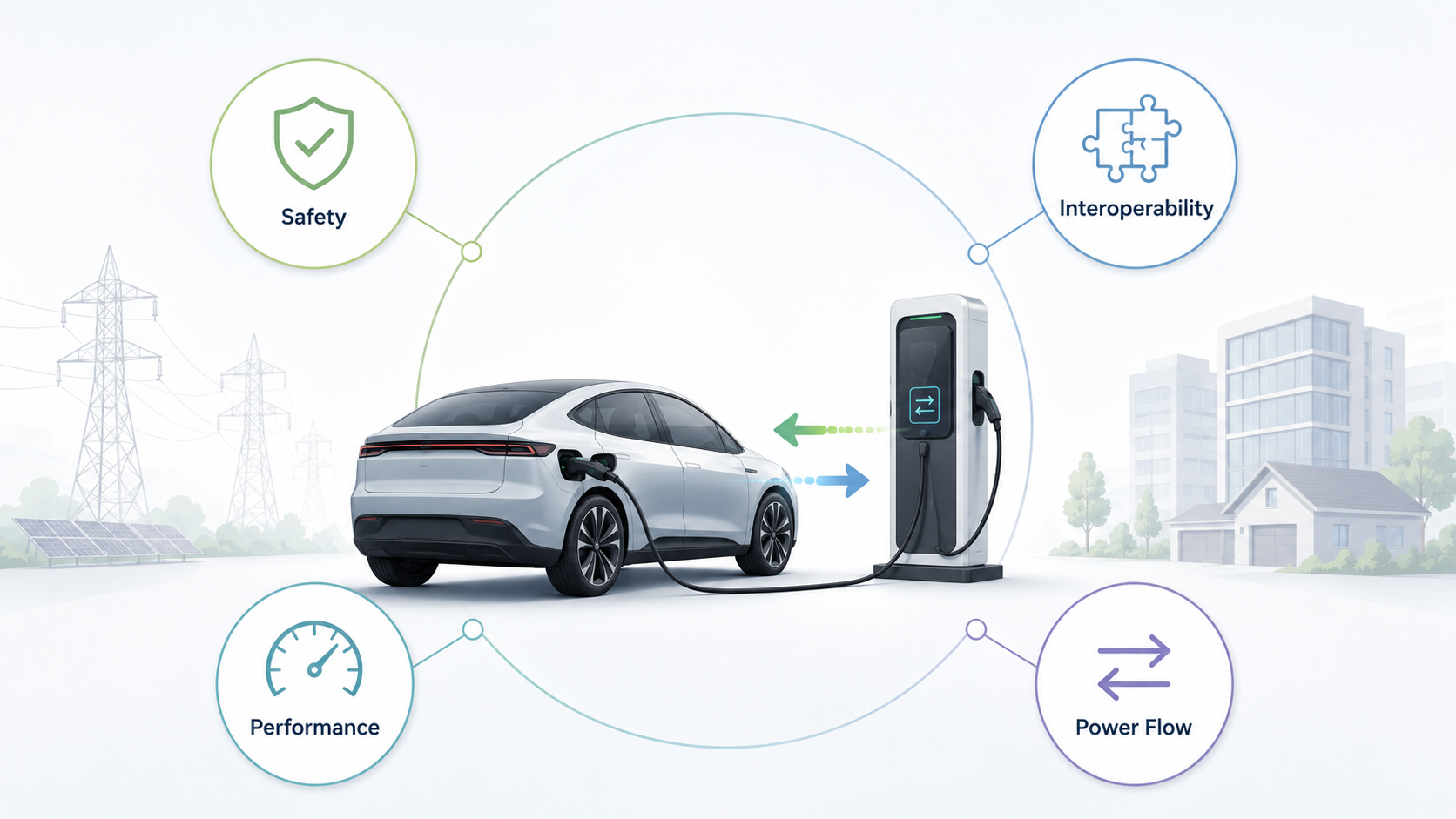
This is where the UL Solutions report provides value. It organizes the standards landscape around safety, interoperability, performance, and power flows. That structure gives readers a better way to understand why no single standard solves the entire problem. ISO 15118-20 may address vehicle-to-charger communication for bidirectional power transfer, but it does not, by itself, resolve interconnection approval, inverter certification, local grid-code compliance, utility dispatch, or customer compensation.
Europe Shows Where Grid-Code Compliance Is Heading
The European sections of the report are particularly useful because they show how bidirectional charging is being pulled into a broader grid-code framework. In Europe, V2G is increasingly being treated through the lens of generator requirements, type-test certificates, equipment documentation, and conformity procedures.
That approach may feel technical, but it signals something important. As bidirectional charging scales, grid operators will need a way to know which products can operate in parallel with the grid and under what conditions. The report describes emerging requirements for EVs and EVSE, including equipment certificates, type-test certificates, data exchange, communication handshakes, and technical power transfer procedures.
The industry should pay attention to this direction of travel. Even if North America does not follow the same regulatory structure, the underlying issue is universal. Utilities and regulators need repeatable evidence that bidirectional charging systems can provide grid services without creating operational uncertainty. Certification can help convert one-off engineering review into a more scalable approval process.
North America: Two Pathways Matter
For North American readers, the most valuable section of the report is the discussion of bidirectional charging pathways. The report distinguishes between DC and AC export architectures, which is critical for understanding where the market is headed.
For DC bidirectional charging, UL 9741 plays a central role. In this architecture, the bidirectional charger can serve as the grid-facing compliance point between the EV and the electric power system. The UL report describes this pathway as a UL 9741 bidirectional charger that includes a UL 1741 Listed SA/SB inverter or converter capable of meeting applicable local grid-code requirements. This has near-term practical value because the charger, rather than the vehicle, can operate as the certified grid-support device. As a result, the EV itself does not necessarily need to be evaluated as a grid-code-compliant inverter for every jurisdiction.
The AC pathway is different. In AC bidirectional charging, the vehicle’s onboard inverter becomes central to power export. That creates a more complex compliance challenge because the EV itself is part of the export system. The UL report highlights the emerging role of UL 1741 SC and SAE J3072 for AC V2G applications. Under this approach, certified bidirectional EVSE or interconnection systems equipment would monitor and oversee EVs with onboard AC inverters, communicate with the vehicle, enforce local interconnection requirements, and stop export if the EV fails to meet required operating conditions.
This distinction matters for utilities and regulators. DC bidirectional charging and AC bidirectional charging should not be forced into a single approval model. Each architecture has different equipment boundaries, control responsibilities, and certification needs. A clear understanding of these pathways will help avoid unnecessary barriers and reduce confusion in interconnection proceedings.
Why This Matters Now
The timing of this report is important. Bidirectional charging is beginning to appear in more utility programs, state proceedings, school bus deployments, residential backup power offerings, and fleet electrification strategies. At the same time, many jurisdictions are still trying to determine how these systems should be classified, tested, interconnected, and compensated.
Without clearer standards pathways, the industry risks slowing itself down. Utilities may hesitate to approve systems. Regulators may impose requirements that are technically premature or poorly matched to the use case. Manufacturers may face inconsistent expectations across markets. Customers may see promising products delayed by unclear approval processes.
The value of the UL Solutions report is that it helps organize the conversation. It does not answer every policy question, but it provides a practical map of the standards architecture that will shape bidirectional charging deployment. For the V2G community, that map is increasingly essential.
Bidirectional charging will not scale on enthusiasm alone. It will scale when safe, certified, interoperable products can move through predictable approval pathways and participate in durable grid service programs. Standards are part of that bridge from pilots to markets. That is why this report is worth reading, and why we are highlighting it for the V2G News audience.
