May 26, 2026
This article is the third in the V2G News 2026 Policy Series examining the structural barriers that continue to slow the transition of vehicle to grid from pilots to scalable market offerings. The first installment focused on the importance of enabling grid exports from EVs. The second examined why long term, predictable revenue streams are essential to moving V2G beyond demonstration projects. This third piece turns to the compensation mechanisms themselves: how different payment structures can reward EV owners, fleets, and aggregators for the capacity, energy, flexibility, and grid services that bidirectional charging can provide.
As bidirectional charging with V2G technology moves from demonstration into early commercial deployment, the central question is no longer only whether EV owners should be compensated. It is how they should be compensated. A payment level that looks attractive on paper may still fail if the structure is confusing, too uncertain, difficult to finance, or poorly aligned with the grid value being delivered.
For V2G to scale, compensation design must address three linked questions. What is being paid for? How is the payment calculated? And how is the customer actually paid?
Beyond Price: Why Structure Matters
Compensation for V2G program participation is not just a question of price. It is a question of architecture. Programs can pay customers for energy exported to the grid, capacity made available during peak periods, verified performance during dispatch events, or the upfront cost of installing enabling infrastructure. Each approach sends a different signal and creates a different customer experience.
That distinction matters because V2G compensation structure sits at the intersection of customer adoption, utility planning, and infrastructure finance. Customers need a simple and credible reason to participate. Fleet operators need enough certainty to justify investments in bidirectional chargers, site upgrades, interconnection work, and operational changes. Aggregators and technology providers need compensation structures that support customer acquisition, software integration, and long term service delivery. Utilities and regulators need confidence that paid resources will show up when and where the grid needs them.
The central question, then, is not simply how much V2G participants should be paid. It is how compensation should be structured so that bidirectional charging can move from promising pilots to a durable grid resource.
The broader distributed energy resource experience offers useful lessons. Rooftop solar relied heavily on energy export credits. Demand response programs developed approaches for compensating dependable peak reduction. Stationary storage programs often combine upfront incentives with operational value through bill savings and utility programs. V2G brings these structures together because the same asset can be a flexible load, an export capable resource, a backup power source, and, most importantly, a mobility asset.
The Main Payment Structure Types
V2G compensation can be organized around four basic payment structures, each designed to address a different part of the value and adoption challenge. All should ultimately reflect the electric system value delivered, but they do so in different ways.
| Type | Units | Description |
| energy payment | $/kWh | This structure pays for actual energy delivered, exported, or load reduced during a defined event. |
| capacity or performance payment | $/kW | This structure pays based on the measured ability to reduce peak demand or provide dependable grid support during a defined set of events, dispatch windows, or program season. |
| upfront incentive | $/installation | Upfront capital incentive, which helps reduce the cost of installing enabling technology. For V2G, this could include support for bidirectional chargers, electrical upgrades, site design, interconnection costs, communications equipment, or software integration. |
| Hybrid (two or more of the above) | multiple | A hybrid structure might pair an upfront incentive with an ongoing performance payment, or combine a capacity payment with an energy payment during dispatch events. |
For V2G, the question is not which structure is universally best. The better question is which structure fits the market stage, customer type, grid need, and investment barrier being addressed.
Energy Payments: Simple, Intuitive, and Uncertain
Energy based payments are the easiest to understand. A customer exports energy or reduces load during an event and is paid a fixed amount per kWh. For V2G, this structure is attractive because it directly connects compensation to measured energy delivered. The customer does something visible and receives payment for the amount provided.
California’s Emergency Load Reduction Program (ELRP) illustrates this approach. The program was designed to reduce the risk of outages during grid emergencies by paying customers for load reduction or increased supply. Under some ELRP pathways, including sub-group A.5 for V2G, participants are paid $2 per kWh for verified event performance. For V2G, this provides a straightforward model: when the grid needs support, enrolled vehicles can discharge energy or reduce charging load, and participants are paid based on measured performance.
The advantage of this structure is clarity. It is easy to explain, relatively easy to audit, and closely tied to actual dispatch performance. It can work well for early pilots, emergency programs, and use cases where grid needs are concentrated in a limited number of high value hours.
The limitation is revenue uncertainty. If events are rare, annual payments may be modest even if the per kWh rate is high. A mild weather season, fewer emergency events, or changing dispatch practices can materially reduce participant earnings. That uncertainty makes it difficult for fleets to justify infrastructure investments based only on per kWh payments. It also makes it difficult for residential customers to understand the likely value of participation before they enroll. To address these uncertainties, the California Public Utilities Commission guarantees a minimum of 30 dispatch hours per season for bidirectional charging systems.
Energy payments are therefore useful, but incomplete. They reward actual performance, but they do not necessarily create the durable revenue stream needed to support V2G investment at scale.
Capacity Payments: Rewarding Dependable Peak Support
Capacity or performance based payments address a different problem. Instead of paying only for energy delivered during individual events, they compensate resources based on their measured contribution to reducing peak demand over a defined period.
Massachusetts’ ConnectedSolutions program provides one of the clearest examples. Participating batteries, including V2G, are dispatched during peak periods, and compensation is based on average kilowatt performance during program events. Participating residential customers receive payments of $275 per kW for the average over all summer events, which can number between 30 – 60 1 to 3 hour events during the season.
This structure has direct relevance for V2G. Bidirectional EVs can reduce peak demand by avoiding charging during peak periods, discharging to serve onsite load, or exporting power where rules allow. A per kW payment recognizes that dependable peak shaving has value even when the program is not designed primarily as an energy export tariff.
The advantage of a capacity or performance based structure is that it can create more predictable annual value. Participants have a clearer sense of what their resource may earn if it performs during the program season. For fleets and aggregators, this predictability matters because it can support planning, investment, and customer acquisition.
The limitation is that a per kW payment does not always capture the full value of actual energy delivered during an event. A resource may be paid based on its average contribution to reducing peak demand, but that payment may not fully reflect how often it was called, how much energy it delivered, or whether it provided additional value during especially constrained hours.
For V2G, capacity based payments are especially promising for predictable fleet use cases, such as school buses, municipal fleets, workplace charging, or depot based vehicles with known dwell times. But they may need to be paired with energy or event payments to fully reflect the value of actual dispatch performance.
Upfront CapEx Incentives: Solving the Adoption Barrier
Upfront incentives solve a different problem. They do not pay for grid performance directly. Instead, they help customers install the equipment needed to participate.
For V2G, this is important because bidirectional charging still carries higher upfront costs than conventional charging. Customers may need a bidirectional charger, electrical upgrades, metering changes, communications equipment, software integration, and, in some cases, interconnection upgrades. These costs can be a major barrier, especially when future grid services revenue is uncertain.
Stationary battery programs show how this kind of support can accelerate early deployment. New York State’s residential and retail energy storage incentive programs, administered by NYSERDA, provide fixed rate incentives based on storage system capacity, measured in dollars per kWh of installed storage. Residential incentives are available for eligible home battery systems up to 25 kWh, while retail incentives support commercial scale distributed storage projects up to 5 MW. These incentives do not compensate customers for each dispatch event. Instead, they reduce the upfront cost of installing storage systems that can later provide customer and grid value through bill savings, demand charge management, demand response participation, or other applicable compensation mechanisms.
A similar approach could help V2G by reducing the incremental cost of choosing a bidirectional charger instead of a conventional charger. It could help fleets build V2G readiness into depot electrification projects and help residential customers adopt bidirectional capable equipment before full operating compensation programs are mature. It could also help utilities and regulators build a base of capable resources that can later be enrolled into managed charging, demand response, export compensation, or VPP programs.
The strength of CapEx support is that it accelerates deployment. It is especially useful in the early market, when equipment costs are high, customer awareness is limited, and operational programs are still being developed.
The weakness is that upfront incentives alone do not ensure ongoing performance. A customer can receive support to install equipment but still have limited motivation to remain available, respond to dispatch signals, or optimize behavior around grid needs. Upfront support can help create the technical capability for V2G, but it does not substitute for durable operating compensation.
If policymakers want more bidirectional chargers installed, upfront incentives are useful. If they want those chargers to become dependable grid resources, they also need ongoing compensation tied to availability, dispatch performance, or measured grid value.
Hybrid Models: Where the Market Is Likely Heading
A hybrid model combines two or more compensation structures to address multiple barriers at once. For V2G, this may be the most practical path forward because no single payment mechanism fully solves the problem.
A well designed hybrid model could combine different elements depending on the barrier being addressed: upfront incentives to reduce equipment costs, capacity or availability payments to provide predictable value, and energy or performance payments to reward actual dispatch. Not every program needs all three. The basic concept is that V2G compensation should recognize both the cost of enabling the resource and the value it provides once operational.
California’s Demand Side Grid Support program offers a useful example of this hybrid direction. DSGS is not a V2G only program, and its details vary by participation option. But Participation Option 3, the Market Aware Storage Virtual Power Plant Pilot, is especially relevant because it combines VPP aggregation, demonstrated capacity compensation, and a separate energy payment under certain emergency conditions. Under Option 3, storage VPP aggregators, including aggregators of bidirectional charging systems, may receive performance based capacity payments based on demonstrated capacity, with payment rates expressed in dollars per kW month. The same option also provides a $1/kWh payment for net discharge during qualifying day of emergency events. In this sense, DSGS illustrates a hybrid structure that combines capacity oriented compensation with event based energy compensation.
This is where the emerging virtual power plant model becomes important. VPPs provide a way to aggregate many small, customer-sited resources and operate them as a coordinated grid asset. For V2G, this model is likely to be central because individual EVs are mobile, variable, and customer controlled. Their grid value depends less on any single vehicle and more on the ability of an aggregator or utility platform to coordinate many vehicles across dispatch windows, customer preferences, feeder constraints, and system needs.
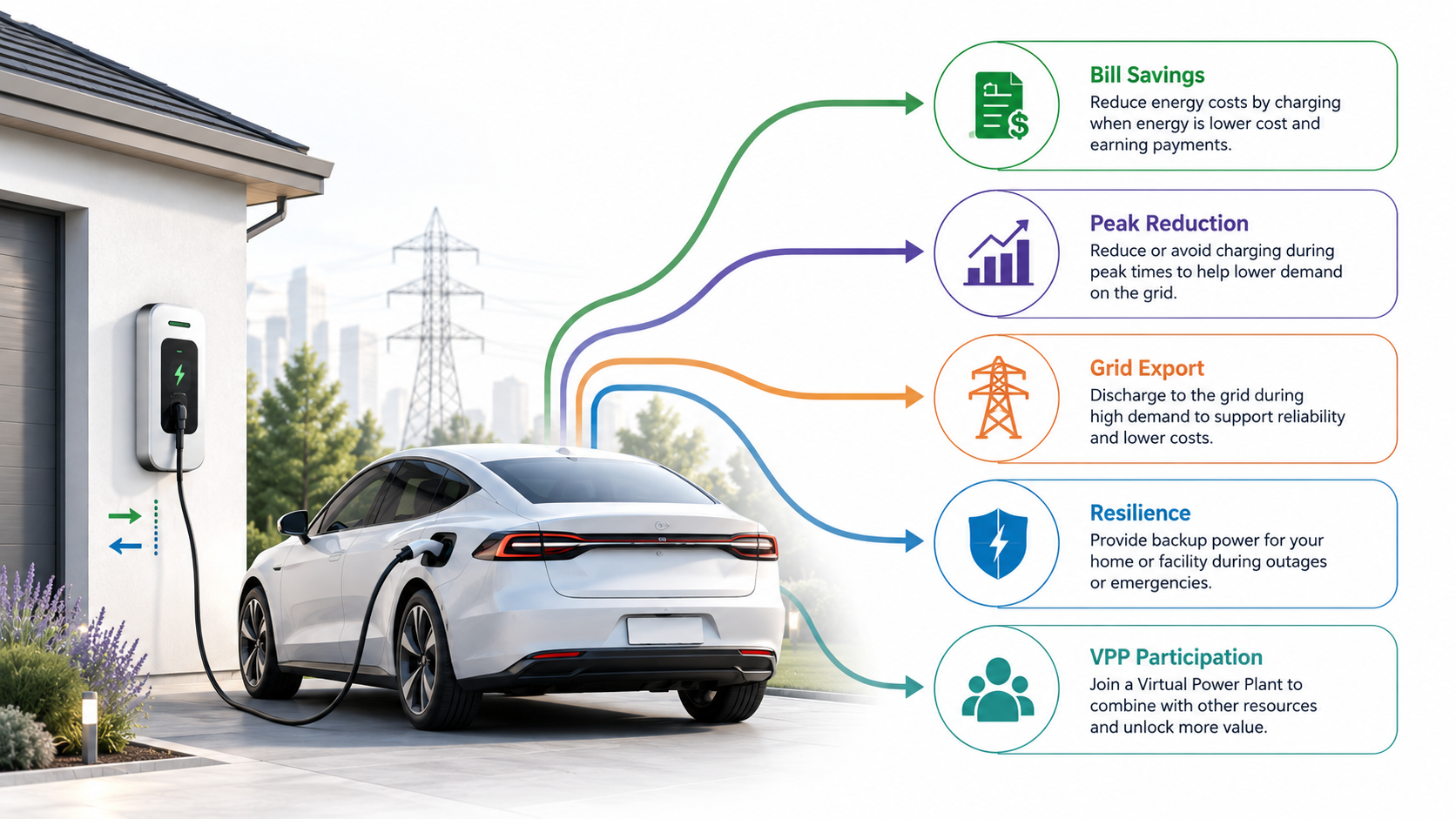
In a VPP framework, a bidirectional charging system may provide value in several ways. It may avoid charging during a peak period. It may discharge to serve onsite load. It may export to the grid. It may support resilience. It may respond to a day ahead or day of event signal. A hybrid compensation model is better suited to this operational reality than a single payment type.
The strength of the hybrid approach is that it can balance simplicity, predictability, and performance. An upfront incentive can help overcome adoption barriers. A capacity or availability payment can create a revenue floor. An energy or event payment can reward actual delivery. Together, these elements can create a stronger value proposition for customers, fleets, aggregators, and utilities.
The risk is complexity. A hybrid program can become difficult to explain if too many payment streams, eligibility rules, settlement methods, and performance adjustments are layered together. The goal should not be to create the most theoretically complete value stack. The goal should be to create a compensation structure that is understandable, durable, and tied closely enough to grid value to maintain regulatory support.
How Customers Are Paid Matters Too
Payment structure is not only about whether compensation is calculated per kWh, per kW, or through an upfront incentive. It is also about how the customer receives the money.
For residential customers, bill credits are often the simplest delivery method. They reduce the customer’s utility bill and fit naturally within utility administered programs. ELRP materials, for example, state that directly enrolled customers receive compensation in the form of a bill credit, while customers participating through aggregators should look to the aggregator for incentive details.
Bill credits have advantages. They are administratively familiar, can be integrated into utility billing systems, and may be easier for regulators to oversee. They can also be effective for customers who primarily think about energy programs in terms of bill savings.
But bill credits have limitations. They may be less attractive for fleet operators, third party owners, or aggregators that need direct cash payments to support operations and investment. A school district, for example, may prefer a check, ACH payment, or contracted service payment that can be tracked as program revenue rather than a utility bill offset. Aggregators may need direct payment arrangements to compensate customers, recover platform costs, and manage performance obligations.
Checks or direct electronic payments can make compensation feel more tangible. They may be better suited for fleets, commercial customers, and VPP aggregators. They also support cleaner accounting for projects where multiple parties share value, such as a fleet owner, charger provider, software platform, and energy services company.
There are also non cash or bundled approaches. Some programs may provide charging discounts, subscription savings, equipment rebates, lease reductions, or bundled service credits. These can be useful when the customer values simplicity more than precise settlement. But they can also obscure the value of the grid service being provided if the customer cannot see how compensation was calculated.
For V2G, payment delivery should match the customer segment. Residential programs may work well with bill credits or simple app based rewards. Fleet programs may need direct payments and transparent settlement reports. Aggregator led VPPs may require contractual payment flows that allow value to be shared among customers, technology providers, and program administrators.
The principle is straightforward: the payment mechanism should reinforce trust. Customers should understand what they earned, why they earned it, when they will receive it, and what behavior or performance produced the payment.
Matching Mechanisms to Market Stage
Different compensation mechanisms are useful at different stages of market development.
In the early stage, upfront incentives may be necessary to build the installed base of bidirectional chargers. Without equipment in the field, utilities and aggregators cannot gain operational experience, test measurement methods, or demonstrate grid value.
As programs mature, per kW capacity or performance payments become more important. They create a clearer annual value proposition and help support investment in customer acquisition, dispatch platforms, and fleet integration. They are especially important for VPP models because the aggregator needs confidence that enrolled capacity has recurring value.
Per kWh payments remain important as an event based incentive. They reward actual delivery and help align compensation with grid conditions. They may be especially useful during emergency events or high value periods when the system needs measurable energy support.
Over time, the most effective V2G programs are likely to combine these mechanisms. A residential V2G program might offer an upfront charger incentive, a modest annual availability credit, and a per kWh payment during events. A fleet program might offer make-ready funding support, a contracted per kW payment for dependable seasonal capacity, and a performance payment for verified exports or load reduction. A VPP program might compensate aggregators for portfolio level capacity while requiring transparent customer payments and performance reporting.
The design should be tailored to the use case. A school bus depot, a residential pickup truck, a workplace charging site, and a commercial delivery fleet will not all respond to the same payment structure. But each will need some combination of adoption support, predictable value, and performance-based upside.
A Practical Path Forward
The current V2G compensation landscape remains limited. A few programs are beginning to demonstrate how bidirectional EVs can be paid for grid support, but most jurisdictions are still debating eligibility, measurement, export rules, interconnection requirements, aggregator roles, and customer compensation. That is not a sign of failure. It is a sign that the market is still being formed.
The opportunity now is to design compensation structures that are simple enough to attract customers and robust enough to support investment. Programs should avoid two extremes. A pure energy payment may be easy to understand but too uncertain to finance. A highly detailed value stack may be theoretically precise but too complex for early customer adoption. A one time equipment rebate may help install chargers but will not create a dependable grid resource on its own.
The strongest path is likely a staged hybrid model. Start with upfront incentives where equipment costs remain a barrier. Add per kW compensation where utilities need dependable peak reduction or VPP capacity. Use per kWh payments to reward verified performance during dispatch events. Deliver payments in a form that fits the customer, whether bill credits for households, direct payments for fleets, or contractual settlement for aggregators.
This approach does not require regulators to invent V2G compensation from scratch. The pieces already exist in programs such as ELRP, ConnectedSolutions, DSGS, managed charging pilots, storage incentive programs, and emerging VPP platforms. The task is to adapt those pieces to the unique characteristics of bidirectional EVs.
Conclusion: Designing Compensation for Scale
V2G will not scale on technical capability alone. It will scale when customers, fleets, aggregators, utilities, and regulators can see a clear value proposition and trust that the compensation structure will endure.
That means policy should focus not only on the headline payment level, but also on the architecture of the payment. The emerging VPP model provides a useful framework for the next phase. It recognizes that the value of V2G will often come from aggregating many vehicles and coordinating them with other distributed resources. In that context, compensation must reward both readiness and delivery. Customers need simplicity. Fleets need revenue confidence. Aggregators need scalable settlement. Utilities need measurable performance.
