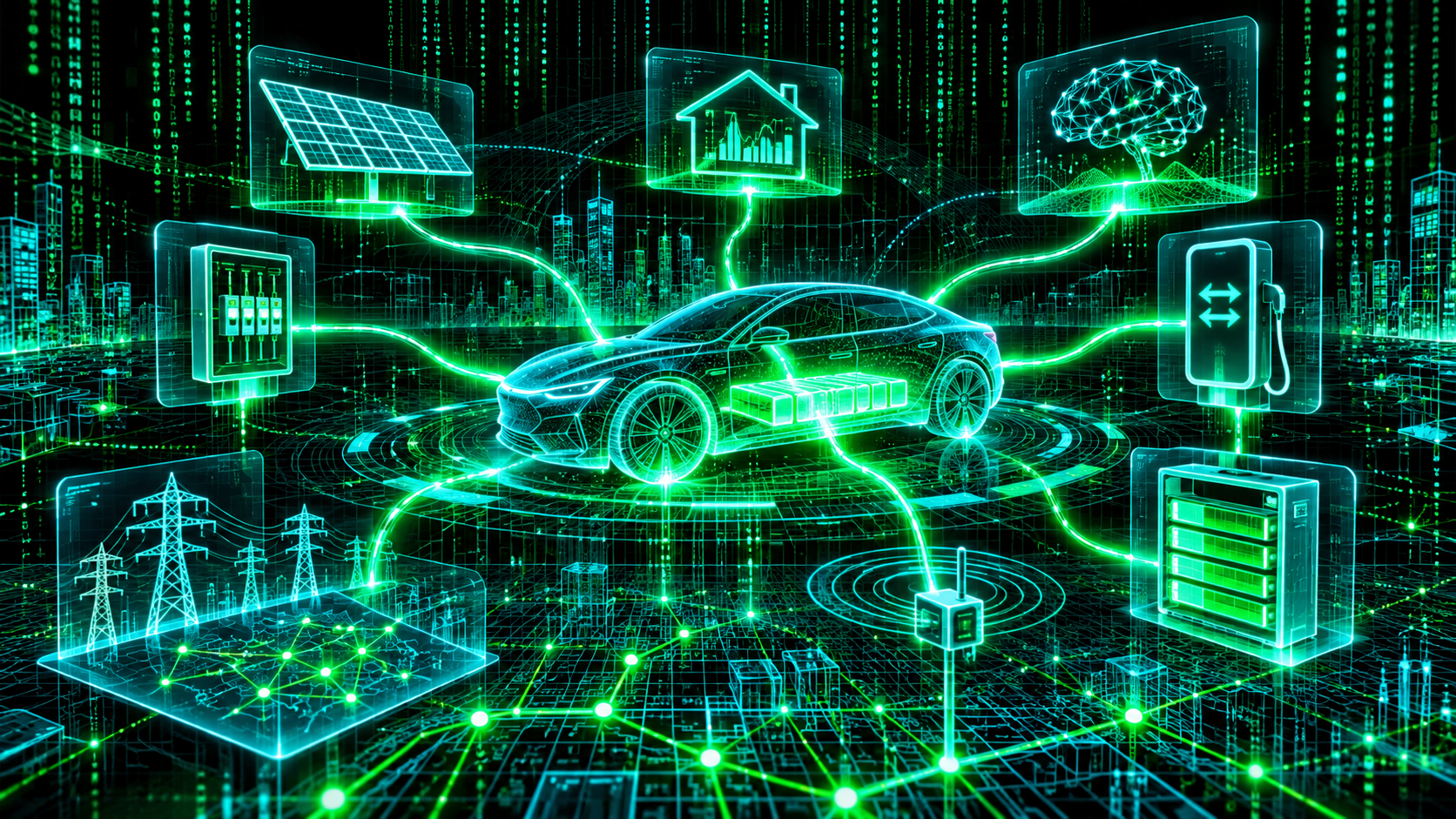
An expanding ecosystem of connected devices, sensors, advanced software, and distributed energy resources is opening new possibilities at the grid edge. EVs will be at the heart of this evolution, provided regulatory frameworks and business models evolve to support their integration.
November 24, 2026
A New Frontier for Electricity Innovation
Some of the most interesting innovations in the electricity industry are occurring in places that have traditionally received relatively little attention: inside electrical panels, behind utility meters, at EV charging stations, and along neighborhood distribution circuits. A growing ecosystem of technology companies is developing products that are transforming how electricity is monitored, managed, stored, and exchanged. Smart electrical panels can now actively manage household circuits, artificial intelligence can optimize electricity consumption and storage based on forecasts of prices and weather, and bidirectional chargers are beginning to turn electric vehicles into sources of electricity for homes and the grid. Meanwhile, advanced sensors and computing platforms are providing utilities with new visibility into conditions along their distribution networks.
These developments reflect more than incremental improvements in electrical equipment. They represent an emerging field of innovation in which hardware, software, communications, and advanced analytics are converging to create new capabilities throughout the electricity system. Innovation is certainly occurring on the bulk power system, including grid-enhancing technologies, advanced conductors, and power electronics. But the grid edge offers a particularly expansive opportunity because it encompasses millions of independently owned devices, diverse customer needs, and a rapidly expanding range of technologies and business models. Startups, established equipment manufacturers, automotive companies, and software developers are competing to unlock capabilities that were largely unavailable just five years ago.
Yet there is an important distinction between developing these technologies and realizing their collective value. Much of the innovation remains fragmented across individual products, proprietary platforms, and utility programs. The next challenge is to create the technical, operational, and regulatory conditions that allow these technologies to work together. Electric vehicles could become particularly important in this effort, providing substantial energy storage and flexible electricity demand that amplify the capabilities of other grid-edge resources.
An Explosion of Grid-Edge Technologies
The growing diversity of grid-edge technologies illustrates the scope of innovation underway, but many of their most promising capabilities are only beginning to emerge and have yet to be fully realized. What makes these developments particularly significant is not simply the sophistication of individual products, but their potential to coordinate electricity consumption, generation, and storage across previously independent devices and systems. As these technologies mature and become more widely integrated, they could unlock a new level of flexibility, intelligence, and control across the distribution system. It is the convergence of these technologies, rather than any single innovation, that makes the grid edge such an important new frontier for the electricity industry.
The following table highlights six emerging categories of grid-edge innovation, the capabilities they are introducing, and examples of companies developing solutions. These categories are not mutually exclusive, and many companies offer technologies that span multiple functions.
| Technology category | Emerging capabilities | Example companies |
|---|---|---|
| Smart electrical panels | Circuit-level monitoring, automated load controls, and dynamic capacity management. These technologies can accommodate new electrical loads, prioritize critical circuits, and potentially avoid costly electrical service upgrades. | SPAN, Savant, Lumin, Leviton |
| Whole-home energy management systems | Integrated management of rooftop solar, stationary batteries, EV charging, and household loads. Software can coordinate energy flows to reduce costs, increase solar utilization, and support backup power and grid services. | Schneider Electric, Tesla, Enphase, FranklinWH |
| Bidirectional EV charging systems | Power electronics and controls that allow compatible EV batteries to supply electricity to homes, buildings, or the grid, enabling new applications for energy management, resilience, and grid services. | dcbel, Wallbox, Emporia, Lunar Energy |
| Edge DERMS | Software platforms that aggregate, forecast, and optimize customer-owned distributed resources. These systems enable managed charging, demand response, VPP participation, and increasingly infrastructure-aware management of local grid constraints. | EnergyHub, Uplight, Virtual Peaker, Everyday Electric, WeaveGrid |
| Grid-edge sensors and intelligence | Advanced sensing, measurement, monitoring, and edge computing that improve visibility into distribution-system conditions, identify equipment constraints, and support more responsive network operations. | Karman, Sentient Energy, Gridware, Itron |
| Grid DERMS and orchestration platforms | Utility-facing platforms that integrate network models, operational data, forecasting, and distributed-resource controls to manage feeder and transformer constraints, grid capacity, and reliability. | Camus Energy, Smarter Grid Solutions, GE Vernova |
Why EVs Could Be at the Center of Grid-Edge Innovation
The real promise of grid-edge innovation lies not simply in what individual technologies can accomplish, but in what becomes possible when they operate together. Smart electrical panels, home energy management systems, distributed generation, intelligent sensors, and advanced optimization platforms each provide valuable capabilities. When connected and coordinated, however, these technologies can create flexibility, intelligence, and control that extend beyond what any one can deliver independently. Electric vehicles could play a particularly important role in realizing this potential because their large batteries provide a versatile energy resource that can amplify the capabilities of other grid-edge technologies.
Consider the relationship between an EV and rooftop solar. Solar generation is variable, and its production often does not coincide with periods of greatest household demand or electricity-system value. Integrating a large EV battery with intelligent energy management creates opportunities to store surplus solar electricity for later use. Similarly, smart electrical panels can coordinate household demand with EV charging and discharging, helping buildings accommodate additional loads such as heat pumps without exceeding electrical capacity limits. The EV battery expands the options available to these technologies, allowing them to manage not only when electricity is consumed but also when stored energy is supplied.
The relationship also works in reverse. The value of an EV battery increases when integrated with forecasting tools, home energy management platforms, and utility systems that optimize its use based on electricity prices, weather, household demand, and grid conditions. The battery makes these optimization technologies more valuable, while the surrounding intelligence makes the battery more useful. This mutually reinforcing relationship is central to understanding why EVs could become particularly important at the grid edge.
The implications extend beyond individual buildings. As utilities gain greater visibility into distribution networks through advanced sensors and monitoring technologies, grid orchestration platforms could coordinate EVs and other distributed resources to address local constraints. Aggregations of connected vehicles could help manage demand peaks, accommodate additional electrification, and provide grid services that individual resources could not deliver as effectively on their own. These capabilities could also expand consumer choice, allowing households and businesses to establish preferences for electricity costs, resilience, and grid participation while intelligent systems manage the underlying technologies.
Much of this potential remains unrealized. EVs must serve their owners’ transportation needs, and interoperability among vehicles, chargers, energy management systems, and utility platforms is still developing. Nevertheless, with batteries commonly ranging from approximately 60 to 100 kWh, EVs bring substantial storage capacity into homes, businesses, and distribution networks, primarily financed for transportation rather than electricity services. As grid-edge technologies mature and become more integrated, EVs could substantially increase the flexibility and economic value of the entire ecosystem, making the combined system more valuable than its individual components.
From Technological Innovation to Grid Integration: What Needs to Change?
The rapid development of grid-edge technologies raises an important question for the electricity industry: What will it take to move beyond promising individual products and unlock the value of an integrated grid-edge ecosystem? The challenge is not simply technological. It involves how equipment communicates, how utilities plan and operate their networks, how distributed resources are compensated, and how consumers participate. Four priorities deserve particular attention.
First, interoperability must become a foundational requirement rather than an afterthought. Smart panels, energy management systems, vehicles, chargers, batteries, and utility platforms need to communicate and coordinate across different manufacturers and service providers. Common technical standards, accessible interfaces, and practical certification processes can reduce integration costs and allow consumers to combine technologies without becoming locked into a single vendor’s ecosystem. Automakers, charging equipment manufacturers, software providers, and standards organizations have important roles to play in ensuring that interoperability extends beyond basic communications to reliable coordination of energy resources. The industry should increasingly evaluate products not only by their individual capabilities, but by how effectively they contribute to integrated systems.
Second, utilities need to make distributed flexibility part of mainstream distribution planning and operations. Advanced sensors and grid orchestration technologies create opportunities to identify where flexible demand and distributed storage could relieve local capacity constraints, but visibility alone does not deliver these benefits. Utilities need methods to quantify the locational value of flexibility, communicate operational requirements to technology providers, and procure services that can be measured and verified. Rather than treating distributed resources primarily as new loads or generation requiring accommodation, utilities should increasingly evaluate their potential to defer infrastructure investments, manage network constraints, and improve system utilization. Demonstration projects can help establish technical performance, but the industry also needs repeatable approaches that move these capabilities into routine planning and operational decisions.
Third, regulatory frameworks must catch up with the capabilities of integrated grid-edge systems. Many utility tariffs, interconnection procedures, metering requirements, and compensation structures were developed when distributed technologies largely operated independently. As we explored in our recent V2G News article, Beyond Solar: Building the Rules for V2G and the Connected Home, existing net energy metering (NEM) rules can create conflicts when customers combine rooftop solar with bidirectional EVs and seek to participate in grid services programs. Rules designed to compensate solar generation do not always accommodate electricity stored in an EV battery and later exported under a different compensation arrangement. Regulators and utilities should develop clearer pathways for integrated systems, including appropriate metering, streamlined interconnection, and compensation that recognizes the distinct services these resources can provide. Regulatory requirements should protect safety and reliability without unnecessarily restricting new capabilities.
Fourth, the industry must develop business models that translate technical flexibility into tangible customer benefits. Most households and businesses are unlikely to participate in complicated energy programs simply because their equipment can provide grid services. They need understandable financial incentives, convenient participation, reliable performance, and the ability to maintain control over their equipment. Aggregators, utilities, and technology companies should develop offerings that combine customer benefits, such as lower electricity costs and resilience, with compensation for flexibility delivered to the grid. Equally important, these opportunities must become accessible beyond customers who can afford expensive equipment and sophisticated energy management systems. The potential to democratize electricity depends on making the value of grid-edge innovation available to a broad range of consumers.
These priorities are closely connected. Interoperability makes it possible to coordinate resources, improved grid visibility allows utilities to identify their value, regulatory modernization creates pathways for participation, and viable business models provide incentives for consumers and technology providers to participate. Progress in one area without the others will leave significant potential unrealized. The electricity industry therefore needs to approach grid-edge innovation as a coordinated undertaking rather than a series of independent technology deployments.
The Next Chapter of Grid Innovation
The technologies emerging at the grid edge are creating opportunities to transform how electricity is managed, delivered, and valued. Electric vehicles could become particularly important within this ecosystem, with their large batteries and digital connectivity amplifying the capabilities of intelligent buildings, distributed generation, and grid orchestration platforms. But the scale of this opportunity will depend on more than the pace of technological development.
The next priority for utilities, regulators, automakers, and technology providers should be to establish the conditions that allow these innovations to work together at scale. That means making interoperability a priority, integrating distributed flexibility into utility operations, modernizing outdated rules, and creating compelling value propositions for consumers. The technologies are advancing rapidly. The challenge now is to ensure that the electricity industry can fully leverage what they make possible.
