November 10, 2026
Held October 27–29 at the American Center for Mobility, the eighth annual V2G Forum brought together automakers, utilities, charging providers, aggregators, national laboratories, policymakers, and researchers. I had the opportunity to participate in several sessions, including moderating a panel exploring how vehicle-grid integration (VGI) can contribute to energy affordability. After three days of presentations and conversations, several developments stood out to me. Together, they suggest that the industry is making meaningful progress toward broader commercialization, even as significant technical, regulatory, and economic challenges remain.
Progress Toward V2G Interoperability
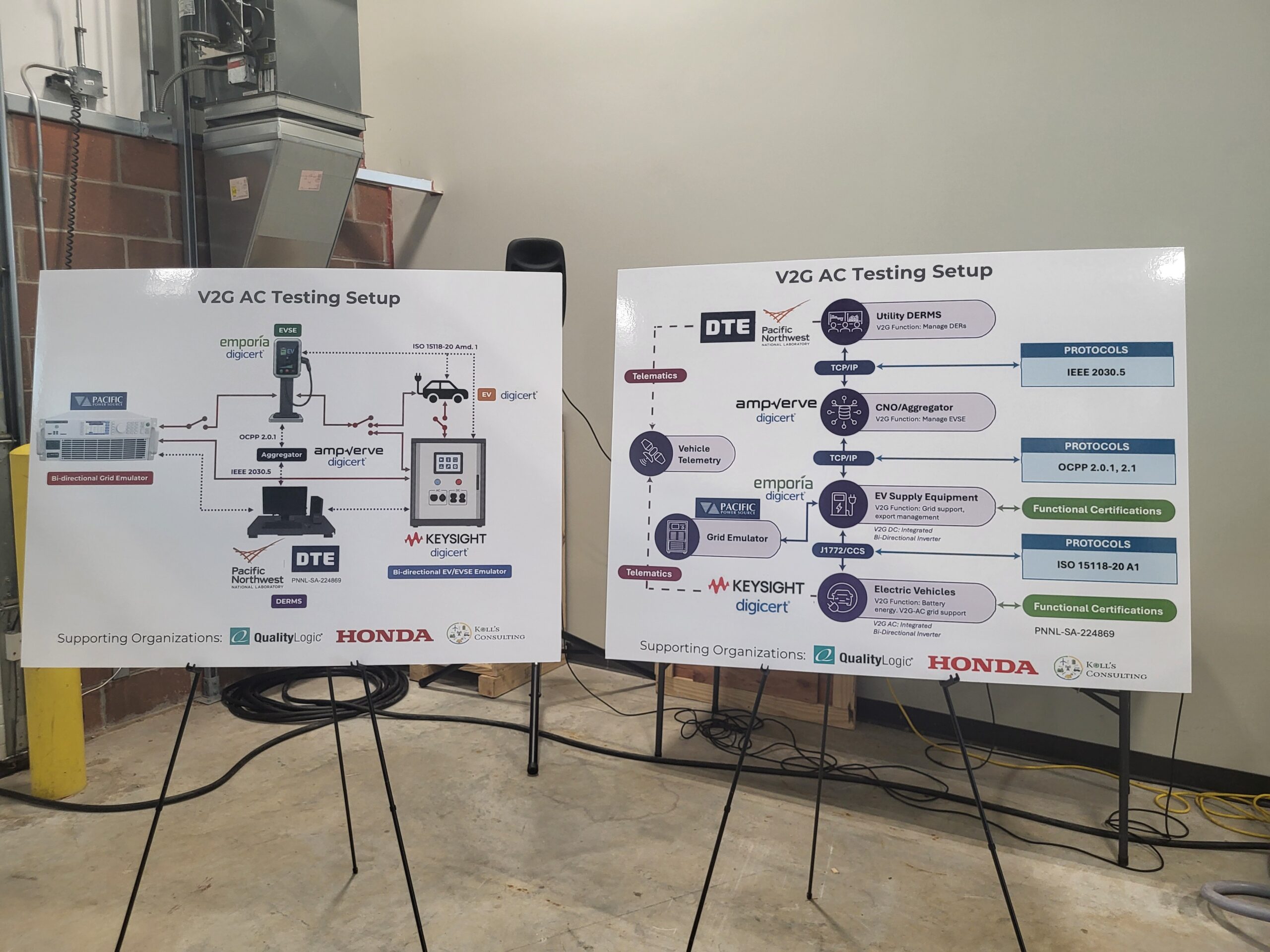
One of the most noteworthy developments was the collaborative end-to-end interoperability demonstration conducted during the Forum. For years, the V2G industry has relied heavily on proprietary solutions requiring specific combinations of vehicles, charging equipment, and software platforms. While these arrangements have demonstrated the technology’s potential, they present challenges for broader market adoption. The Detroit demonstration illustrated how independently developed components could work together using open industry standards to deliver grid services.
As Andrew Cifala of Keysight Technologies describes in his post-Forum article, the demonstration connected utility distributed energy resource management systems (DERMS), aggregators, bidirectional chargers, and vehicles or vehicle emulators into an integrated grid-service delivery system. The demonstration incorporated both AC and DC bidirectional charging architectures, with a grid-service request originating from a DERMS provided by DTE Energy and Pacific Northwest National Laboratory and ultimately producing a measurable power response. Multiple industry standards and protocols were involved, including ISO 15118-20, OCPP, IEEE 2030.5, and SAE J3072.
What impressed me most was the collaboration required to bring these components together. Organizations developing different pieces of the V2G ecosystem worked collectively to demonstrate how their technologies can function as an integrated system. As Andrew emphasizes, interoperability is ultimately an ecosystem challenge, not something any single company can solve independently. While a successful demonstration is not the same as interoperability among commercially available products under routine operating conditions, this effort represents useful progress toward repeatable testing and certification. For an industry that has struggled with fragmented technology solutions, it was an encouraging development.
AC Bidirectional Charging Could Improve V2G Economics
Another highlight was the growing interest in AC bidirectional charging, which has the potential to improve the economics of V2G deployment. My longtime colleague and mentor, Dr. Willett Kempton, presented research on low-cost, interoperable systems, including advances in the LIN-Control Pilot (LIN-CP) communications protocol that can support bidirectional charging using onboard vehicle inverters. In a previous edition of V2G News, we explored this University of Delaware research in detail in University of Delaware Tests a New Path to Scalable, Low-Cost V2G, highlighting how LIN-CP, onboard AC power conversion, and modern interconnection standards could reduce V2G costs while enabling vehicles to provide grid services.
This work has particular significance for me. When Willett and I published our first paper on using electric vehicles as a power resource in 1997, we envisioned EVs providing valuable services to the electric grid. Nearly three decades later, advances in technology, communications, and standards are helping address some of the technical barriers to realizing that vision, although widespread commercial deployment remains a longer-term undertaking.
Ford’s recent announcement, covered in this edition of V2G News, that its Fathom platform will incorporate AC bidirectional charging with LIN-CP is particularly noteworthy. As Dr. Kempton highlighted, Ford reports that its new architecture can reduce hardware costs by at least 60% compared with its previous approach. Unlike DC bidirectional systems that typically require a relatively expensive external inverter, AC bidirectional charging uses inverter functions onboard the vehicle, potentially reducing the cost and complexity of equipment installed at homes and businesses. Presentations from Ford, UL Solutions, Emporia, and others also highlighted ongoing efforts to establish the standards and certification pathways necessary to support this architecture, particularly through SAE J3072 and UL 1741 Supplement SC.
These developments are important because the high cost of today’s bidirectional charging systems remains a significant barrier to customer adoption. Lower-cost, interoperable equipment could make V2G financially attractive to a broader range of EV owners. However, meaningful cost reductions in commercial products have yet to be demonstrated at scale, and challenges remain related to certification, product availability, and interoperability among different vehicles and charging systems. Nevertheless, the progress highlighted at the Forum suggests that AC bidirectional charging could play an important role in the next phase of V2G development.
Regulatory Barriers and Customer Compensation Remain Critical Challenges
While technological progress was a major theme of the Forum, presentations at the event also underscored how regulatory processes and market structures are struggling to keep pace. Utility speakers highlighted efforts to establish practical interconnection pathways for bidirectional charging systems, including approaches for accommodating V2G alongside existing rooftop solar installations. This is a challenge we explored in our recent V2G News article, Beyond Solar: Building the Rules for V2G and the Connected Home, which examined how existing net energy metering rules can create barriers to integrating bidirectional EVs with rooftop solar and other distributed energy resources. These efforts are encouraging, but presentations highlighting experience from actual deployments demonstrated that permitting and interconnection continue to introduce substantial delays and costs, even for projects supported by well-funded state initiatives.
Several speakers also highlighted the need to modernize interconnection requirements to better reflect the unique operating characteristics of bidirectional EV charging systems. One recurring challenge is the application of procedures developed for stationary generation resources to vehicles that may operate in several different modes. Bidirectional systems configured exclusively for backup power during grid outages, for example, should not face the same requirements as systems designed to export electricity to the distribution grid. Similarly, clear and predictable pathways are needed for both AC and DC bidirectional charging architectures. The discussions reinforced the importance of interconnection reform in reducing deployment costs and establishing more predictable conditions for V2G commercialization.
Equally important is establishing sustainable mechanisms to compensate vehicle owners for the grid services they provide. This was a central theme of the panel I moderated on VGI and energy affordability, which explored how flexible EV charging and bidirectional energy flows can help reduce electricity system costs and deliver financial benefits to customers. The discussion reinforced a fundamental challenge facing the industry: demonstrating that EV batteries can create value for the electric system is not the same as creating a compelling business proposition for the vehicle owner. A growing body of research documents the potential benefits of V2G, but customers must have meaningful opportunities to capture a share of those benefits if they are expected to invest in bidirectional charging equipment and make their vehicles available for grid services.
Speakers offered examples of emerging compensation frameworks, including efforts in Connecticut to integrate bidirectional EVs into the state’s Energy Storage Solutions program, as well as research examining how V2G can help address distribution system needs. These presentations highlighted opportunities for bidirectional EVs to participate in established utility programs rather than depend exclusively on temporary pilot funding. However, significant work remains to establish compensation structures that appropriately value V2G services while recognizing customer mobility needs and the costs of participation. Durable utility programs, tariffs, and market opportunities that provide reasonably predictable financial returns will be important to supporting broader adoption.
Real-World Deployments Are Revealing What Still Needs Work
Another important takeaway was the growing body of operational experience from V2G systems deployed in the field. PowerFlex presented findings from Commonwealth Edison’s electric school bus V2G pilot, which involved four buses across three school districts. The buses successfully discharged during 82% of scheduled events, and when operating, generally delivered more than 90% of the requested power. These results provide evidence that electric school buses can deliver dispatchable grid services under real-world conditions, while also revealing the practical challenges associated with dependable performance. Firmware problems, communications failures, and disconnected vehicles all contributed to missed events, underscoring the importance of system integration and operational reliability.
These experiences reinforce why well-designed demonstrations remain valuable, even as the industry looks for opportunities to move beyond pilot projects. Real-world operating data are needed to validate performance, identify shortcomings, and improve products and programs. The longer-term objective, however, is to translate those lessons into commercially available solutions that work reliably without requiring customers or fleet operators to become technology integration specialists. Cybersecurity is another important consideration, as presentations from national laboratory researchers emphasized. As bidirectional charging becomes integrated into virtual power plants and utility operations, secure communications and shared responsibility across the V2G ecosystem will become increasingly important.
My Biggest Takeaway: Technical Progress Is Encouraging, but Commercialization Remains Challenging
If I had to identify one overarching takeaway from the Forum, it would be that the V2G industry is making meaningful technological progress, but achieving commercial scale will require corresponding advances in regulatory frameworks, market structures, and the economics of deployment. The end-to-end interoperability demonstration illustrated the potential of collaboration around common standards. Advances in AC bidirectional charging offer a possible pathway to reducing equipment costs, while experience from utility programs and field deployments is helping identify the operational requirements for successful commercialization. These developments are encouraging, but many of the barriers that have constrained V2G deployment for years remain unresolved.
I also came away with a renewed appreciation for the importance of collaboration across the transportation and electricity sectors. No single automaker, charging company, aggregator, or utility can create a scalable V2G market on its own. The technical progress demonstrated in Detroit was possible because organizations worked together across traditional industry boundaries. A similar level of collaboration will be needed among utilities, regulators, policymakers, and industry participants to develop the interconnection rules, compensation mechanisms, and commercial frameworks necessary to support broader deployment.
After nearly three decades working on V2G, I continue to see considerable potential for electric vehicles to serve as distributed energy resources, delivering value to the electricity system while creating opportunities to reduce transportation costs for their owners. What I found most encouraging in Detroit was not any single technology announcement, but the progress occurring across several interconnected areas of the V2G ecosystem. There is still substantial work ahead, particularly in translating technical capabilities into reliable products and financially attractive opportunities for customers. The discussions and demonstrations at this year’s Forum suggest that progress is being made, even if the path to widespread commercialization remains complex.
