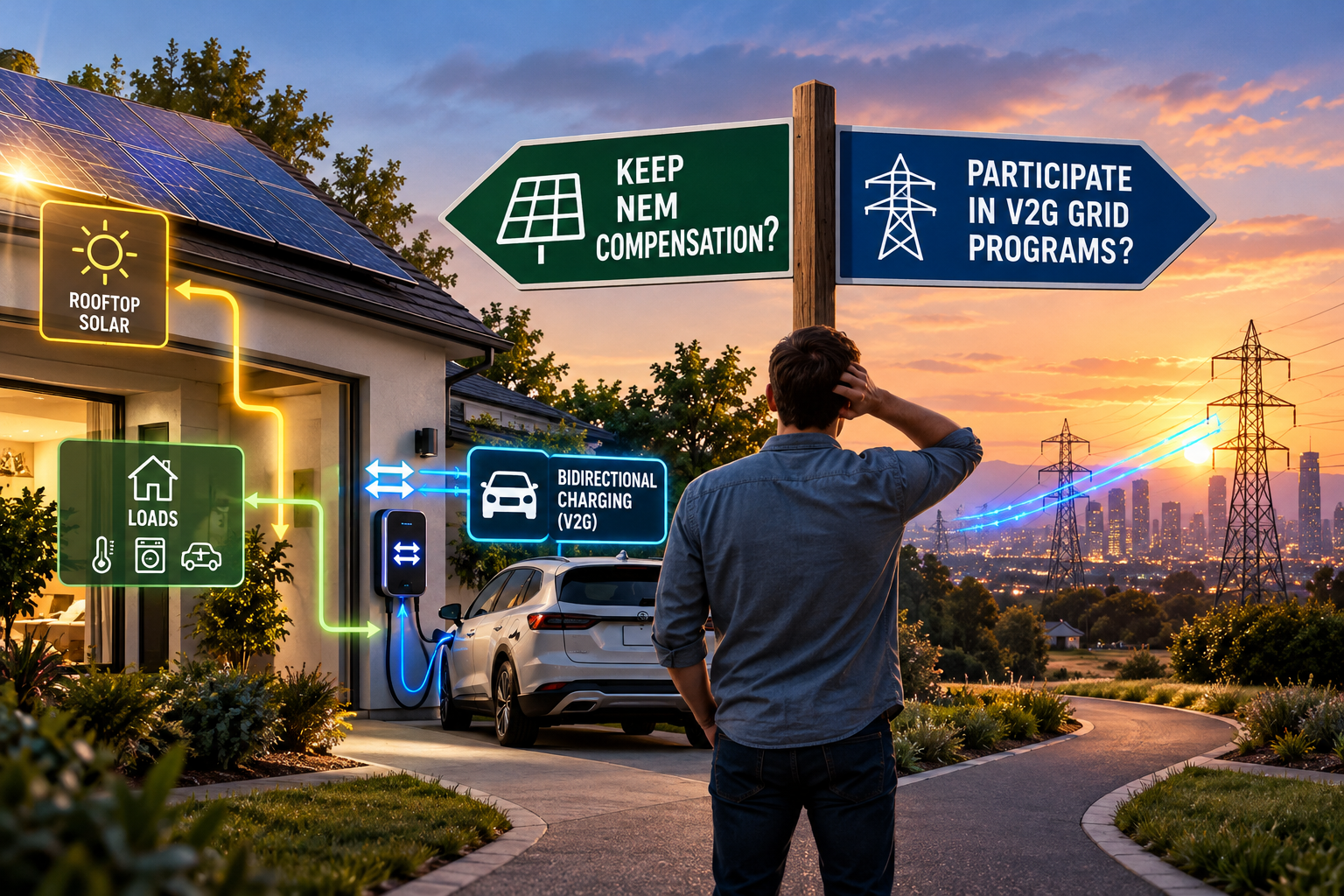
As electric vehicles, rooftop solar, batteries, and flexible loads converge behind the customer meter, outdated regulatory frameworks threaten to limit their collective value. Fortunately, practical solutions are emerging.
October 13, 2026
This article is the fifth and final installment in the V2G News 2026 Policy Series examining the regulatory and market barriers to scaling vehicle-to-grid (V2G). Previous installments explored enabling grid exports from EVs, establishing predictable revenue streams, designing effective compensation mechanisms, and integrating V2G into virtual power plants (VPPs). This final article brings these themes together at the customer site, where rooftop solar, bidirectional charging, stationary batteries, and other flexible resources increasingly need to operate as coordinated systems. We examine a particularly pressing challenge: integrating V2G with existing net energy metering (NEM) arrangements and the practical regulatory solutions that could help unlock the connected home’s full potential.
The Connected Home Meets a Regulatory Disconnect
Imagine a homeowner who has invested in rooftop solar, purchased an electric vehicle, and now wants to use the vehicle’s battery to support the grid during peak demand. The technology is becoming commercially available, and utilities are beginning to compensate customers for electricity exported from EV batteries. Yet installing a grid-connected bidirectional charger could jeopardize the compensation that made the homeowner’s solar investment attractive in the first place.
Early bidirectional charging pilot programs are bringing this challenge into focus. In some jurisdictions, existing net energy metering (NEM) rules can make it difficult for homeowners to retain solar compensation while participating in V2G programs. These rules were generally developed to compensate electricity generated by rooftop solar, not electricity discharged from an EV battery that may have been charged from the grid. As a result, customers may face restrictions on combining solar and V2G behind the same utility meter, potentially forcing them to choose between preserving their solar benefits and participating in programs that compensate EV owners for providing grid services.
The irony is that solar and EV ownership often go hand in hand. A 2024 study found that approximately one-quarter of surveyed EV owners also owned rooftop solar, compared with just 8% of non-EV owners. These households are a natural market for residential bidirectional charging, having already invested in technologies that give them greater control over their energy use. Yet rules originally designed for rooftop solar can become barriers when an EV battery capable of exporting electricity is added behind the same meter.
The problem also reflects a broader transition underway. Homes increasingly combine solar generation, stationary batteries, bidirectional EV charging, heat pumps, and other flexible loads. Together, these technologies can lower electricity bills, reduce peak demand, provide backup power, and support the grid. Unlocking their full value will require regulatory frameworks that treat the connected home as an integrated energy system rather than a collection of separate technologies.
Two Problems Behind the Meter: Double Compensation and NEM Integrity
Traditional net metering was designed around a relatively simple arrangement: rooftop solar generates electricity, the home consumes some of it, and excess production flows to the grid. The utility meter records net imports and exports, and the customer receives credits under the applicable tariff. In many states, those credits are tied to electricity produced by an eligible renewable energy system.
Bidirectional charging complicates that arrangement. A home with solar and a grid-connected EV battery can export electricity from either resource. The EV may also store electricity purchased from the grid or obtained at public charging stations. Because a conventional utility meter measures the combined electricity flowing into and out of the home, it cannot distinguish solar exports from electricity discharged by the EV.
This creates two related but distinct regulatory questions: what services are being compensated, and where did the exported electricity come from? The first concerns potential double compensation. A homeowner participating in both NEM and a virtual power plant (VPP) program might receive credits for exported electricity while also earning payments for providing grid services. But these payments are not necessarily duplicative. NEM may compensate eligible electricity exports, while VPP programs may reward capacity, availability, or performance during peak demand periods. The key is ensuring that each payment reflects a distinct value rather than compensating the same service twice.
The second question concerns NEM integrity. In states where NEM compensation is limited to eligible renewable generation, electricity purchased from the grid and subsequently discharged from an EV battery may not qualify for those credits. This is fundamentally an energy accounting issue: determining which exports qualify for renewable energy compensation and which may instead be eligible for other grid-service payments. Resolving potential double compensation does not automatically resolve the source-attribution question, and vice versa.
Importantly, neither issue presents an insurmountable barrier to integrating solar and V2G. With appropriate energy accounting and clearly defined compensation mechanisms, customers can receive credit for eligible renewable generation while also earning payments for distinct grid services provided by their EVs. The challenge is to establish practical rules that recognize the different sources and values of electricity exported from a connected home, without imposing unnecessary restrictions on how EV owners charge their vehicles.
Practical Solutions for Integrating Solar, V2G, and Other Distributed Resources
Fortunately, regulators do not need to start from scratch. Experience integrating stationary batteries with rooftop solar offers practical approaches for accommodating bidirectional EV charging. The key is to establish reasonable methods for accounting for electricity exports while ensuring that customers are compensated for the distinct grid services they provide.
California offers one example. Under CPUC Decision 16-04-020, subsequently modified by Decision 18-02-008, qualifying small solar-plus-storage systems can use estimated solar production to establish limits on exports eligible for NEM credits. A similar approach could help accommodate residential V2G without requiring additional meters or restricting where EV owners charge their vehicles.
New York’s Value of Distributed Energy Resources (VDER) framework provides another useful precedent. Its hybrid tariff includes an export-netting methodology to account for energy consumed by storage when determining eligible renewable compensation. More broadly, the VDER Value Stack distinguishes among energy, generation capacity, environmental benefits, and distribution system value. Together, these approaches illustrate how regulators can address energy accounting while compensating distributed resources for distinct grid services.
As V2G participation grows, more detailed accounting may be appropriate. Networked chargers, vehicle telematics, solar inverters, and home energy management systems can provide data to help distinguish eligible solar exports from EV battery discharges. Regulators should allow appropriately verified device-level data and avoid imposing unnecessary metering costs, particularly for residential customers and early pilot programs.
The larger opportunity is to move beyond regulatory frameworks that treat each technology independently. Solar panels, stationary batteries, bidirectional EVs, and flexible loads can work together to reduce peak demand, shift energy consumption, and provide grid services. Some of these benefits involve exporting electricity, while others come from reducing imports. Regulatory frameworks should recognize these distinct values while allowing the connected home to operate as an integrated energy system, benefiting customers and the broader grid.
Why This Matters for the Future of V2G
The implications extend well beyond today’s relatively small residential V2G market. States are developing virtual power plant (VPP) programs to aggregate distributed resources, reduce peak demand, lower electricity costs, and defer grid investments. EV batteries could become an important part of these programs because customers have already purchased the most expensive component of an energy storage system: the battery itself.
Early V2G programs cannot afford to discourage customers who are ready to participate. Excluding or financially penalizing homeowners with rooftop solar could reduce enrollment and limit opportunities to demonstrate V2G performance, understand customer behavior, and quantify grid value. It also creates uncertainty for customers considering bidirectional charging, manufacturers developing compatible products, and aggregators seeking to bring these resources into electricity markets.
The challenge extends beyond solar and EVs. As highlighted in recent V2G News coverage of research from the National Laboratory of the Rockies, interoperability cannot stop at the vehicle-to-charger connection. Homes are becoming increasingly sophisticated energy systems, with solar, stationary batteries, EVs, and flexible loads capable of working together to serve both customer and grid needs. Regulatory frameworks must evolve to support this integration rather than impose barriers based on how individual technologies have historically been treated.
This fifth and final installment of the 2026 V2G News Policy Series reinforces a central lesson from the series: enabling V2G requires more than removing individual regulatory barriers. Interconnection pathways, compensation mechanisms, customer protections, and access to grid-service programs must work together to create a coherent framework for participation.
The opportunity is to move beyond policies designed around individual technologies and toward rules that recognize the connected home as an integrated energy resource. Customers should be able to combine solar, bidirectional EVs, batteries, and flexible loads without sacrificing existing benefits, while receiving fair compensation for the distinct grid services they provide. Getting these rules right will help unlock the potential of millions of distributed energy assets to deliver value for their owners and the broader electricity system.
