New research examining 86 studies finds widespread evidence that V2G can generate economic value, but substantial uncertainty remains over how much EV owners can actually earn.
November 10, 2026
Signer, T., et al. (2026). Two decades of vehicle-to-grid research show widely divergent profitability estimates. Advances in Applied Energy, 24, 100306.
Two decades of research suggest that vehicle-to-grid (V2G) can generate positive economic returns, but there is remarkably little agreement on how much. A new peer-reviewed analysis of 86 studies finds a median estimated annual profit of €201 per vehicle, with 86% of studies reporting positive median outcomes. Behind these headline figures, however, lies substantial variation in electricity market conditions, participation arrangements, cost assumptions, and the types of financial benefits being measured.
Published in Advances in Applied Energy, the study examines 680 economic outcomes from research conducted between 2000 and 2026. Most of the underlying research focuses on V2G participation in wholesale electricity and balancing markets, rather than compensation through utility-administered programs. This distinction is important for understanding what the findings mean for EV owners, particularly in the United States, where opportunities to earn compensation for bidirectional charging remain limited.
Examining Two Decades of V2G Economics
The study was conducted by Tim Signer, Max Kleinebrahm, Thorsten Weiskopf, Jann Weinand, Moritz Raab, Vincenz Regener, and Wolf Fichtner, researchers affiliated with the Karlsruhe Institute of Technology (KIT), Forschungszentrum Jülich, and Forschungsstelle für Energiewirtschaft in Germany. Published online on September 25, 2026, the research sought to identify patterns in V2G profitability and better understand why economic estimates differ so substantially across studies.
Rather than developing another V2G simulation, the authors conducted a systematic review of 86 studies covering 17 countries across Europe, North America, and the Asia-Pacific. The researchers standardized 680 reported economic outcomes to euros per EV per year, expressed in 2025 prices, providing a common basis for comparing results across different electricity markets, operating strategies, and modeling assumptions.
The research primarily examined opportunities to earn revenues from wholesale electricity trading and balancing services, including frequency regulation. Of the 86 studies, 60 examined balancing markets, 29 considered wholesale spot markets, eight evaluated retail electricity tariffs, and seven addressed other compensation arrangements, including contracted peak reduction and interruptible load programs. Some studies examined more than one market segment. This distribution illustrates the emphasis on electricity market participation in the existing literature, with relatively limited attention to compensation mechanisms resembling utility-administered V2G programs.
The researchers also examined how vehicle availability, battery degradation, equipment costs, and operating expenses influence profitability. Importantly, they distinguished between revenues generated through market participation and profits remaining after the costs accounted for in each study. They also considered where financial benefits accrue along the V2G value chain, recognizing that revenues earned by aggregators or other market participants do not necessarily translate directly into earnings for EV owners.
Most Studies Find Positive Returns, but Estimates Vary Widely
The study found broad agreement that V2G can generate positive economic value, but substantially less agreement about how much. Among the 69 studies reporting profit outcomes, the median estimated annual profit was €201 per vehicle, with an interquartile range of €48 to €698. Approximately 86% reported positive median outcomes, although estimates ranged from net losses to gains of several thousand euros annually. These differences reflect the considerable variation in electricity markets, operating strategies, and modeling assumptions.
An important qualification is that most studies measured the economic value realized through electricity market participation rather than the financial benefits ultimately received by EV owners. Reported profits also reflected different definitions of costs, with some studies accounting for equipment, operating, and battery degradation expenses more comprehensively than others. Consequently, the €201 median should not be interpreted as a forecast of typical EV-owner earnings or an indication of the compensation that utilities should offer for participation in V2G programs.
The findings are nevertheless useful for understanding the economic potential of bidirectional charging. They demonstrate that V2G can generate financial value under a range of conditions while illustrating why profitability estimates must be evaluated in the context of specific markets, business models, and participation requirements.
Why Do Profitability Estimates Vary So Widely?
The researchers identified several factors influencing V2G profitability, including vehicle availability, electricity market conditions, battery cycling costs, and the treatment of operational constraints. Within individual studies, profitability generally increased as more vehicle flexibility became available and decreased as battery cycling costs rose. However, these relationships became much harder to identify when comparing studies conducted in different markets using different assumptions.
Vehicle availability is particularly important. Many modeling studies assume that EVs are connected to charging equipment for substantial portions of the day. In practice, a parked vehicle is not necessarily plugged in, and owners must retain sufficient battery energy for driving. Studies assuming greater vehicle availability generally identify more opportunities to generate revenue, but those assumptions may overstate the flexibility available under actual customer behavior.
Battery cycling costs also affect profitability. Charging and discharging create efficiency losses and contribute to battery wear, reducing net economic returns. Strategies based on electricity price arbitrage require buying electricity at lower prices and selling it at higher prices, with the difference sufficient to cover these costs. Balancing markets, which compensate resources for providing reserve capacity and sometimes for actual energy delivery, can offer a different revenue structure with less intensive battery cycling. The researchers found that these differences in compensation mechanisms significantly affect how much gross revenue remains after costs.
Equipment and market participation costs introduce additional uncertainty. Some studies exclude the costs of bidirectional charging equipment, electrical upgrades, or regulatory compliance, potentially overstating profitability from the customer’s perspective. Many also assume that vehicles or aggregators can participate in electricity markets without fully accounting for minimum bid sizes, qualification requirements, or the possibility that bids will not be accepted. These assumptions can result in profitability estimates that are difficult to achieve under actual market conditions.
One of the study’s more interesting findings is that restricting the analysis to studies with more comprehensive modeling assumptions did not systematically reduce reported profitability. This challenges the assumption that favorable V2G results necessarily reflect simplified economic models. Instead, the researchers found that differences in market conditions, operating strategies, and modeling choices interact in ways that make profitability difficult to generalize.
What Do These Findings Mean for EV-Owner Compensation?
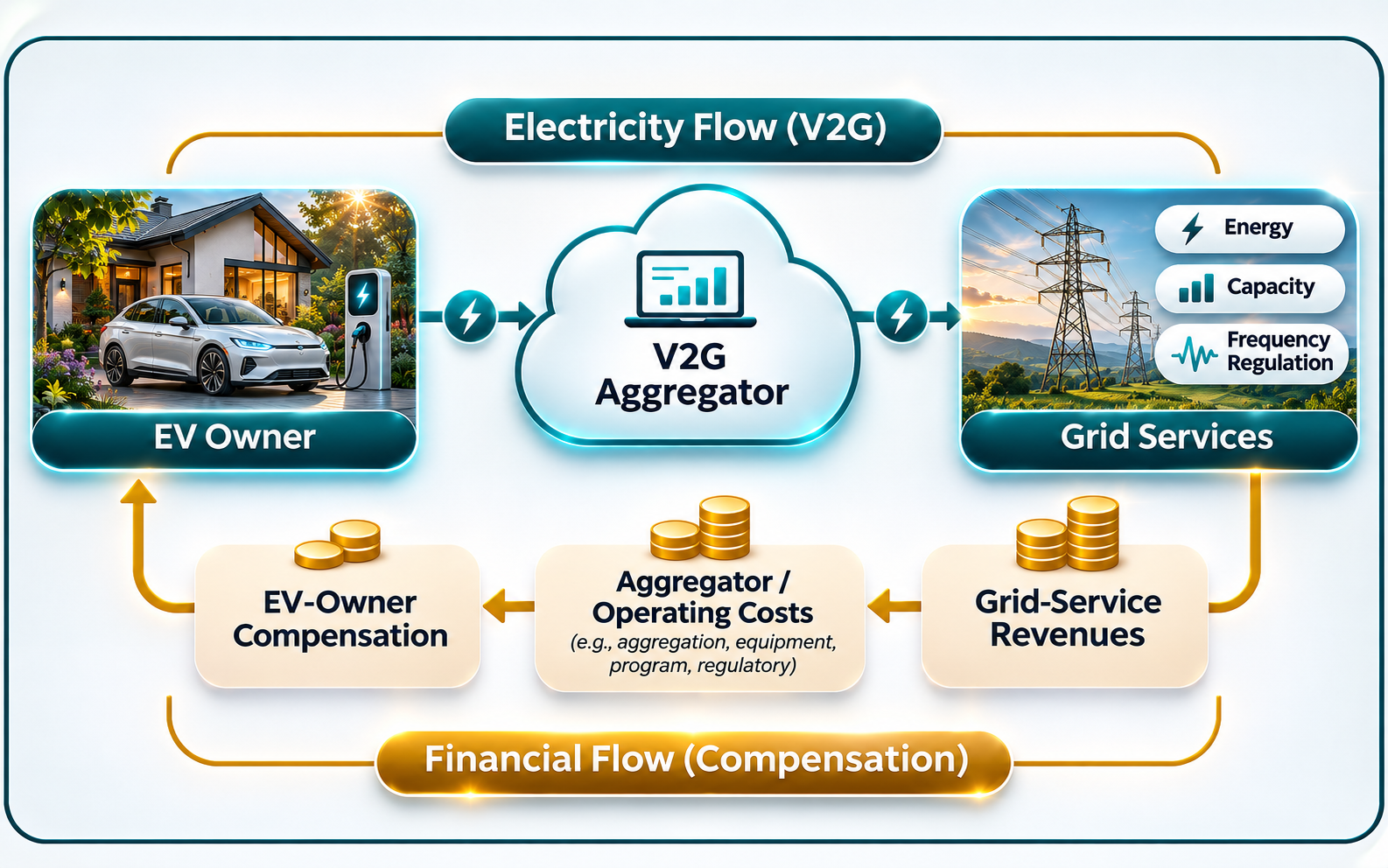
One of the study’s most useful contributions is its distinction between economic value generated through V2G participation and the financial benefits received by individual EV owners. While modeled electricity market revenues may appear attractive, the costs of delivering grid services and the arrangements for sharing revenues determine how much compensation ultimately reaches customers. This distinction is especially important because many studies estimate the value of V2G resources under market participation arrangements that do not fully reflect the regulatory and operational requirements of commercial deployment.
Individual EVs generally cannot meet the minimum capacity, technical, and administrative requirements for participating directly in wholesale electricity markets. Aggregators can address some of these barriers by combining vehicles, managing availability, coordinating dispatch, and participating in electricity markets on customers’ behalf. However, aggregation introduces additional costs for software, communications, customer enrollment, operations, and compliance. How these costs and the remaining revenues are divided among customers, aggregators, utilities, and other participants can substantially affect the financial attractiveness of V2G participation.
These considerations are particularly relevant in the United States, where practical opportunities for customer-owned bidirectional charging systems to participate in wholesale electricity markets remain limited. Utility-administered demand response, peak reduction, and other compensation programs may provide more accessible pathways for V2G participation, although relatively few studies in the review specifically examined these arrangements. Unlike wholesale market revenues, utility program payments may be based on administratively established incentives, demonstrated performance, or contracted capacity commitments.
The findings therefore have implications for how utilities, regulators, and industry participants evaluate emerging V2G compensation programs. Economic assessments should distinguish gross market revenues, net returns after costs, and payments ultimately received by EV owners. They should also account for customer requirements, including the ability to maintain minimum battery reserves, control vehicle availability, and opt out of dispatch events when necessary. Programs offering predictable compensation for availability or demonstrated performance may provide attractive opportunities, but their economics must be evaluated under the specific conditions in which customers participate.
The Need for More Evidence from Operating V2G Programs
The extensive modeling literature contrasts with the relatively limited evidence available from actual V2G operations. Although researchers have examined numerous market conditions and operating strategies, comparatively few studies document realized revenues, the full costs of delivering grid services, and the net financial benefits received by participating customers. This gap is especially significant for utility-administered programs, which represent a potential near-term pathway for expanding V2G participation in the United States but received relatively little attention in the reviewed research.
Operating deployments introduce constraints that can be difficult to capture fully through modeling, including actual vehicle connection patterns, customer reserve preferences, charger availability, communications reliability, and program participation requirements. More transparent reporting from V2G demonstrations would help address these uncertainties. Particularly useful information would include compensation earned for specific grid services, equipment and installation costs, aggregator expenses, customer payments, and the actual availability and performance of participating vehicles.
For residential V2G in the United States, these questions are especially relevant because commercially available bidirectional charging systems have largely been marketed for backup power, while opportunities to earn grid-service compensation remain limited. Resilience benefits may currently provide much of the justification for investing in bidirectional equipment. Additional compensation opportunities could improve the economics, but their contribution will depend on program design, participation costs, and actual operating performance.
What Two Decades of Research Tell Us
The study provides substantial evidence that V2G can generate positive economic value, while also demonstrating why profitability estimates vary so widely. Differences in electricity market conditions, operating strategies, and modeling assumptions make it difficult to establish a single representative value for bidirectional charging. The researchers also found that more comprehensive modeling assumptions did not consistently produce lower profitability estimates, indicating that the variation cannot be explained simply by differences in modeling rigor.
For utilities, regulators, and companies developing V2G offerings, perhaps the most important lesson is the need to distinguish between the economic value of grid services and the compensation ultimately available to EV owners. Much of the existing research examines electricity market opportunities that are not yet readily accessible to customer-owned vehicles, while relatively few studies assess the utility-administered programs that may provide near-term compensation opportunities in the United States.
After more than two decades of research, the evidence supports V2G’s economic potential, but better information from operating projects and emerging compensation programs will be essential to understanding how that value can translate into attractive and sustainable financial benefits for EV owners.
