This edition of V2G News explores groundbreaking research from the University of Delaware demonstrating how LIN-CP, a simpler, potentially lower-cost approach to vehicle-charger communications, could help advance AC bidirectional charging and unlock new opportunities for grid services. We also feature our first-ever V2G News interview with an electric utility—and who better to start with than Pacific Gas and Electric (PG&E), a national leader in vehicle-grid integration? We sit down with Kristin Landry to explore PG&E’s experience with V2G pilots, emerging opportunities, and the challenges of bringing bidirectional charging into the mainstream.
Plus, we cover the latest V2G developments from around the world, including the formation of a new national vehicle-grid integration alliance in Canada, an important step toward building the coordinated industry support needed to advance V2G commercialization.
Lots to explore in this edition of V2G News!

V2G Insights
Making V2G Work for Customers: A
Conversation with PG&E’s Kristin Landry

Kristin Landry, Expert Product Manager, Pacific Gas & Electric
October 27, 2026
Pacific Gas and Electric Company (PG&E) has been one of the most active U.S. utilities exploring vehicle-grid integration (VGI), with work spanning residential backup power, grid-connected bidirectional charging, commercial fleets, microgrids, managed charging, and emerging dynamic-rate applications. As those efforts mature, the questions are shifting from whether bidirectional charging works to how utilities, automakers, charging providers, and customers can make it work at scale.
V2G News spoke with Kristin Landry, Expert Product Manager at PG&E, about what the utility is learning from its Vehicle-to-Everything (V2X) Programs, how customers are responding, the growing range of bidirectional products entering the market, and the regulatory and operational challenges that remain. Landry leads implementation of PG&E’s Residential V2X Program and serves as an internal subject-matter expert on the different ways bidirectional EVs can connect to the grid.
A recurring theme throughout the conversation was simplicity. The technology is advancing, but customers still face a complicated journey involving vehicles, chargers, software providers, interconnection, rates, incentives, and program enrollment. Reducing that friction is emerging as one of the industry’s most important challenges.
The interview has been edited for length and clarity.
V2G Intelligence
University of Delaware Tests a New Path to Scalable, Low-Cost V2G
October 27, 2026
An Exelon-sponsored research project demonstrates how onboard AC bidirectional charging, LIN-CP communications, and modern interconnection standards could lower V2G costs while enabling EV fleets to provide high-value grid services.
Kempton, W., Ejzak, G. A., Faghri, S., Gilman, C. M., Mediavilla Gallano, M., Metz, J. G., and Veras, R. B. S. (2026). Evaluating the Capabilities and Value of V2G Grid Services in Fleet Operations. Final report, March 31, 2026. University of Delaware. Sponsored by Exelon Corporate Strategy – Technology and R&D.
For vehicle-to-grid (V2G) technology to scale, electric vehicles must do more than discharge electricity. They must communicate reliably with charging equipment, demonstrate compliance with utility interconnection requirements, respond accurately to grid operators, and generate enough economic value to justify the investment. A new University of Delaware (UD) research report brings these challenges together, offering one of the most comprehensive demonstrations to date of a potentially scalable architecture for bidirectional charging.
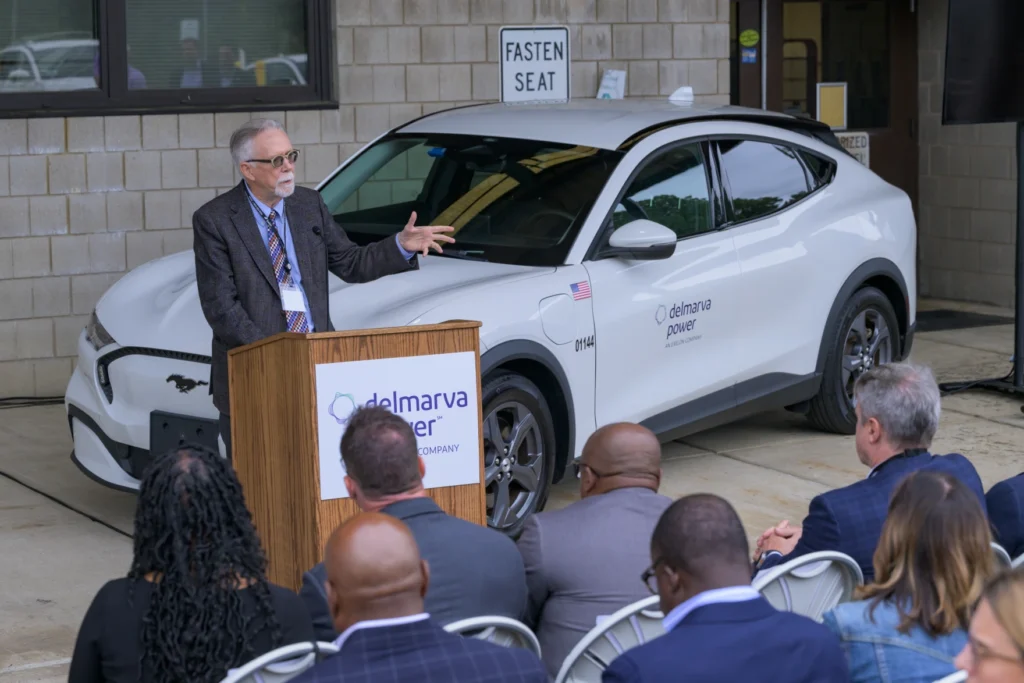
The 63-page report, led by V2G pioneer Willett Kempton and colleagues at UD, documents a year of grid-service operations using four modified Ford Mustang Mach-E vehicles in Delmarva Power’s Delaware fleet. Sponsored by Exelon, the project brought together Ford, Nuvve, Watt & Well, AutoPort, PJM Interconnection, and other partners to test an integrated combination of new technologies, technical standards, and electricity-market rules.
The research is particularly notable for its use of LIN-CP (Local Interconnect Network over Control Pilot), a digital communications protocol defined in SAE J3068 that enables detailed, bidirectional communication between an EV and its charging station.
V2G Finds—US
Oakland Electric School Bus Fleet Delivers 1.7 GWh of V2G Energy Over Two Years
A fleet of 74 electric school buses operated by Zum for Oakland Unified School District has delivered approximately 1.7 GWh of electricity to the grid over two years, according to charging equipment manufacturer Tellus Power. The buses collectively provide approximately 2 MW of discharge capacity from 11.5 MWh of onboard battery storage, with reported charger uptime exceeding 99.5%. The fleet charges overnight and discharges during periods of high electricity demand, demonstrating how school buses can function as dispatchable distributed energy resources. The operating data provide a valuable indication of the technical performance and grid-service potential of commercial V2G fleets.
10/20/2026
Industry Coalition to Demonstrate End-to-End AC and DC V2G Interoperability
DTE Energy, Stellantis, Pacific Northwest National Laboratory, Keysight Technologies, Heliox, and other industry participants will demonstrate separate AC and DC vehicle-to-grid testbeds at the upcoming V2G Business, Policy & Technology Forum in Michigan. The demonstrations will explore interoperability across the communications and control systems connecting vehicles, bidirectional charging equipment, aggregators, and utilities. The initiative will examine standards-based architectures, including ISO 15118-20, SAE J3072, IEEE 2030.5, and OCPP, with particular attention to interoperability and cybersecurity. The testbeds represent an effort to advance repeatable, standards-based approaches for integrating bidirectional charging systems across manufacturers and service providers.
10/13/2026
Portland General Electric Highlights the V2G Potential of Heavy-Duty Electric Trucks
Portland General Electric (PGE) is highlighting the potential for medium- and heavy-duty electric vehicles to serve as valuable grid resources, helping utilities manage peak electricity demand and control costs. At Oregon’s first fleet-focused electric vehicle ride-and-drive event, PGE transportation electrification manager Karla Hendrickson described electric trucks and buses as “batteries on wheels” that could support the grid through bidirectional charging. School buses are particularly promising because of their predictable schedules and extended parking periods. PGE is already testing the ability to dispatch energy from electric school buses back to the grid. As commercial fleet electrification expands, the large batteries in trucks and buses could become an increasingly important source of distributed energy storage.
10/18/2026
V2G Finds—Global
Canada Forms National Alliance to Advance Vehicle-Grid Integration
Dunsky Energy + Climate Advisors has launched the Canadian Vehicle-Grid Integration Alliance, bringing together utilities, governments, automakers, and industry organizations to accelerate the commercialization of managed and bidirectional charging. Funding partners include BC Hydro, Manitoba Hydro, Alectra, and the Government of Nova Scotia, with General Motors providing support and the Vehicle-Grid Integration Council participating as a strategic collaborator. The alliance will focus on market alignment, standards and interoperability, regulatory and investment pathways, and customer deployment. The initiative represents an important effort to coordinate stakeholders across the automotive and electricity sectors and establish the conditions needed for broader commercial deployment of V2G in Canada.
10/20/2026
Australia Launches AU$5.35 Million Commercial V2G Demonstration with 130 Government Fleet Vehicles
The Australian Renewable Energy Agency (ARENA) is providing AU$4.1 million toward a three-year, AU$5.35 million project led by JET Charge, in partnership with AGL and the Australian Capital Territory government. The REVS2 project will deploy up to 130 electric vehicles and bidirectional chargers, making it Australia’s largest commercial fleet V2G demonstration. Building on an earlier trial that established the technical feasibility of V2G, REVS2 will focus on the operational and commercial challenges of integrating bidirectional charging into everyday fleet operations. The project will evaluate potential grid-service revenues while ensuring vehicles remain available to meet transportation needs.
10/21/2026
Mercedes-Benz Introduces Residential V2G Offering with Availability-Based Customer Compensation
Mercedes-Benz and The Mobility House Energy have introduced a residential V2G offering in Germany that combines compatible electric vehicles, an 11-kW bidirectional DC wallbox, and a dedicated electricity tariff. Initially available for the electric GLC and C-Class, the offering compensates customers based on the time their vehicles remain connected, regardless of whether they are charging, discharging, or idle. Mercedes-Benz estimates that customers connected for an average of 12 hours daily could earn more than €500 annually in bonuses. The first 500 customers can purchase the wallbox for €1,990. The program demonstrates a potentially important compensation model that rewards battery availability rather than solely compensating exported electricity.
10/13/2026
Chery Announces Plans for 20,000 V2G Charging Stations Worldwide by 2029
Chinese automaker Chery has announced plans to deploy 20,000 V2G-enabled charging stations globally by 2029, signaling a major commitment to the commercialization of bidirectional charging. Unveiled at the company’s Global Innovation Conference, the initiative includes V2G technology integrated with solar generation, stationary battery storage, and high-power charging infrastructure. Chery is developing both AC and DC bidirectional charging capabilities and plans to introduce V2G functionality in its electric Fengyun A9 in 2027. The company also highlighted a solar-plus-storage microgrid deployment at a heavy-truck facility in Spain. While details on the planned rollout remain limited, the announcement underscores the growing interest among Chinese automakers in integrating EV batteries into electricity markets and grid operations.
10/21/2026

