September 29, 2026
Vehicle-to-grid systems are often described as if the essential transaction were straightforward: an electric vehicle connects to a bidirectional charger, receives a signal from the grid, and either charges or sends electricity back. In practice, considerably more has to happen behind the scenes.
The vehicle must communicate with the charger. The charger may communicate with an aggregator or charging-management platform. A utility may need to send operating limits or grid-support settings. And at a home, commercial building, or fleet depot, the EV may also need to operate alongside solar, stationary batteries, and other flexible loads. Each device may use different communications protocols, while the site as a whole still has to comply with grid-interconnection requirements.
A June 2026 report from the National Laboratory of the Rockies (NLR), V2XConnect: Harmonizing the Landscape of Bidirectional Charging Codes, Standards, and Communication Protocols, examines this increasingly complicated landscape. The report reviews the standards governing bidirectional charging and distributed energy resources (DERs), analyzes the communications protocols supported by hundreds of inverter products, and proposes a site-level gateway that could coordinate multiple energy resources while responding to utility and customer needs.
The central message for the VGI industry is important: interoperability cannot stop at the vehicle-to-charger connection. As EVs increasingly share customer sites with solar, batteries, and flexible loads, those resources will need to communicate and operate as a coordinated grid resource, while preserving drivers’ transportation needs.
A Growing Site-Level Coordination Problem
V2G will rarely operate in isolation. Many of the customers participating in or expressing interest in bidirectional charging are also early adopters of other distributed energy technologies, including rooftop solar, stationary batteries, smart thermostats, heat pumps and other controllable loads. Fleet and commercial sites can be even more complex, combining multiple EV chargers with solar, battery storage, building loads and energy-management systems.
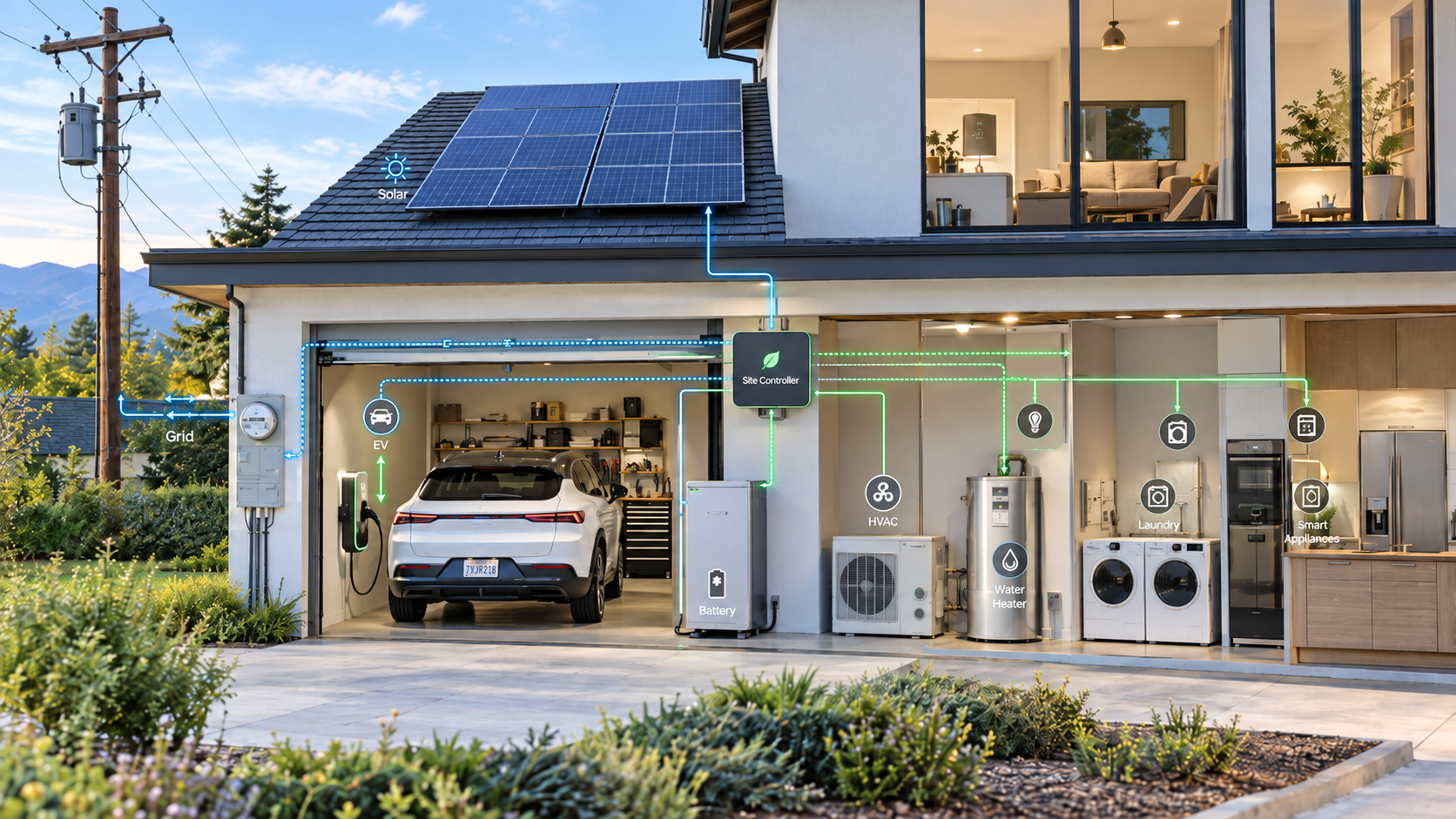
NLR focuses on this increasingly important reality. The report uses the example of a home combining rooftop solar with energy storage, including a stationary battery or V2X-capable EV, to illustrate how multiple assets operating behind a single utility connection can create a complicated communications and control environment. Each resource may come from a different manufacturer, use a different communications protocol and have its own controller and operating objective. Yet the utility ultimately sees the combined behavior of the site at the point of common coupling.
That distinction becomes especially important as customers try to use several resources at the same time. A homeowner may want rooftop solar to charge an EV during the day, preserve enough battery capacity for backup power and still participate in a V2G program during high-value grid events. A fleet operator may need vehicles charged for their next route while also responding to a utility demand-response event or staying below a distribution-system import limit. A stationary battery may be responding to still another price signal or site objective.
These resources therefore cannot always be controlled independently. A charging command that makes sense for the EV alone may conflict with a site import limit. Simultaneous exports from solar, a stationary battery and a bidirectional EV could exceed an allowed export level. And a utility requirement intended to apply at the meter may need to be translated into operating instructions for several individual devices behind it.
NLR describes this as a growing site-harmonization problem. Its diagrams show how communications can quickly become convoluted when the utility, aggregator, EVSE, vendor clouds and other DERs all communicate through different pathways. The report proposes simplifying that architecture through a common gateway that can translate among protocols and coordinate the resources so the entire site responds cohesively to IEEE 1547, UL 3141, utility operating limits and customer needs.
This shifts the interoperability discussion in an important way. The challenge is no longer simply whether the vehicle can communicate with the charger or whether an individual device can satisfy an interconnection standard. It is whether solar, batteries, EVs and flexible loads can be coordinated so that the whole site behaves as one manageable grid resource.
For VGI, that is likely to become increasingly important as bidirectional charging moves beyond stand-alone pilots and into homes, fleets and commercial facilities where multiple DERs already coexist. The next stage of interoperability is therefore not just device-to-device communication. It is site-level orchestration.
What NLR Studied
NLR approached the interoperability problem from several directions. The researchers first mapped the codes and standards relevant to bidirectional charging and other distributed energy resources, including IEEE 1547, SAE J3072, UL 1741 SC and UL 3141, to understand how vehicles, chargers, inverters, power-control systems, and utilities need to interact. They then examined the communications protocols supported by commercially available inverter products, using sources including UL’s Product iQ database, utility-approved smart-inverter lists, and SunSpec Alliance members. The resulting dataset included 751 inverter models from 50 companies, spanning PV inverters, battery inverters, microinverters, and bidirectional converters.
The researchers also examined how several major open communications protocols, particularly OCPP 2.1, SunSpec Modbus and IEEE 2030.5, could work together in a multi-DER environment. From that analysis, NLR developed a conceptual architecture for a power control system, or PCS, gateway capable of translating among protocols, coordinating individual resources and managing site-level operating limits. The report should therefore be viewed as a standards assessment, market analysis and proposed technical architecture rather than a field demonstration of a finished commercial gateway.
A Fragmented Communications Landscape
One of the report’s clearest findings is just how fragmented today’s equipment landscape remains. Of the 751 inverter models examined, only 184 supported at least one nonproprietary communications protocol. The remaining 567 relied on proprietary communications, collectively using 45 different proprietary protocols.
That does not mean proprietary communications are inherently problematic. Manufacturers may use them to optimize performance or provide functions not available through standardized interfaces. The problem emerges when customers, aggregators or site controllers need to combine equipment from several manufacturers. Each proprietary interface can require another custom integration, making multi-vendor systems harder and potentially more expensive to deploy.
Even the open protocols were developed for different purposes. SunSpec Modbus is widely used for inverter and DER communications. IEEE 2030.5 can support communications between utilities or DER management systems and customer-side resources. OCPP was developed primarily to connect charging stations with charging-management systems. NLR does not argue that one should replace the others. Instead, it proposes using a gateway to translate among a limited number of widely adopted protocols, a pragmatic recognition that interoperability may depend less on every device speaking the same language than on providing a reliable way for different systems to understand one another.
Why OCPP 2.1 Matters for VGI
The evolution of OCPP is particularly important for vehicle-grid integration because the protocol is moving beyond conventional charge-station management. OCPP 1.6 is widely deployed, but newer versions add functions needed when charging infrastructure begins acting more like a distributed grid resource. OCPP 2.1 includes bidirectional power-transfer capabilities, DER control and energy-management functionality, along with native support for ISO 15118-20. NLR therefore identifies OCPP 2.1 as a logical pathway for communication between EVSE and a site-level gateway.
The report examines how those capabilities could support functions associated with IEEE 1547 and UL 3141, including exchanging operating limits, charging profiles, power settings and DER-control information. In practical terms, that begins to connect the EV-charging communications world with the systems used to control solar, storage and other DERs.
But NLR also cautions against assuming that adopting a common protocol automatically creates interoperability. OCPP defines message structures, but some fields are optional and important implementation choices remain with manufacturers and system operators. Equipment can therefore support the same protocol and still require additional integration work. The challenge is not simply whether two devices can exchange a message, but whether they interpret and act on that information consistently within a larger system.
From Communications Gateway to Site Controller
The most interesting part of the NLR proposal is that the gateway would do more than translate communications. NLR envisions combining the gateway with a power-control system that monitors conditions at the site’s point of common coupling and coordinates individual resources so the combined site complies with utility requirements.
That capability becomes especially important under flexible interconnection. A utility could allow a customer to connect more charging, generation or storage capacity than the distribution system could accommodate under an unconstrained worst-case scenario, provided the site agrees to remain within specified import or export limits. The PCS gateway could monitor total power at the utility connection and then adjust EV charging, batteries or other controllable resources to stay within that limit. NLR specifically describes using power import- and export-limiting functions together with gateway communications to support this type of flexible operation.
For a fleet depot, for example, the local grid might not have enough capacity for every charger to operate at full power simultaneously. Rather than automatically requiring a conventional grid upgrade, a site controller could allocate the available capacity among vehicles based on departure times, battery state of charge and other priorities. On the export side, a home or commercial site with solar, stationary storage and bidirectional EVs could similarly coordinate those resources so their combined export remains within an agreed limit.
This is an important evolution in the interconnection discussion. Instead of determining whether every individual device can operate at its maximum capability at all times, utilities could increasingly manage the net behavior of the site. VGI would then become one of several flexible resources used to keep that site within a defined operating envelope.
When Multiple Signals Compete
Site-level coordination also raises a less obvious problem: different parties may be asking the same resource to do different things at the same time. A utility could impose an import or export constraint, IEEE 1547 requirements could call for a response to an abnormal voltage or frequency condition, an aggregator could dispatch an EV for a VPP event, and the customer could simultaneously want to preserve enough battery energy for transportation or backup power.
NLR therefore envisions the PCS gateway as a prioritization layer as well as a communications interface. It would receive information about utility limits, grid conditions and individual resources, including battery state of charge, and determine how site-wide operating constraints should be allocated among the devices behind the meter. The report provides examples in which the controller must reconcile grid-code requirements, import or export limits, customer loads and DER operating objectives.
That makes the interoperability challenge substantially more complex than simply ensuring that a vehicle can communicate with a charger. A functioning multi-DER site must establish which signal has priority, how a site-wide constraint is divided among individual resources and how customer requirements are protected while utility obligations are satisfied. Those questions will become increasingly important as EVs participate simultaneously in managed charging, VPPs, distribution services and customer energy-management strategies.
What It Means for the VGI Industry
Several broader implications emerge from the report. First, standards compliance does not necessarily equal interoperability. A vehicle, EVSE, solar inverter and battery can each satisfy the standards applicable to that device and still prove difficult to integrate into a coordinated multi-vendor system. The next challenge for the industry is increasingly about how individually compliant products function together.
Second, VGI cannot be developed in isolation from the broader DER ecosystem. EVs will increasingly share customer sites with solar, stationary batteries, heat pumps, building controls and other flexible loads. Treating EV charging as a separate communications and control problem risks creating parallel infrastructure when many of the same site-level functions, power limiting, DER dispatch, measurement and prioritization, apply across resources.
Third, NLR’s market analysis reinforces the value of open communications. The large number of proprietary interfaces found in the inverter market illustrates why multi-vendor integration remains difficult. Open standards will not eliminate implementation differences, but they can reduce the number of one-off integrations required and make it easier for customers to combine equipment from different manufacturers.
Perhaps most importantly, the gateway concept links interoperability directly to distribution capacity and flexible interconnection. If utilities can rely on site controllers to maintain import and export within enforceable limits, additional EV charging and DER capacity could potentially connect without automatically triggering the grid upgrades that would otherwise be required to accommodate maximum simultaneous operation. This could make communications and control technology an important part of unlocking existing distribution capacity, rather than simply a technical requirement layered onto VGI.
From Interoperable Devices to an Interoperable Grid Edge
For much of V2G’s development, interoperability has focused on whether a vehicle, charger and grid can successfully exchange power and information. Those interfaces remain essential, but NLR’s report points toward a broader challenge. EVs will increasingly operate within sites containing solar, stationary batteries, flexible loads and multiple control systems, while simultaneously responding to customers, aggregators and utilities.
The proposed PCS gateway is not evidence that this site-level interoperability problem has been solved. It is a framework for how the industry might address it: translate among a manageable set of communications protocols, monitor the site at the utility connection, coordinate individual resources and establish priorities when operating objectives conflict.
That evolution matters for VGI. The objective is no longer simply to make an EV and charger interoperable. It is to make the entire site operate as a coherent, flexible grid resource while preserving the mobility, energy and resilience needs of the customer. If that can be achieved reliably across equipment from multiple vendors, site-level coordination could become a key enabling technology for managed charging, bidirectional charging, VPPs and flexible interconnection.
