October 27, 2026
An Exelon-sponsored research project demonstrates how onboard AC bidirectional charging, LIN-CP communications, and modern interconnection standards could lower V2G costs while enabling EV fleets to provide high-value grid services.
Kempton, W., Ejzak, G. A., Faghri, S., Gilman, C. M., Mediavilla Gallano, M., Metz, J. G., and Veras, R. B. S. (2026). Evaluating the Capabilities and Value of V2G Grid Services in Fleet Operations. Final report, March 31, 2026. University of Delaware. Sponsored by Exelon Corporate Strategy – Technology and R&D.
For vehicle-to-grid (V2G) technology to scale, electric vehicles must do more than discharge electricity. They must communicate reliably with charging equipment, demonstrate compliance with utility interconnection requirements, respond accurately to grid operators, and generate enough economic value to justify the investment. A new University of Delaware (UD) research report brings these challenges together, offering one of the most comprehensive demonstrations to date of a potentially scalable architecture for bidirectional charging.
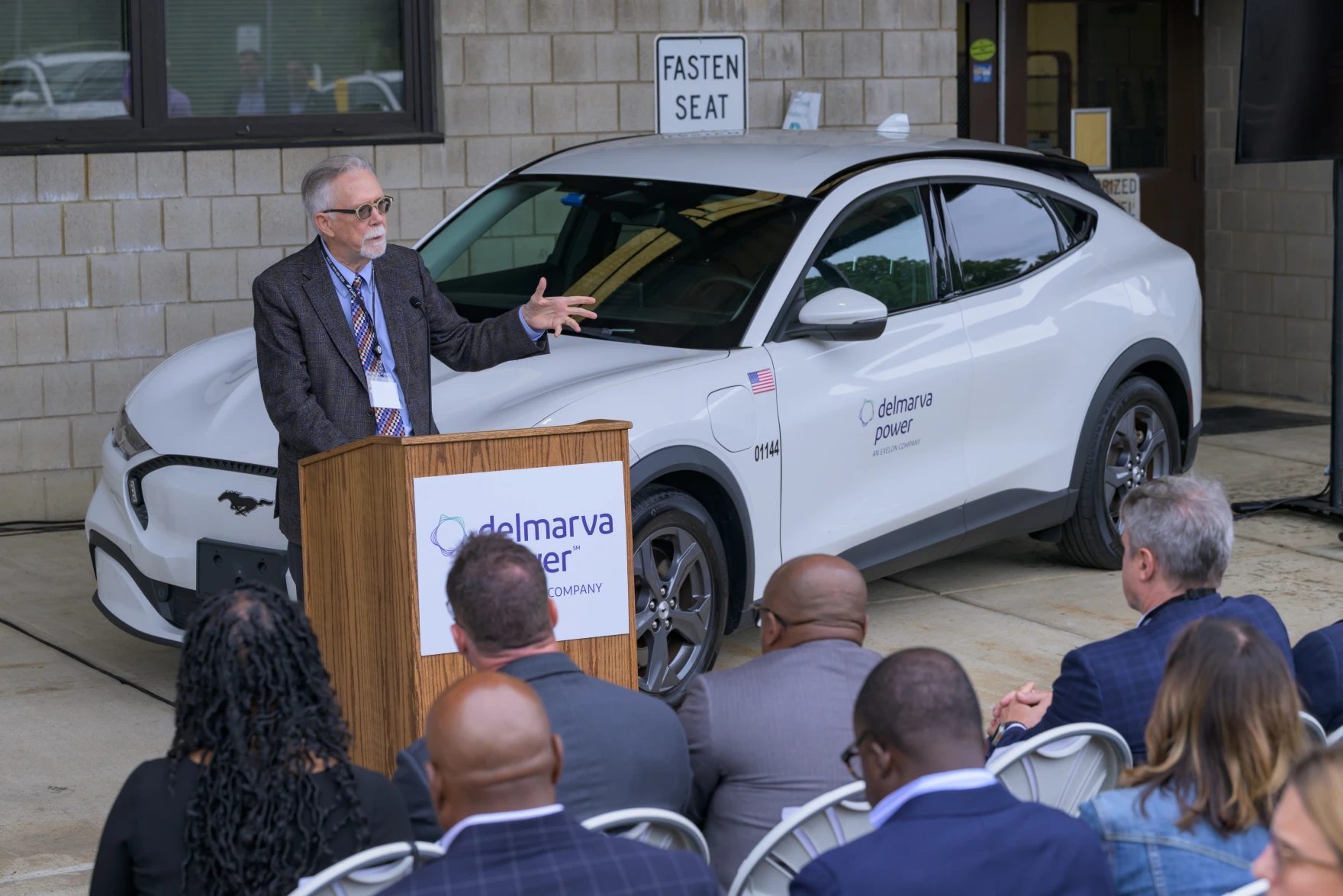
The 63-page report, led by V2G pioneer Willett Kempton and colleagues at UD, documents a year of grid-service operations using four modified Ford Mustang Mach-E vehicles in Delmarva Power’s Delaware fleet. Sponsored by Exelon, the project brought together Ford, Nuvve, Watt & Well, AutoPort, PJM Interconnection, and other partners to test an integrated combination of new technologies, technical standards, and electricity-market rules.
The research is particularly notable for its use of LIN-CP (Local Interconnect Network over Control Pilot), a digital communications protocol defined in SAE J3068 that enables detailed, bidirectional communication between an EV and its charging station. Combined with onboard bidirectional AC power conversion and the SAE J3072 interconnection standard, LIN-CP provides an alternative to ISO 15118-20 for enabling AC V2G, with the potential to reduce communications hardware costs and implementation complexity. Approaches combining bidirectional AC and this new communications standard could also offer substantial cost advantages over DC bidirectional charging architectures that require a separate, off-board grid-interactive inverter.
The researchers sought to answer a question increasingly important to the V2G industry: Can electric vehicles equipped with commercially scalable technologies provide reliable, high-value grid services without expensive charging equipment or significant impacts on battery health?
Their findings suggest that the answer is yes, although important questions remain about production-scale costs, commercial market access, and widespread deployment.
A Different Approach to V2G: Onboard AC Charging and LIN-CP
V2G News has previously explored the technical and economic differences between AC and DC bidirectional charging, including a detailed assessment in Highway to Scale: Why the AC/DC Debate is Slowing Down V2G. All commercially available bidirectional charging systems in the U.S. today, with the exception of Tesla’s Cybertruck PowerShare system, use DC power transfer between the vehicle battery and an external grid-interactive inverter located in the charging station or associated equipment. By contrast, AC bidirectional charging places the inverter functions onboard the vehicle, allowing it to deliver grid-compatible AC power through the charging connection.
This approach has potentially important economic advantages. Onboard inverter capabilities can leverage power electronics manufactured at automotive scale, while the external charging station primarily provides connection, protection, metering, and communications. The researchers argue that eliminating the need for an expensive off-board inverter could substantially reduce the incremental cost of enabling V2G.
To test this architecture, UD designed a retrofit for four production Ford Mustang Mach-E vehicles using Watt & Well bidirectional power converters. The modified vehicles supported three-phase AC charging and discharging at up to 33 kW, limited by the vehicle connector, although the power-conversion and charging equipment could support bidirectional 50 kW power levels. Nuvve supplied the charging stations and aggregation platform used to coordinate the vehicles’ grid services for a utility tariff and an RTO market. The University of Delaware project demonstrated this architecture using higher-power, three-phase AC charging suited to commercial fleets, while the underlying approach could also support lower-power, single-phase residential applications.
The more significant innovation may be how the vehicles communicated with their charging stations.
In conventional AC charging, the control pilot is a signaling circuit that allows the vehicle and charger to establish a safe electrical connection and communicate basic charging information. Traditional SAE J1772 signaling relies primarily on pulse-width modulation (PWM), a simple electrical signal that communicates information such as the current available for charging. This works well for one-way charging but provides limited information for the more complex demands of bidirectional operation.
LIN-CP builds substantially greater functionality onto this existing control-pilot pathway. Rather than relying solely on a simple analog signal, the protocol uses digital communication to exchange structured messages between the vehicle and electric vehicle supply equipment (EVSE). Because it uses the existing control-pilot conductors, it does not require a separate high-bandwidth communications connection between the vehicle and charging station.
The protocol supports several capabilities especially important for V2G:
- Dynamic operating limits: The EV can report its available charging and discharging power as battery conditions, temperature, and operating constraints change.
- Grid-interconnection compliance: The vehicle and EVSE can exchange information needed to verify the vehicle’s onboard inverter certification and authorized operating modes.
- Bidirectional control: The EVSE can request charging, discharging, reactive power, or changes in operating mode, subject to vehicle and system constraints.
- Battery monitoring: Information such as battery energy, temperature, state of health, and available capacity can be communicated to the charging station and aggregator.
- Energy management: Commands support operating modes including V2G, vehicle-to-load, home backup power, and sleep states that reduce standby consumption.
These capabilities are particularly important when EVs are aggregated into virtual power plants (VPPs), where each vehicle’s available capacity may change continuously.
How LIN-CP Fits into the Standards Framework
LIN-CP is defined under SAE J3068, originally developed to support higher-power three-phase AC charging. The report demonstrates how this communication protocol works in conjunction with SAE J3072, which establishes requirements for safely interconnecting EVs equipped with onboard grid-interactive inverter functions. Under this framework, the vehicle’s inverter must meet applicable grid requirements, including IEEE 1547-2018, while the charging station verifies the vehicle’s certification and authorizes grid-parallel operation. If the station meets UL 1741 Supplement SC, it can detect and disconnect an EV that doesn’t meet these grid requirements. The researchers also note that LIN-CP is incorporated by reference into the SAE J3400 and J1772 standards framework, extending its potential application beyond three-phase charging.
This division of responsibilities is particularly important for interoperability. With the grid-interactive inverter functions residing in the vehicle, the fixed charging station serves as the utility-approved point of interconnection. SAE J3072 provides a framework for verifying that a connected vehicle meets applicable requirements before permitting it to discharge in parallel with the grid. This could allow different certified EVs to use compatible charging stations without requiring separate utility interconnection reviews for each vehicle. Delaware law and Maryland regulations already recognize this approach, and the UD project successfully interconnected its AC V2G systems under Delaware’s existing framework. The researchers recommend that other states adopt similar provisions to streamline interconnection and support broader deployment.
LIN-CP also offers a different approach to vehicle-charger communications than ISO 15118-20. While ISO 15118-20 uses higher-bandwidth power-line communication, LIN-CP transmits lower-data-rate digital messages over the existing control-pilot circuit using simpler, less expensive LIN communications hardware already familiar to automakers and Tier 1 suppliers. The UD researchers argue that this approach can provide the detailed controls and operating data required for sophisticated V2G services while potentially reducing implementation costs, hardware complexity, and cybersecurity exposure. However, the study did not directly compare the two protocols in terms of cost, reliability, or cybersecurity performance.
The significance of LIN-CP is not that it replaces ISO 15118-20, but that it offers another standards-based pathway to interoperable AC bidirectional charging. By demonstrating its use in actual grid-service operations, the UD-Exelon research provides evidence that a relatively simple communications architecture can be interconnected and support the sophisticated controls required for V2G participation at low cost.
Putting the Technology to Work: A Year of Grid Services
The project went beyond laboratory validation by operating four modified fleet Mach-Es at Delmarva Power’s New Castle Regional Office during 2025. Each vehicle connected through a Nuvve AC bidirectional charging station equipped with revenue-grade metering, while Nuvve’s aggregation platform coordinated charging and discharging. The researchers evaluated six potential grid services and tested two on these EVs: PJM frequency regulation under current PJM market rules and time-of-use (TOU) energy arbitrage under Delmarva Power’s retail rates.
For frequency regulation, which helps grid operators continuously balance electricity supply and demand, the four vehicles operated as a single virtual power plant (VPP). The aggregator distributed dispatch requests across the vehicles, directing them to absorb or discharge electricity as needed. Through LIN-CP, each EV reported its available charging and discharging capacity, allowing the aggregator to adjust individual contributions while maintaining the performance of the combined resource.
The results demonstrated an exceptionally fast and accurate response. The researchers measured an average delay of just 1.5 seconds between a dispatch request arriving at the charging station and the corresponding change in metered power, compared with response times of 30–60 seconds for conventional combustion turbines cited in the report. The four-vehicle aggregation successfully met a 100 kW dispatch target despite variations in individual vehicle capabilities.
These findings illustrate how VPP operators can manage the variability inherent in mobile energy resources. As vehicles unplug, battery conditions change, or equipment becomes temporarily unavailable, the aggregator can redistribute dispatch requests among connected EVs. This flexibility is essential to providing reliable grid services at scale.
For TOU arbitrage, vehicles charged during lower-priced periods and discharged when electricity prices were higher, transferring approximately 36 kWh per vehicle during a typical weekday cycle. The researchers also demonstrated that vehicles could switch between regulation and TOU arbitrage remotely through the aggregation platform within minutes, without changes to equipment or on-site intervention.
Importantly, because PJM’s market rules for aggregated distributed energy resources were not yet in effect, the regulation test operated under a special pilot arrangement using recorded historical dispatch signals rather than live wholesale-market participation. The vehicles physically charged and discharged in response to these signals, demonstrating their ability to provide regulation services, but received no PJM market payments.
Performance, Battery Health, and the Economics of V2G
Beyond communications and dispatch, the UD report provides important insights into system efficiency, battery health, and the economics of V2G. Researchers measured converter efficiencies reaching 96% during discharging and 92% during charging, using an assumed 90% round-trip efficiency, including battery losses, for their economic analysis. Efficiency fell sharply at low power levels, suggesting that VPP aggregators could reduce losses by concentrating dispatch among fewer vehicles operating at higher power while placing others in low-power sleep modes. LIN-CP supports this approach, although it was not tested in the pilot.
Battery performance was equally encouraging. Despite substantial energy throughput from regulation services, several times the energy required for typical annual driving, the four vehicles showed no measurable decline in manufacturer-reported battery state of health. The researchers also demonstrated an improved dispatch algorithm that maintained battery charge near a target level, reducing time spent at extreme states of charge. While the small sample and reliance on imperfect onboard battery-health estimates limit broader conclusions, the findings reinforce the importance and practicality of intelligent dispatch in managing battery degradation.
Perhaps most consequential are the potential revenues. Using measured operating performance, Delmarva Power retail rates, and historical PJM regulation prices from 2021–2025, the researchers estimated annual grid-service value under representative fleet-driving assumptions:
| Vehicle power capability | PJM regulation annual value* | TOU arbitrage annual savings* |
|---|---|---|
| 10 kW passenger EV | $1,102–$3,359 | $873 |
| 33 kW fleet EV (29 kW dispatched) | $3,195–$9,741 | $1,048 |
*Modeled annual estimates assume vehicles are unavailable for grid services 40 hours per week. Values account for energy losses but exclude aggregator fees, customer support, and battery degradation costs. Due to the pilot project status, actual PJM regulation service value was not paid. From: Kempton et al 2026, Tables 7.1 and 7.2.
The findings highlight the potentially substantial value of higher-power AC V2G, particularly for commercial fleets. However, regulation is a relatively small market, and revenues could decline as additional resources participate. The researchers also cite a separate estimate suggesting that mass-produced AC bidirectional charging equipment could add as little as $20/kW, or $200 for a 10 kW system, compared with conventional AC charging. This is a projected incremental manufacturing cost, not a demonstrated installed cost.
Together, these findings suggest that high-value grid services could justify the modest incremental manufacturing cost of AC bidirectional charging, particularly when the capability is integrated into vehicles at production scale. The larger commercial challenge is translating this technical potential into accessible grid-service markets and viable customer economics.
What the Findings Mean for the V2G Industry
The significance of the UD research extends beyond the performance of four modified vehicles. It demonstrates how vehicle design, communications, interconnection standards, utility tariffs, and aggregation software must work together to make V2G commercially viable.
Several findings stand out.
First, AC bidirectional charging offers a potentially lower-cost alternative to today’s predominantly DC-based commercial systems. By placing grid-interactive conversion equipment onboard the vehicle and using comparatively simple AC charging infrastructure, the architecture could substantially reduce the cost of deploying V2G. Realizing this opportunity will require automakers to incorporate bidirectional inverters and compatible communications into production vehicles.
Second, LIN-CP provides a practical standards-based approach to the communications requirements of V2G. TThe protocol demonstrated the ability to exchange detailed operating information, support grid-interconnection functions, and enable sophisticated VPP control without relying on higher-bandwidth vehicle-to-charger communications. This could provide manufacturers with another pathway toward interoperable AC bidirectional charging. Although not part of the pilot, LIN-CP also provides standard and low-cost signaling to switch among charging, V2G, V2Load, and home backup power.
Third, the quality of V2G control matters as much as the amount of available battery capacity. The project’s rapid regulation response, dynamic management of individual EV limits, and ability to coordinate multiple vehicles illustrate the importance of effective aggregation software. VPPs must account for driving needs, equipment availability, battery conditions, and system efficiency rather than treating every connected EV as a fixed-capacity battery.
Fourth, interconnection and market-access rules remain critical barriers. The project encountered utility interconnection procedures designed primarily for solar generation rather than mobile battery systems, creating unnecessary complexity and delays. The researchers recommend streamlined interconnection for certified V2G equipment, broader state recognition of SAE standards and UL 1741 SC, and tariffs that appropriately credit electricity exported from EV batteries.
Finally, the challenge is moving from technical demonstrations to scalable commercial deployment. The researchers deliberately combined technologies, standards, and market rules intended to enable low-cost equipment and high-value grid services. Yet the project still required custom vehicle retrofits, substantial engineering support, and a special PJM pilot arrangement. Replicating these results commercially will require factory-equipped vehicles, production charging equipment, and routine pathways for interconnection and market participation.
The V2G industry is rapidly expanding its portfolio of compatible EVs and charging products. The University of Delaware research points toward a complementary priority: establishing scalable architectures that combine low-cost equipment, reliable communications, standards-based interconnection, and access to valuable grid-service markets.
The report’s most important contribution may be demonstrating that these technologies, standards, and market mechanisms can work together as an integrated system. While LIN-CP and onboard AC bidirectional charging have yet to be proven at mass-market scale, the research provides a strong technical and operational foundation for making V2G more accessible and affordable, potentially at substantially lower cost than today’s predominantly DC-based commercial offerings.
The report is open-access, available from the University of Delaware at: https://bit.ly/4vB3w6u.
Acknowledgment: The author would like to thank Willett Kempton for his thoughtful review and comments on an earlier draft of this article. Any remaining errors or omissions are the sole responsibility of the author.
