This edition of V2G News looks at a simple but critical question: are we paying distributed resources for signing up—or for performing?
Our latest 2026 Policy Series article explores VPPs as a pathway to V2G at scale, while our review of GridLab’s Unlocking California’s Flexible Load report highlights the shortcomings of programs that rewarded enrollment or nominated capacity without equivalent grid response. The durable model is performance-based: pay for verified value delivered. As we write in the VPP article, “The VPP may not simply be another application for V2G. Designed correctly, it could provide the market architecture that finally allows V2G to scale.”
And, as always, we cover the latest developments in bidirectional charging, including the expanding availability of bidirectional vehicles and charging systems and other developments from across the globe..

V2G Insights
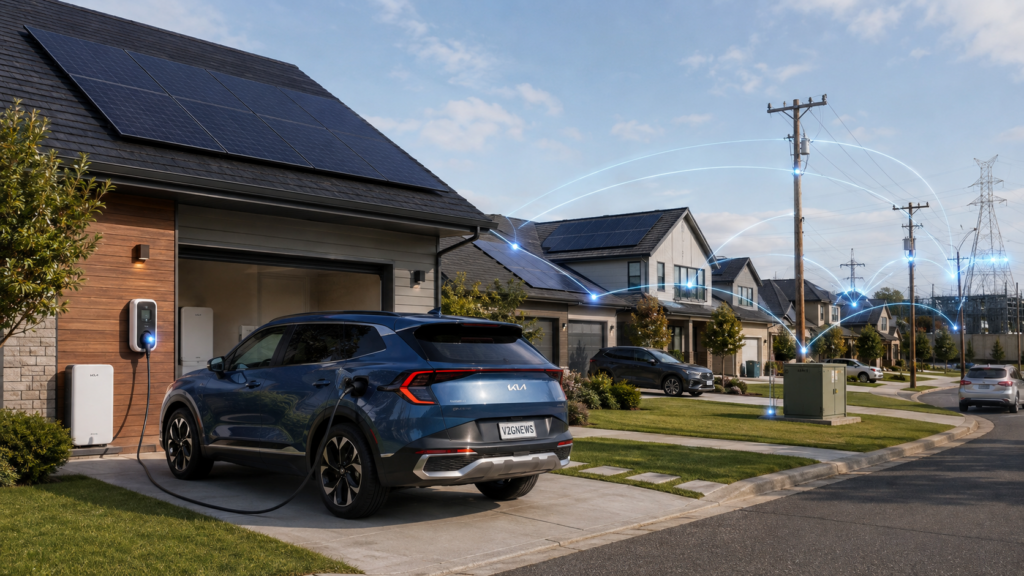
The VPP Pathway: How Virtual Power Plants Could Take V2G to Scale
September 1, 2026
This article is the fourth in the V2G News 2026 Policy Series examining the structural barriers that continue to slow the transition of vehicle-to-grid from pilots to scalable market offerings. The first installment focused on enabling grid exports from EVs. The second examined why long-term, predictable revenue streams are essential to moving V2G beyond demonstration projects. The third looked at the compensation mechanisms that can reward EV owners, fleets and aggregators for the capacity, energy, flexibility and grid services they provide. This fourth installment considers where those services might actually be brought to market: through the rapidly expanding world of virtual power plants.
For years, vehicle-to-grid has largely been treated as its own category of emerging technology. Utilities launch V2G pilots. States investigate V2G tariffs. Automakers demonstrate that EV batteries can discharge to the grid. Each effort moves the industry forward, but the result has often been a collection of one-off programs rather than a repeatable pathway to market.
What if V2G does not need a market of its own?
Across the United States, states, regulators and utilities are rapidly building another market framework designed specifically to aggregate thousands of small, customer-owned energy resources and pay them for providing grid services. It is called the virtual power plant, and it may provide one of the clearest pathways yet for taking V2G from pilots to scale.
V2G Intelligence
California Flexible Load Blueprint Sees Major Role for V2G
September 1, 2026
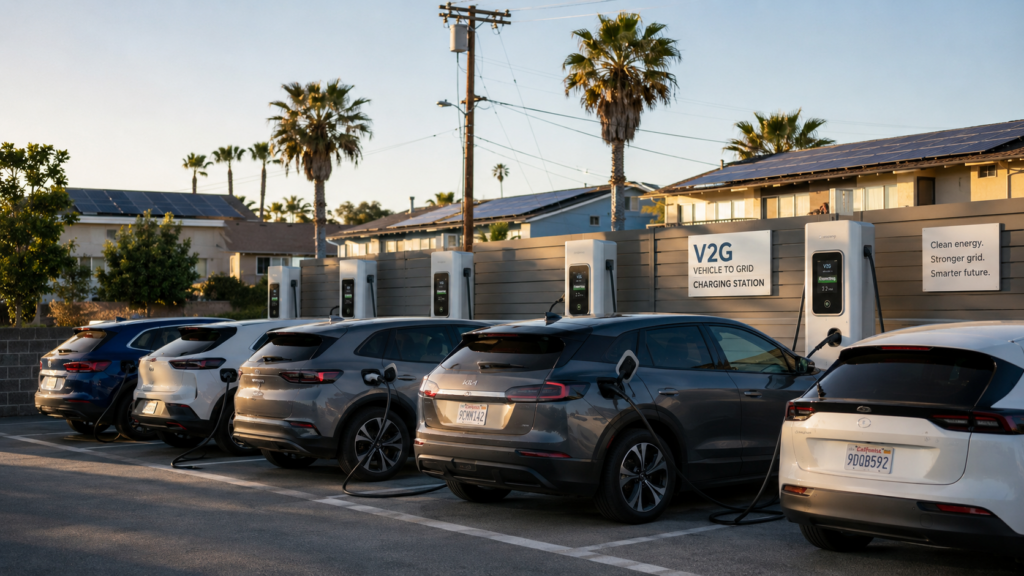
A new California report titled Unlocking California’s Flexible Load: A Durable Blueprint for Affordability and Reliability, authored by Eric Cutter of Energy and Environmental Economics (E3), Pete Skala of Kevala, and Ric O’Connell of GridLab, concludes that electric vehicles could become one of the state’s largest sources of flexible grid capacity, with vehicle-to-grid resources potentially supplying a meaningful share of California’s future storage needs. But the authors argue that realizing this opportunity will require a shift away from fragmented demand-response programs toward standardized, performance-based pathways that compensate EVs and other flexible resources for verified grid value.
The report was prepared in part by E3 for GridLab. It does not identify a separate external funding source for the overall study. The UC Davis Energy and Efficiency Institute convened and facilitated stakeholder roundtables during the year leading up to publication, helping inform the report’s recommendations. Reviewers included representatives from PG&E, Southern California Edison, San Diego Gas & Electric, CAISO, SMUD, CalCCA, Recurve, Olivine, UC Davis and others.
The authors emphasize that the report is separate from E3’s work for the California Public Utilities Commission and that the CPUC did not participate in or endorse the analysis.
V2G Finds—US
PG&E Expands V2X Program to More Bidirectional EV Models
PG&E has expanded eligibility for its California vehicle-to-everything program to include additional bidirectional-capable EVs from GM, Kia, Nissan, Volvo and Polestar. The expansion opens the program to models including the new Chevrolet Bolt EV, Kia EV9 and Volvo EX90, allowing more customers to use their EV batteries for home backup, energy cost savings and grid support.
8/24/2026
California Opens Public EV Charging Test Center With V2G and V2H R&D
Cal EPIC has opened its 33,000-square-foot Innovation Hub in Sacramento, including what it says is California’s first public EV charging testing center. Backed by a $4 million California Energy Commission grant, the Capital Charge Yard will bring automakers, charging providers, utilities, and technology companies together to test charger reliability and interoperability. The facility will also support research and development of vehicle-to-grid and vehicle-to-home technologies, providing another venue for addressing the technical integration challenges that must be resolved as bidirectional charging moves toward broader deployment.
8/27/2926
Dcbel Expands Bidirectional Charging Reach Through Massachusetts and California Pilots
Dcbel’s Ara Home Energy Station has been selected for bidirectional charging pilots in Massachusetts and California that could provide EV owners with equipment incentives, energy savings and new revenue opportunities. Participants in California’s REDWDS pilot may earn up to $3,200 per vehicle annually for exporting power to the grid, while Massachusetts’ MassCEC V2X demonstration will cover the cost of qualifying bidirectional charging systems and test how EVs can support homes and the grid. The programs also highlight the growing importance of interconnection rules and standards as V2G moves from limited demonstrations toward broader deployment.
8/26/2026
V2G Finds—Global
German Renewable Energy Reform Could Undercut Bidirectional Charging
Germany’s auto and energy industries are warning that proposed changes to the country’s renewable energy rules could unintentionally restrict exports from EV batteries. A planned 50% cap on power fed through certain residential grid connections is intended to limit midday solar exports and encourage storage, but industry groups argue the draft could also constrain bidirectional EV charging even when grid capacity is available. Volkswagen subsidiary Elli and industry association VDA say the provision could weaken the economics of V2G and reduce its appeal to consumers.
8/25/2026
Hyundai Ioniq 3 Brings V2X Capability to a More Affordable EV Segment
Hyundai’s upcoming Ioniq 3 could bring bidirectional capability to a more affordable and practical small-EV segment. UK specifications point to a 61 kWh battery, up to 483 km of WLTP range, and available V2L and V2X functionality, with Australian pricing potentially landing below A$40,000. While Hyundai currently has no plans to offer the Ioniq 3 in North America, the model illustrates how bidirectional features are beginning to move beyond premium EVs and larger trucks and SUVs into smaller, more affordable vehicles.
8/18/2026
Electrive: V2G Still Faces a Gap Between Promise and Scale
A new electrive analysis argues that bidirectional charging is moving closer to commercialization in Europe, but scalable deployment remains constrained by fragmented standards, proprietary technology stacks, inconsistent grid integration, and limited business models. The article highlights BMW, Volkswagen, Elli, Moon, Ambibox, EcoG, The Mobility House and IEA Task 53, with particular emphasis on the need for multiparty interoperability across vehicles, chargers, aggregators and grid systems. It also notes that predictable fleet use cases may reach commercial viability sooner than mass-market residential V2G.
8/19/2026
China V2G Campaign Discharges 19 MWh During Evening Peak
State Grid Changzhou Power Supply Company coordinated a large-scale dispatch of flexible resources during a period of record summer demand, including a dedicated V2G campaign involving 13 public V2G stations, eight bidirectional battery-swapping stations and 208 new-energy vehicles. The vehicles discharged a combined 19,000 kWh during the evening peak, supported by a government incentive of RMB 3 per kWh based on actual reverse discharge. The broader exercise also dispatched 17 virtual power plants with 164.4 MW of declared adjustable capacity and achieved a maximum actual response of 214.8 MW.
8/19/2024
Hyundai and Kaluza Build Smart-Charging Platform Ahead of 2027 V2G Launch
Hyundai Motor Group and Kaluza are partnering to integrate smart charging directly into the Kia and myHyundai apps, beginning in the UK and later expanding to Australia and other markets. The initial rollout will let drivers optimize charging around vehicle needs, electricity prices and renewable-energy availability, while the companies say the same platform will support V2G services planned from 2027. The partnership is notable for linking today’s managed-charging capabilities with a clear pathway toward bidirectional participation, potentially allowing Hyundai and Kia customers to move from flexible load to grid-interactive storage through the same digital ecosystem.
8/20/2026

