September 1, 2026
A new California report titled Unlocking California’s Flexible Load: A Durable Blueprint for Affordability and Reliability, authored by Eric Cutter of Energy and Environmental Economics (E3), Pete Skala of Kevala, and Ric O’Connell of GridLab, concludes that electric vehicles could become one of the state’s largest sources of flexible grid capacity, with vehicle-to-grid resources potentially supplying a meaningful share of California’s future storage needs. But the authors argue that realizing this opportunity will require a shift away from fragmented demand-response programs toward standardized, performance-based pathways that compensate EVs and other flexible resources for verified grid value.
The report was prepared in part by E3 for GridLab. It does not identify a separate external funding source for the overall study. The UC Davis Energy and Efficiency Institute convened and facilitated stakeholder roundtables during the year leading up to publication, helping inform the report’s recommendations. Reviewers included representatives from PG&E, Southern California Edison, San Diego Gas & Electric, CAISO, SMUD, CalCCA, Recurve, Olivine, UC Davis and others.
The authors emphasize that the report is separate from E3’s work for the California Public Utilities Commission and that the CPUC did not participate in or endorse the analysis.
What Did the Study Seek to Understand?
The report examines how California can use a rapidly expanding base of flexible electric loads—including EVs, distributed batteries, smart appliances and electrified buildings—to improve reliability while containing electricity costs. The central concern is affordability: whether these resources can reduce the need for new generation, storage and grid infrastructure, and how programs should be designed so that the value they create exceeds what ratepayers spend to obtain it.
EVs figure prominently because their numbers are growing rapidly. The report cites the California Energy Commission’s projection of 8.4 million light-duty EVs by 2035 and argues that unmanaged charging could increase infrastructure needs, while managed and bidirectional charging could help flatten demand and provide grid capacity.
How Was the Analysis Conducted?
Rather than conducting a new demonstration or field trial, the report synthesizes existing California planning studies, utility analyses and program-performance data. It draws on CEC and CPUC forecasts, CAISO demand-response results, the three investor-owned utilities’ Electrification Impact Studies, utility program evaluations, and prior GridLab-sponsored modeling by Brattle and Kevala. The work was also informed by stakeholder roundtables convened over the prior year by the UC Davis Energy and Efficiency Institute.
A central part of the analysis is comparing broad estimates of technical potential with more granular evidence of achievable grid value. Brattle previously estimated 7,671 MW of statewide VPP potential by 2035, while updated Kevala analysis estimated that an additional 3.5 GW of load flexibility could avoid $6.7 billion to $9.9 billion in distribution upgrades. The report cautions, however, that these are directional estimates and that actual value depends heavily on location, timing, customer participation and implementation costs.
The authors also review actual program performance. Appendix B compiles results from more than 30 California programs spanning storage, EV rates, demand response, smart devices and emergency load reduction. That review, together with CAISO performance data, supports the report’s broader argument that enrolled or nominated capacity should not be treated as equivalent to verified grid performance.
The V2G Finding That Stands Out
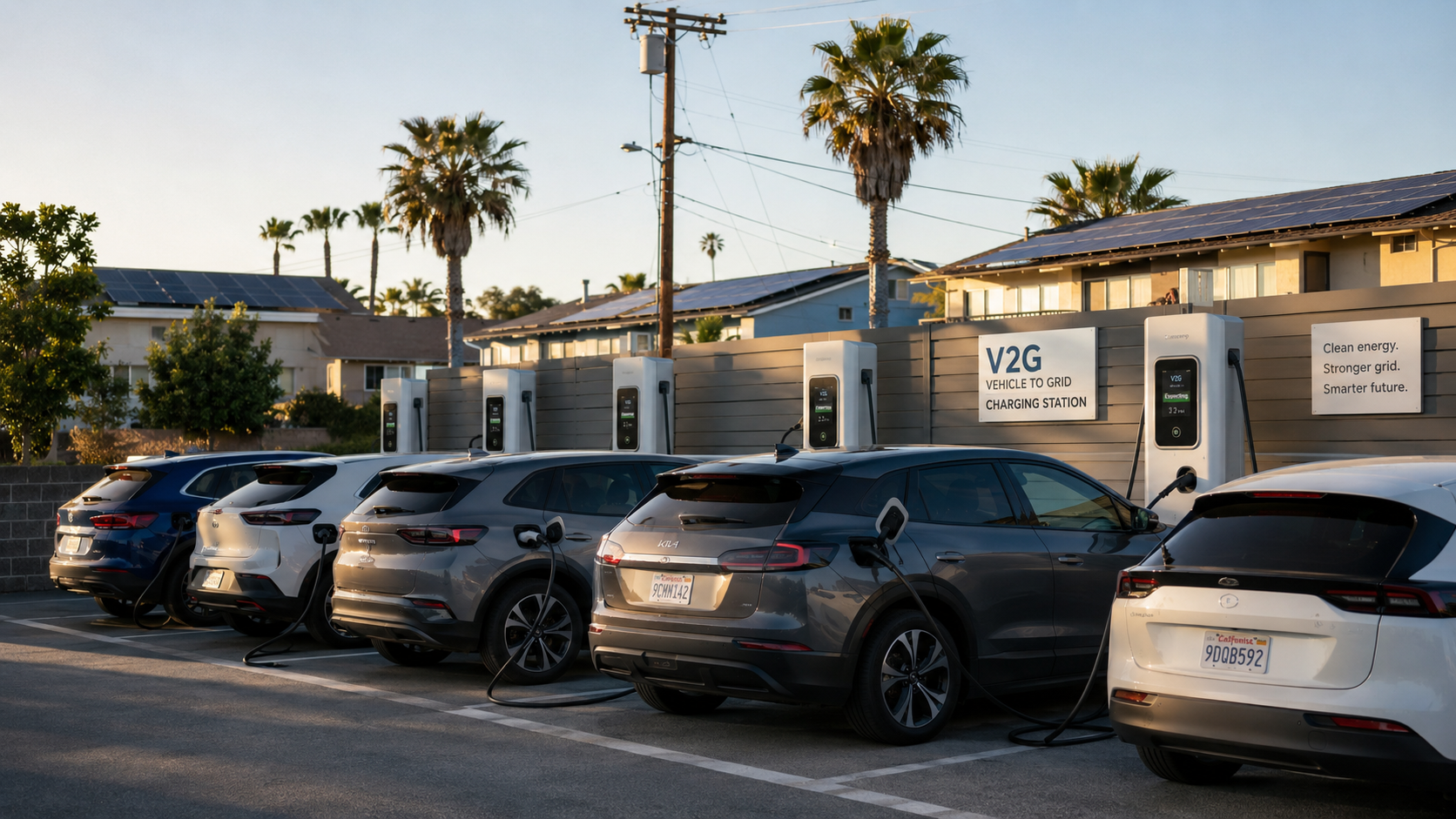
The report’s most striking V2G finding is the potential scale of California’s future EV fleet as a grid resource. The authors estimate that if just 10% of the 9.7 million light-duty EVs projected for 2036 were capable of providing V2G, they could supply roughly 30% of California’s cumulative utility-scale storage procurement target for that year, assuming those resources can be accredited and operated on terms comparable to grid-scale storage.
The chart on page 5 reinforces that point by comparing planned utility-scale storage procurement with projected installed power capability from behind-the-meter storage and EVs. The authors do not argue that all of this vehicle capacity will be available to the grid, or that EVs will replace stationary storage. Their point is that the resource is large enough that flexible EVs could compete with utility-scale storage for some services, particularly resource adequacy and load shifting.
Performance, Not Enrollment
One of the report’s strongest themes is that flexible load should be compensated for what it actually delivers. The authors criticize programs that rely too heavily on enrollment, availability or nominated capacity without sufficiently verifying performance. They cite CAISO data showing that non-utility third-party demand-response resources delivered load reductions averaging only 54% of scheduled curtailments during high-load conditions in 2024.
For V2G, direct measurement may offer an advantage over some traditional demand-response resources. The report notes that directly metered resources such as battery storage and EV discharge can support settlement without relying on counterfactual load baselines, provided the retail rates paid and received appropriately reflect avoided costs. An EV exporting measured energy therefore presents a different measurement challenge from a thermostat or other load-reduction resource whose performance must be estimated against what the customer otherwise would have consumed.
Three Pathways for Flexible EVs
For bulk-system value, the report proposes three complementary participation pathways. Retail pay-for-performance would compensate customers for verified, as-available flexibility without requiring a firm capacity commitment. Firm-capacity programs would provide a pathway for flexible loads that can make more dependable commitments and contribute to Resource Adequacy or other planning needs. Direct CAISO market participation would remain available for larger or more sophisticated resources that can meet wholesale-market registration, telemetry, settlement and compliance requirements.
The authors do not view wholesale participation as the default path for mass-market flexible loads. Instead, they argue for retail and planning-based pathways that can capture much of the same value without forcing aggregations of small behind-the-meter resources into rules designed around conventional generators. For V2G, that could create multiple levels of participation ranging from as-available residential dispatch to more dependable aggregated capacity.
What It Means for the V2G Industry
For the V2G industry, the report’s importance is less about a single forecast than about how it frames the resource. V2G is treated as a potential capacity and storage resource that should be evaluated against the grid value it can reliably provide, including the cost of alternative resources such as utility-scale storage.
That framework creates opportunity, but also a higher bar. V2G developers will need to demonstrate dependable performance, and distribution value cannot simply be assumed across an entire service territory. The report emphasizes that avoided distribution costs are highly locational: flexible resources create meaningful infrastructure savings only when they are connected at constrained locations and dispatched during the hours driving the need for upgrades.
Finally, the report argues that scale will require simpler and more standardized participation pathways. Common approaches to enrollment, measurement, dispatch and settlement, supported by interoperable communications, could reduce the cost and complexity of aggregating large numbers of customer resources across utility territories.
The larger takeaway is that California may already be deploying an enormous future storage resource in the form of EV batteries. The policy challenge is not merely to demonstrate that those batteries can send power back to the grid, but to create durable market structures that can turn a portion of that mobile capacity into a measurable, reliable and cost-effective grid resource.
