September 1, 2026
This article is the fourth in the V2G News 2026 Policy Series examining the structural barriers that continue to slow the transition of vehicle-to-grid from pilots to scalable market offerings. The first installment focused on enabling grid exports from EVs. The second examined why long-term, predictable revenue streams are essential to moving V2G beyond demonstration projects. The third looked at the compensation mechanisms that can reward EV owners, fleets and aggregators for the capacity, energy, flexibility and grid services they provide. This fourth installment considers where those services might actually be brought to market: through the rapidly expanding world of virtual power plants.
For years, vehicle-to-grid has largely been treated as its own category of emerging technology. Utilities launch V2G pilots. States investigate V2G tariffs. Automakers demonstrate that EV batteries can discharge to the grid. Each effort moves the industry forward, but the result has often been a collection of one-off programs rather than a repeatable pathway to market.
What if V2G does not need a market of its own?
Across the United States, states, regulators and utilities are rapidly building another market framework designed specifically to aggregate thousands of small, customer-owned energy resources and pay them for providing grid services. It is called the virtual power plant, and it may provide one of the clearest pathways yet for taking V2G from pilots to scale.
What Is a Virtual Power Plant?
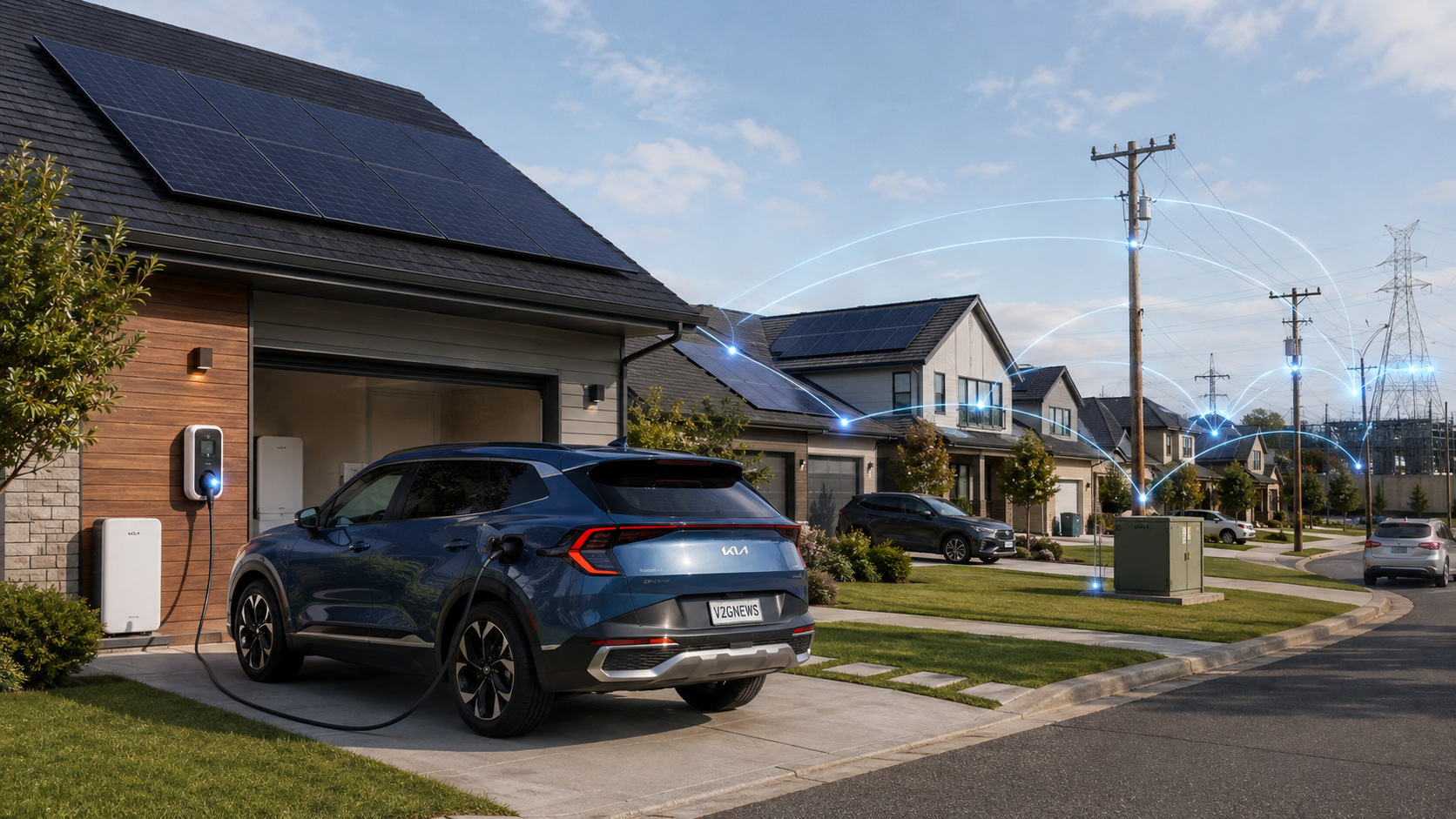
A virtual power plant, or VPP, is an aggregation of distributed energy resources that can be coordinated to behave like a larger grid resource. Those resources can include stationary batteries, rooftop solar, smart thermostats, water heaters, heat pumps, commercial loads and electric vehicles.
The U.S. Department of Energy defines VPPs broadly as aggregations of distributed energy resources that can balance electricity supply and demand and provide utility-scale grid services similar to a conventional power plant. Importantly for V2G, DOE has explicitly included EVs and EV chargers within that vision.
The individual resource may be small. A home battery might provide only a few kilowatts. A bidirectional EV might provide 10 or 20 kW when plugged in. But an aggregator coordinating thousands of devices can assemble megawatts of dispatchable capacity.
That aggregation solves one of V2G’s fundamental commercialization challenges. Utilities and grid operators do not need to manage thousands of individual EVs. They can interact with an aggregator that enrolls customers, manages charging and discharging, protects driver mobility requirements, measures performance and delivers a predictable grid resource.
In other words, the VPP provides the market wrapper around the individual EV.
VPP Policy Is Moving Quickly
This is no longer a niche policy concept.
The Clean Energy States Alliance’s VPP tracker, updated in August 2026, identifies 82 battery-based VPP programs across 30 states plus the District of Columbia, Puerto Rico and the U.S. Virgin Islands. Battery owners in more than half of U.S. states now have some opportunity to participate in a VPP and receive compensation for providing grid services.
The pace of policymaking is also accelerating. SEPA and the North Carolina Clean Energy Technology Center tracked 105 state and investor-owned utility actions across 37 states and Washington, D.C., in 2024. During the first quarter of 2026 alone, VPP and supporting DER activity occurred in more than two dozen states. Illinois enacted VPP legislation, Massachusetts established a 3.5-GW target for new load-management strategies including VPPs, and other states advanced storage, managed charging and DER aggregation initiatives.
The activity continued in the second quarter. Hawaii opened a proceeding to develop a VPP grid-services program. Illinois regulators approved scheduled-dispatch VPP tariffs. Maryland continued implementing a broad VPP framework. Virginia enacted multiple laws addressing VPPs, DER aggregation, planning and non-wires alternatives.
The significance for V2G is not simply that there are more VPP programs. It is how many of these frameworks are being designed around services rather than a single technology.
Build the Market Around the Service, Not the Battery
The conventional V2G approach starts with the technology: identify bidirectional vehicles, develop a V2G pilot and determine what those vehicles can do. A technology-agnostic VPP turns that sequence around by starting with the grid need instead. A utility might need peak capacity, distribution relief, resource adequacy or emergency demand reduction, and then establish the performance requirements and compensation available to any qualifying distributed resource.
Under that model, an EV does not necessarily need a special category simply because its battery happens to have wheels. If a plugged-in vehicle can reliably provide 10 kW during a peak event, meet interconnection requirements, respond to dispatch instructions and satisfy measurement and verification requirements, the relevant question becomes: Why should it be treated differently from another distributed battery providing the same service?
Colorado offers one of the clearest examples of this approach. Legislation enacted in 2024 required a qualifying utility to establish a VPP program with performance-based compensation and expressly included electric vehicles in the definition of distributed energy resources, alongside storage, distributed generation, microgrids and demand flexibility. The law also provides for DER aggregators, performance-based tariffs and compensation for distinct energy, capacity and grid services without paying twice for the same service.
Colorado regulators subsequently approved Xcel Energy’s Aggregator Virtual Power Plant program, targeted to reach 125 MW over five years. The eligible resource mix includes batteries, thermostats, water heaters, heat pumps and EV chargers. The significance is not that EVs dominate the program today, but that EV flexibility is being incorporated into a broader distributed-resource market rather than isolated in a V2G-only pilot.
That is the kind of market structure that could allow V2G to scale.
That performance-based structure matters. As discussed in the review article in this edition of V2G News of GridLab’s Unlocking California’s Flexible Load report, California’s experience shows the risk of paying distributed resources for enrollment or nominated capacity without obtaining an equivalent amount of measurable grid response. The report argues that flexible resources should instead be compensated for verified performance, with payments anchored to the grid costs they actually avoid. For V2G, that principle could be especially important because directly metered EV discharge can provide a clear record of the energy delivered to the grid.
Maryland Goes Further
Maryland provides an even more explicit bridge between VPP policy and bidirectional charging.
The state’s DRIVE Act requires utilities to propose programs that compensate customers and third-party aggregators for using distributed resources to provide distribution grid services. The Maryland Public Service Commission specifically identifies battery storage and bidirectional EV charging as resources capable of reducing demand or injecting power into the grid.
Maryland has also addressed another essential piece of the puzzle: interconnection. State rules establish a pathway for grid-connected V2G systems and direct utilities to treat them as energy storage for purposes of evaluating electrical performance, while recognizing that requirements that cannot reasonably apply to mobile EV batteries should not be imposed on them.
At the same time, the PSC is developing the infrastructure needed for broader VPP participation, including DER data exchange, aggregator access, DER registration and utility DER management systems. Taken together, these policies begin to look less like another V2G demonstration and more like the architecture of an actual market: interconnection + aggregation + dispatch + measurement + compensation.
V2G Can Ride the VPP Wave
Other states are moving in the same direction, even where V2G participation is not yet explicit. New Jersey, for example, is developing a statewide VPP framework built around performance-based compensation for resources that reduce load or inject electricity onto the distribution system. The Board of Public Utilities has also identified V2G as an important part of its emerging VPP strategy, creating a potential pathway for EVs to evolve from managed charging resources into assets capable of providing a broader range of grid services.
Most VPP capacity today does not come from bidirectional EVs. Stationary batteries, thermostats and conventional demand response remain far more established, and not every VPP will be well suited to mobile batteries. Event duration, availability requirements, interconnection rules and compensation structures will all influence whether EVs can participate effectively. But V2G does not need to dominate VPPs for the framework to matter; it simply needs a clear pathway to participate when vehicles can meet the same performance requirements as other distributed resources.
That pathway could also evolve over time. An EV might initially participate as a flexible load through managed charging and later become a dispatchable storage resource as bidirectional equipment becomes more widely available. The same customer relationship, aggregation platform and utility program could potentially support both. That is a more scalable model than creating a separate V2G tariff, enrollment process and market structure everywhere bidirectional vehicles begin to appear.
A VPP Is a Pathway, Not a Guarantee
There is an important caveat to the VPP-as-pathway argument: simply creating a VPP does not guarantee that bidirectional EVs can participate. A program can be described as technology-neutral and still contain interconnection, telemetry, availability, dispatch or compensation requirements that were designed around stationary batteries and are difficult for mobile resources to meet. VPP programs also vary considerably in the services they procure and the value they offer participants, meaning that participation alone does not necessarily create the predictable revenue streams needed to support commercial V2G deployment.
The opportunity, therefore, is not simply to add EVs to existing VPP programs. Policymakers should design VPP frameworks around the grid service being procured while recognizing the operating characteristics of mobile storage. That means allowing reasonable driver overrides, accommodating varying connection times, using fit-for-purpose telemetry and measurement requirements, enabling aggregation, establishing workable interconnection pathways and compensating EVs for the same grid value they provide when compared with other distributed resources.
Viewed this way, the VPP is not a substitute for solving V2G’s remaining policy barriers. It is the market architecture within which those barriers can be solved once, at scale, rather than repeatedly through one-off V2G pilots.
The Market V2G Has Been Waiting For?
The V2G industry has spent years proving that EV batteries can provide grid services. The next challenge is building durable markets that are willing to pay for those services at scale. VPPs may offer that bridge by giving aggregators a structure to combine thousands of customer resources, utilities a way to procure measurable grid performance, and customers a way to receive compensation without having to participate directly in complex electricity markets.
For V2G, that framework could be transformative because it would not require regulators to create an entirely new market around EV batteries. Instead, regulators could establish technology-neutral VPP rules, ensure that bidirectional EVs are eligible wherever they can meet the same performance requirements as other distributed resources, and remove unnecessary barriers related to interconnection, telemetry, aggregation and compensation. In that structure, V2G can compete based on the services it provides rather than on the fact that the battery happens to be in a vehicle.
The path from pilot projects to millions of grid-interactive vehicles may therefore depend less on building a standalone V2G market than on ensuring that EVs can participate in the distributed-energy markets already taking shape around them. If VPP frameworks continue to expand and remain open to bidirectional vehicles, they could provide the market architecture V2G has been waiting for.
The VPP may not simply be another application for V2G. It could be the pathway that finally allows V2G to scale.
