August 4, 2026
A new review article offers a useful reminder for the bidirectional charging industry: technical capability alone will not deliver widespread adoption. Consumer acceptance is changing over time, and the factors that mattered most several years ago are not necessarily the ones that will determine success today.
The article, Evolution of V2G Acceptance: A Review of Influencing Factors Over Time, was written by Albert Caban and Zofia Lukszo of Delft University of Technology (Netherlands) and Geeske Scholz of Bremen University (Germany). It was published by Elsevier in the peer-reviewed journal Energy Reports, Volume 15, in June 2026.
What the Researchers Set Out to Understand
Most prior studies of V2G acceptance provide a snapshot of consumer attitudes at a particular place and time. The authors instead wanted to understand how the relative importance of different adoption factors has evolved between 2017 and 2025, a period marked by rapid EV growth, energy-price volatility, geopolitical disruption, policy change, and increased interest in household energy independence.
Their central question was not simply, “What prevents people from adopting V2G?” It was, “Which barriers and motivations are becoming more important, which remain stubbornly persistent, and which are beginning to fade?” The paper therefore classifies acceptance factors as emerging, persistent, or diminishing.
Methods Used
The authors conducted a structured literature review using Web of Science, Scopus, and Dimensions. Their search covered V2G, V2H, bidirectional charging, smart charging, consumer acceptance, awareness, willingness, and user behavior. From an initial pool of 317 publications, they screened titles, abstracts, and full texts, ultimately retaining 38 studies. Snowballing added another 11 publications.
A distinctive feature of the study was its inclusion of 41 sources of grey literature, including consumer surveys, market reports, consultancy studies, and V2G trial results. The final review covered 90 publications. The authors then used qualitative synthesis to identify recurring themes and determine whether their influence was increasing, remaining persistent, or declining. They also tested the robustness of their conclusions by repeatedly removing random subsets of the reviewed literature and checking whether the main findings changed.
Key Findings
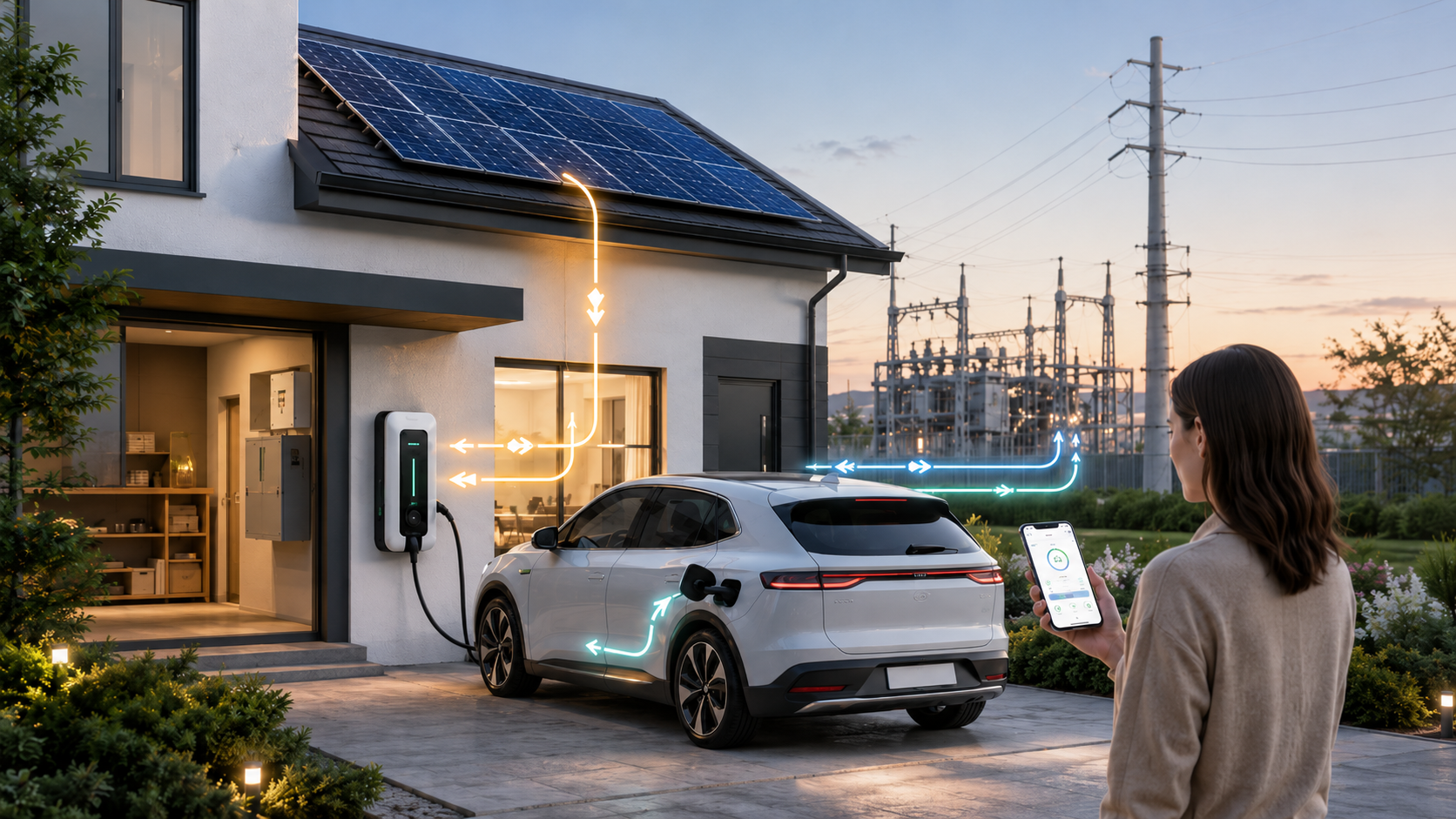
The most important emerging factors are energy autonomy, resilience, renewable-energy integration, and the growing role of consumers as active energy participants. Interest in V2H is particularly strong because powering a home, reducing electricity bills, and using more rooftop solar are tangible benefits that customers can easily understand.
The persistent barriers are equally clear. Financial compensation remains essential, with users expecting meaningful savings or payments in return for making their batteries available. Easy-to-use controls also remain critical. Customers want visibility, the ability to set minimum charge levels, and the option to override automated dispatch. Standardization and interoperability continue to hold the market back because vehicles, chargers, communications protocols, tariffs, and payment systems remain fragmented.
By contrast, range anxiety, battery-degradation concerns, and lack of awareness are beginning to diminish. Longer-range vehicles, greater EV experience, improving battery performance, and increased public exposure to V2H and V2L are gradually reducing these concerns.
Lessons for the Bidirectional Charging Industry
The strongest lesson is that V2G should be sold as a customer energy solution, not merely as a grid service. V2H, resilience, solar optimization, and bill savings may be more compelling entry points than abstract discussions of frequency regulation or wholesale-market flexibility.
Programs also need simple interfaces, guaranteed mobility protections, transparent compensation, and credible warranties. Trial experience matters: users who actually interact with V2G tend to become more accepting and less concerned about battery wear.
Finally, the industry must stop treating interoperability as a secondary technical issue. The paper concludes that institutional indecision and fragmented standards are now greater barriers than technical feasibility. The path to scale will depend on coordinated vehicle-charger offerings, clearer compensation models, and products designed around how customers actually value energy, mobility, and control.
