March 17, 2026
Zhang, C., Takahashi, K., Iwafune, Y., & Shibata, Y. (2025). Understanding user acceptance and behavioral determinants of vehicle-to-grid participation: Evidence from a large-scale survey in Japan. Renewable and Sustainable Energy Reviews, 228, 116603. https://doi.org/10.1016/j.rser.2025.116603
Much of the vehicle-to-grid literature focuses on engineering feasibility and market economics. Researchers have spent years estimating the value EV batteries can provide to the grid, modeling optimal charging and discharging strategies, and examining how dynamic pricing could unlock arbitrage opportunities.
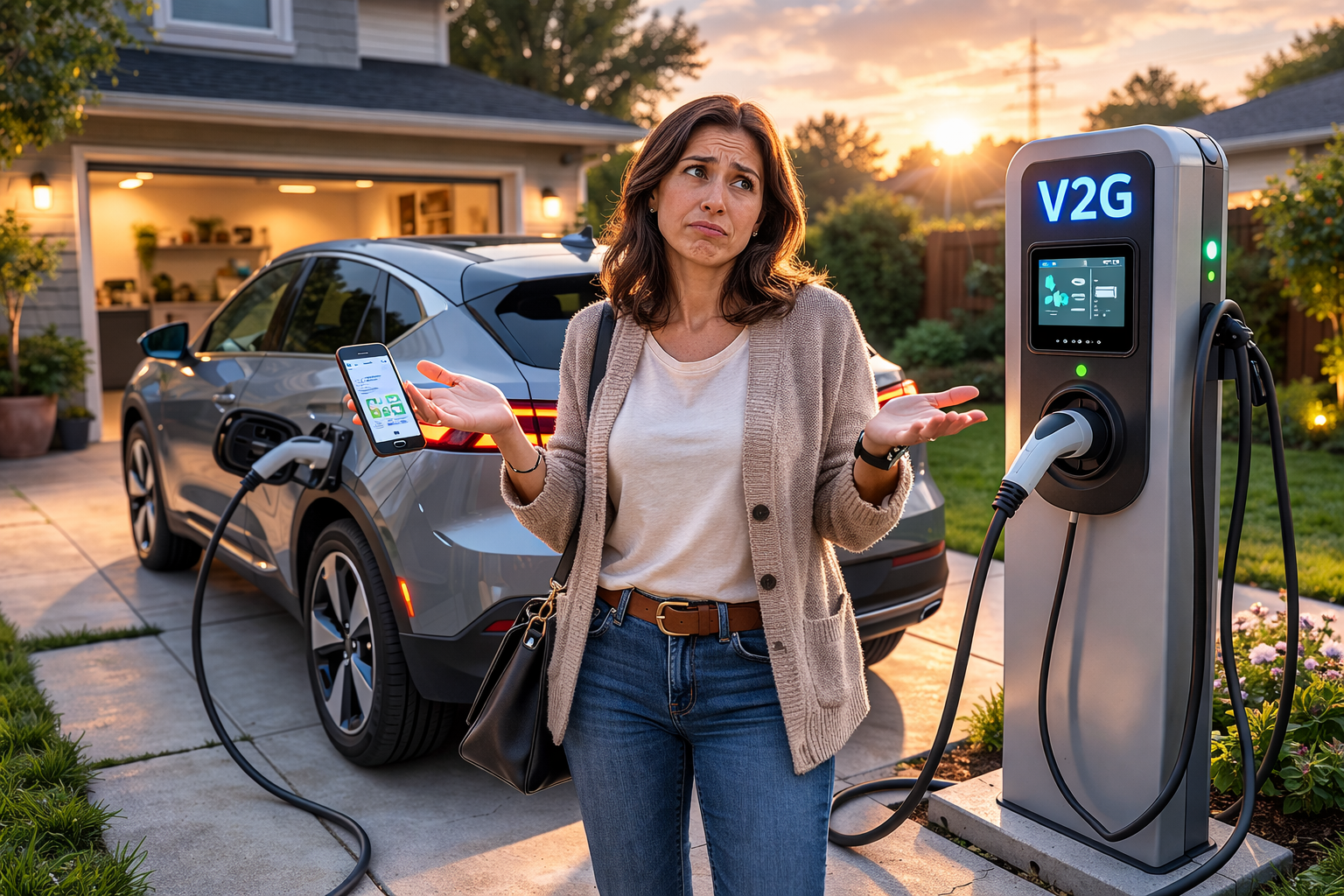
But there is another question that ultimately determines whether V2G will scale: Will drivers actually participate?
A new study published in Renewable and Sustainable Energy Reviews approaches V2G from this behavioral perspective. Rather than modeling electricity prices or dispatch algorithms, the authors examine how consumer awareness, incentives, and personal circumstances shape willingness to participate in V2G programs.
The results offer an important complement to the economic and operational studies previously reviewed in V2G News. Grid value alone does not ensure deployment. That value can only be realized if drivers are willing to allow their vehicles to participate.
Purpose of the Study
The study aims to better understand the behavioral and social factors that influence participation in V2G programs.
Although technical research has demonstrated that EV batteries can provide valuable grid services, far less is known about how drivers perceive these programs or what conditions would motivate them to enroll. Empirical research on V2G user acceptance remains limited, particularly outside Europe and North America and in regions where energy resilience has become a national priority.
The authors therefore examine three central questions:
- How aware are potential EV users of V2G and its benefits?
- What economic and psychological factors influence willingness to participate?
- How do attitudes in Japan compare with results from earlier surveys in Europe and North America?
The broader objective is to identify the social conditions required for V2G to move from pilot projects toward broader adoption.
Methodology
The research combines a literature review with a large-scale consumer survey conducted in Japan.
Using the Web of Science database, the authors screened 227 candidate studies related to V2G user acceptance and ultimately analyzed 34 papers in detail. This review highlights both the growing interest in behavioral dimensions of V2G and the limited number of empirical studies outside Europe and North America.
The core empirical analysis relies on a nationwide survey examining awareness of V2G, perceived benefits such as energy resilience, concerns about technology risk or data sharing, and willingness to participate under different conditions.
Survey responses were analyzed using a multinomial logit model, a statistical method commonly used to evaluate how multiple factors influence participation decisions. The model demonstrates moderate explanatory power for behavioral research, with a McFadden pseudo-R² of about 0.085 and overall classification accuracy near 53 percent. This framework allows the researchers to identify which factors meaningfully influence participation decisions and which commonly cited barriers appear less significant.
Key Findings
The study reveals a striking gap between perceived societal benefits of V2G and individual willingness to participate.
More than 80 percent of respondents agree that bidirectional charging could improve energy security or strengthen resilience during disasters. Yet only about 16 percent indicate they would participate in a V2G program without financial incentives.
In other words, recognition of system benefits does not automatically translate into personal participation.
The analysis also highlights several demographic patterns. Gender differences appear to influence participation willingness, suggesting that perceptions of technology risk or control over vehicle use may vary across groups. Age-related patterns are less straightforward. Respondents aged 36 to 45, often considered prime adopters of new technologies, show no greater willingness to participate than the population average.
The authors suggest that time constraints and risk aversion among middle-aged consumers may reduce willingness to adopt technologies that could complicate daily routines.
Another notable finding is the limited role of privacy concerns. Contrary to common assumptions, concerns about data sharing show little correlation with willingness to participate in V2G programs.
Taken together, the results suggest that participation decisions are driven primarily by personal economic incentives rather than broader societal motivations.
Implications for the V2G Industry
For the V2G industry, the central lesson is straightforward: technical readiness does not guarantee user participation.
The sector has understandably focused on standards, interconnection rules, charger costs, and market design. These issues are critical, but they represent only one side of the adoption equation. Even if the technology works and markets assign value to grid services, large-scale deployment depends on whether drivers see participation as worthwhile and convenient.
The study reinforces several practical lessons for V2G program design.
Lessons for V2G Program Design
- Financial incentives are essential in early markets.
Most respondents acknowledge the societal benefits of V2G, but few are willing to participate without compensation. - Programs must minimize disruption to daily routines.
Consumers are unlikely to adopt technologies that introduce uncertainty into vehicle use. Automation and clear guarantees about vehicle availability will be important. - Program complexity should be minimized.
Simple enrollment processes and clear participation rules can significantly improve adoption. - Communication should emphasize personal benefits.
Messaging focused only on grid resilience or climate benefits may not motivate participation. Drivers respond more strongly to tangible personal value. - Behavioral insights should complement technical modeling.
Understanding how consumers perceive these programs is just as important as estimating grid value.
These findings highlight the importance of integrating behavioral research into V2G program design.
Study Limitations
As with most behavioral survey research, several limitations should be considered.
First, the results are based on stated preferences rather than observed participation behavior. Survey responses may not fully reflect how consumers behave once real financial or technological decisions are required.
Second, the survey was conducted in Japan, meaning cultural and market conditions could differ from those in other regions.
Third, the statistical model provides only moderate explanatory power, reflecting the complexity of human decision-making.
Finally, the study focuses specifically on willingness to participate without financial incentives. Participation levels could differ substantially under well-designed compensation programs.
Bottom Line
The study highlights an often overlooked reality of the V2G transition: participation is as important as technology.
Technical modeling can estimate grid value and identify optimal dispatch strategies. But V2G will only scale if millions of drivers are willing to enroll their vehicles as flexible energy resources.
Understanding how drivers think about their vehicles, their electricity bills, and their participation in energy programs may ultimately prove just as important as solving the remaining engineering challenges.
