March 17, 2023
This article is the second in a new V2G News 2026 Policy Series examining the structural barriers that continue to slow the transition of vehicle-to-grid (V2G) from pilots to scalable market offerings. The first installment focused on the importance of enabling grid exports from EVs. This second piece turns to a closely related issue: compensation, and, more specifically, why the absence of long-term, predictable revenue streams remains one of the biggest obstacles to V2G at scale.
V2G can create real system value, and in many places it already does. But value alone is not enough. To unlock private capital, reduce financing costs, and move beyond grant-funded demonstrations, V2G needs compensation structures that look less like temporary programs and more like durable market infrastructure.
Across the U.S., a growing number of utilities and states have created pathways for EVs to earn revenue by providing grid services. Event-based demand response programs, export tariffs, dynamic rates, and virtual power plant pilots now exist in several major markets. Bidirectional EVs have demonstrated meaningful revenue potential, from several thousand dollars per year for light-duty vehicles to well over $10,000 per year for electric school buses in New England.
Yet despite this progress, V2G deployment remains slow and fragmented. One reason is that nearly all existing compensation mechanisms are short-term, conditional, or inherently uncertain.
Take California’s Emergency Load Reduction Program (ELRP). ELRP has been an important proving ground for V2G aggregation, allowing EVs to earn performance-based payments during grid emergencies. But the program is authorized only through 2027, funded from a finite pool, and subject to annual design changes. Revenue is episodic, not guaranteed, and dependent on emergency conditions that are, by definition, unpredictable.
New England’s Connected Solutions program offers a somewhat more stable framework, with multi year incentive guarantees and predictable summer dispatch windows. Even here, however, incentives are authorized with a fixed incentive lock of five years. That time horizon may still be too short to justify investment in bidirectional charging infrastructure designed to operate for ten years or more.
New York’s Value of Distributed Energy Resources (VDER) tariff takes a different approach, compensating exports based on a stack of value components tied to system conditions and location. In theory, VDER offers a durable pathway for V2G exports. In practice, revenues remain highly variable, sensitive to wholesale prices, utility-specific methodologies, and periodic tariff revisions. For developers and financiers, that variability translates directly into risk.
None of these programs are failures. In fact, they are essential stepping stones. But they share a common limitation: they do not provide the long-term revenue certainty needed to support project finance for bidirectional charging infrastructure.
Why Bankability Matters
In the early days of distributed solar, the core technology was already functional. Panels worked. Inverters worked. Systems could be interconnected safely. But the market remained small because financing was expensive and fragmented. What ultimately unlocked scale was not just incremental improvements in efficiency or manufacturing cost. It was the emergence of durable, long-term financing structures.
Third-party ownership models, including solar leases and residential power purchase agreements, converted rooftop generation into contracted cash flows over 15 to 25 years. Under these arrangements, developers owned and financed the systems, while customers paid a predictable monthly lease or per kilowatt hour (kWh) rate. That structure reduced upfront cost barriers, lowered the cost of capital, and allowed institutional investors to underwrite portfolios of projects with confidence. It did not eliminate policy risk or market volatility, but it created enough revenue certainty to transform distributed solar from a niche offering into a financeable asset class.
V2G is approaching a comparable, though not identical, inflection point. The technology pathway is increasingly clear. Bidirectional chargers are certified under evolving standards. OEMs are embedding bidirectional capability into new models. Utilities are gaining operational experience through pilots. The technical feasibility question, while not fully settled in every use case, is no longer the primary constraint.
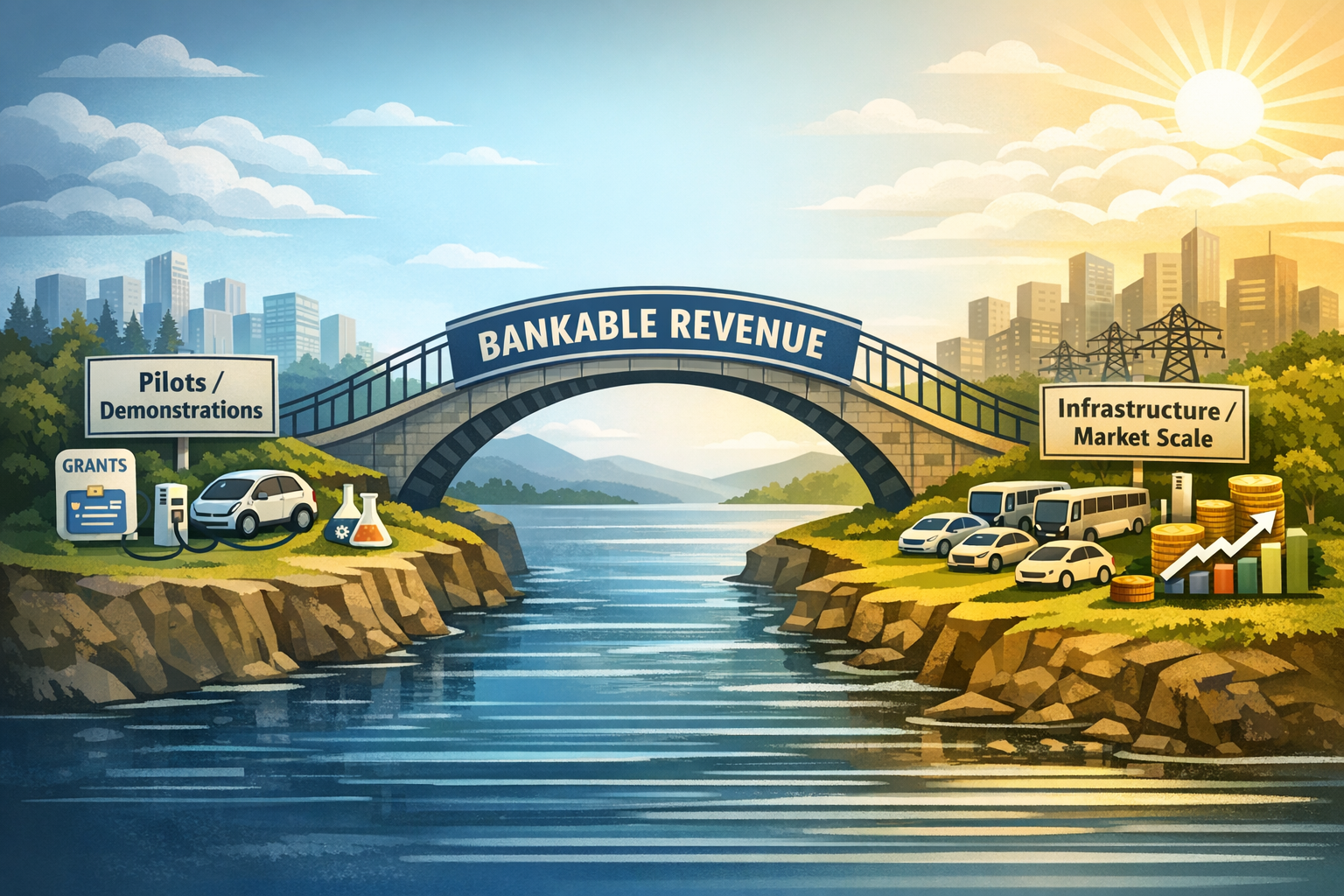
The constraint is structural. Most V2G deployments today depend on grants, demonstration funding, or short-term incentive programs layered on top of time-varying rates. That approach is entirely appropriate for early learning. It supports standards development, interconnection refinement, and real-world validation of operational performance. But it does not yet create predictable, bankable revenue streams over a multi-year horizon that aligns with the useful li.
Without durable compensation structures, developers face a higher cost of capital. Fleet operators and homeowners confront uncertain payback periods. Utilities hesitate to incorporate V2G capacity into resource adequacy planning or distribution deferral analysis because participation and performance are not contractually secured. The result is not technological failure, but institutional hesitation.
In that sense, V2G risks becoming stuck in a perpetual pilot phase. Not because the hardware cannot perform, and not because grid value does not exist, but because the revenue model has not yet matured to the point where private capital, utilities, and regulators can confidently treat it as infrastructure rather than an experiment.
As discussed in the State Profile Series on California in Volume 2 | Issue 5 of V2G News, even leading jurisdictions can find themselves in this “unbankable middle.” The next phase of market development will depend less on proving that V2G works and more on designing compensation and procurement frameworks that allow it to scale.
The Limits of Program-Based Compensation
Most current V2G compensation pathways are embedded in programs rather than durable rates, tariffs, or long-term procurement contracts. That distinction may sound procedural, but it is foundational.
Programs are, by design, discretionary. They are authorized for limited durations, often three to five years. They are subject to budget caps. Enrollment can close without notice once funding is exhausted. Eligibility rules evolve. Incentive levels are adjusted. Measurement and verification protocols are refined midstream. From a regulatory standpoint, this flexibility is a virtue. It allows commissions and utilities to learn, recalibrate, and protect ratepayers while markets are still emerging.
From an investment standpoint, however, that same flexibility introduces material uncertainty.
A fleet operator considering bidirectional charging infrastructure is not making a short-term decision. Depot electrical upgrades, switchgear, software integration, and charger procurement are capital investments with useful lives of 10 to 15 years, sometimes longer. A school district installing V2G-capable buses is committing public funds across multi-year budget cycles, often supported by bonds or state grants that assume stable operating economics. A charging service provider building an aggregation platform is investing in cybersecurity, telemetry, customer acquisition, and compliance systems that must operate reliably over long time horizons.
These actors are not asking whether V2G can generate revenue next summer. They are asking whether it can support debt service, operating margins, and long-term planning.
Against that backdrop, a three- to five-year incentive authorization, or a tariff that may be materially revised in the next general rate case, is not sufficient to anchor capital formation. Even if near term revenues are attractive, the risk that compensation could decline or disappear undermines underwriting confidence. Investors discount uncertain future cash flows. Lenders tighten terms. Customers demand shorter payback periods. The cost of capital rises accordingly.
This mismatch between asset life and revenue certainty is one of the most underappreciated barriers to V2G adoption. The technology may be ready. The grid need may be real. But until compensation structures better align with the long-lived nature of vehicles, charging infrastructure, and integration platforms, scale will remain constrained.
The lesson from other distributed energy markets is not that flexibility should disappear. It is that experimentation must ultimately evolve into durable market design. Without that transition, V2G will continue to demonstrate promise without achieving infrastructure status.
Learning From Solar Without Copying It Blindly
The analogy to solar power purchase agreements is instructive, but V2G will not, and should not, replicate that model mechanically.
Solar is fundamentally an energy production asset with relatively predictable output. V2G, by contrast, is a flexibility resource. Its value is multi-dimensional and context-dependent. It spans capacity during system peak, energy arbitrage, ancillary services, local distribution deferral, resilience during outages, and customer bill optimization. The value stack varies by geography, rate design, market structure, and fleet operating profile. No single contract structure will capture all of that value across all use cases.
But the core lesson from solar still applies: long-term revenue clarity unlocks private capital.
For V2G, that clarity could take several forms. Utilities could establish long-duration tariffs that explicitly compensate EV exports under defined performance standards over 10 to 15 years. Regulators could authorize capacity-style contracts for fleets that commit availability during defined peak windows. Hybrid structures could combine a stable floor payment for availability with upside participation in wholesale or distribution level markets.
What matters less than the precise mechanism is the underlying principle. Revenue streams must be predictable enough and durable enough to support underwriting.
Solar did not scale because every customer signed the same contract. It scaled because the market evolved structures that allowed investors to price risk over long horizons. V2G does not need to copy the instrument. It needs to replicate the confidence.
From Technical Uncertainty to Market Readiness
There is an important irony in the current moment for V2G. Many of the concerns that once justified caution, battery degradation, technology readiness, and interoperability are becoming less binding. As discussed in the first article in this series, export capability is expanding, standards are maturing, and battery health concerns are increasingly manageable through better controls, operating limits, and advancing battery technology.
Yet compensation structures remain stuck in an earlier phase of experimentation.
If policymakers wait for every technical question to be fully resolved before addressing compensation, they risk repeating a familiar pattern: technology readiness outpacing regulatory readiness. By the time V2G is widely accepted as technically viable, the absence of bankable revenue frameworks may become the dominant constraint on scale.
The challenge now is not to lock in a single national compensation model, but to begin the transition from temporary programs to durable market structures. That shift requires asking harder questions in regulatory proceedings today, about which V2G services merit long-term compensation rather than pilot incentives, how utilities can procure V2G capacity in ways that align with planning horizons, and what level of revenue certainty is sufficient to lower financing costs and unlock private capital.
These are not abstract policy debates. They will determine whether V2G remains a niche adjunct to EV charging or evolves into a meaningful, dependable grid resource capturing the massive storage capacity of millions of EVs nationwide.
V2G has already demonstrated value. What it lacks is market infrastructure. Compensation mechanisms are the connective tissue between grid value and private investment. Without long-term certainty, V2G will continue to rely on public funding and bespoke pilots. With it, the market can begin to scale on its own terms.
If the first phase of V2G policy was about proving that EVs can support the grid, the next phase must focus on ensuring they can do so at scale, at reasonable cost, and with durable economics. That means moving beyond programs and toward bankable revenue.
