In this edition of V2G News, we examine what we now know about V2G’s impact on battery health and degradation risk, unpack a major Berkeley-led study that quantifies where V2G value truly comes from, and what can erase it, and track a series of OEM and utility announcements signaling real commercial momentum. From Tesla’s AC-based grid export offering in Texas to BMW and E.ON launching Germany’s first retail V2G tariff, the industry is beginning to align technology, standards, and compensation structures. The remaining question is no longer whether V2G can work, but how quickly market design, deployment strategy, and customer economics can keep pace.
If you have questions, insights, or ideas for future coverage, please reach out to Steve, founder and editor of V2G News. Your input helps shape the conversations that move this industry forward!


V2G Insights
Battery Health and V2G: What We Know & Where the Industry Is Headed
February 17, 2026
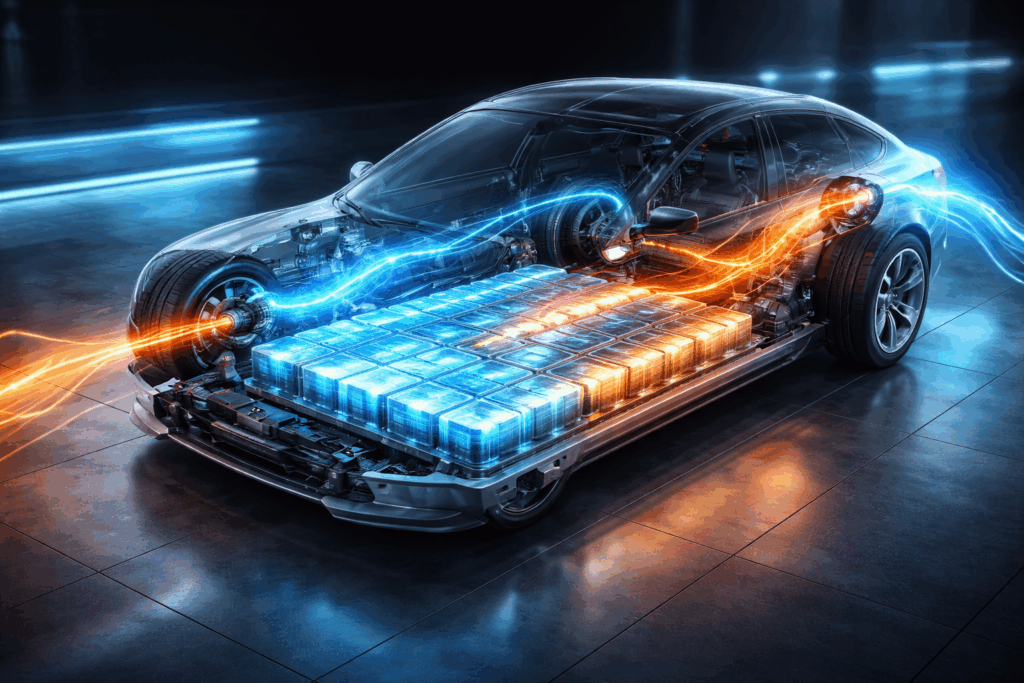
Few topics generate as much concern around vehicle-to-grid (V2G) as battery health. For all the promise of bidirectional charging, grid flexibility, resilience, and new revenue streams, one question persists: What does this do to the battery?
It is a fair question. EV batteries are capital-intensive assets designed first and foremost to deliver mobility. Most drivers still see them as vehicles rather than grid assets. Asking owners to use their batteries for additional services naturally raises concerns about wear, warranties, and long-term value.
The good news is that the conversation has matured. We now have a growing body of experimental evidence, field data from pilots, and more sophisticated modeling that help distinguish real risks from outdated assumptions. At the same time, battery technology itself is evolving rapidly, which is beginning to reshape how degradation should be understood in bidirectional applications.
This article examines what we know today, where uncertainty remains, and why the technology trajectory matters for V2G’s future.
V2G Intelligence
New Berkeley-Led Study Quantifies Where V2G Value Comes From, and What Could Erase It
February 17, 2026

Soomin Woo, Leo Strobel, Yuhao Yuan, Marco Pruckner, Timothy E. Lipman, Exploring bidirectional charging strategies for an electric vehicle population, Applied Energy, Volume 397, 2025, 126361, ISSN 0306-2619, https://doi.org/10.1016/j.apenergy.2025.126361.
A November 2025 paper in Applied Energy by researchers at UC Berkeley’s Transportation Sustainability Research Center and collaborating institutions tackles a question V2G stakeholders often talk around but rarely quantify with real operating data: how much value can bidirectional charging actually produce, and which real-world constraints determine whether that value is realized?
The study’s starting point is a practical one. Despite years of V2G promise, it remains unclear how to design operations that balance mobility needs with grid cost signals, and whether the incremental complexity of V2G (versus smart charging alone) is justified. The authors respond with a framework that compares multiple “service designs” for V2G and V1G, explicitly layering in constraints that resemble what customers and programs are likely to require (like departure SOC guarantees and limits on where bidirectional hardware is available).
What the researchers set out to understand
The paper’s objectives are explicit: propose “realistic” V2G strategies, evaluate them using actual EV charging data, and identify the parameters that most affect benefits (revenues and emissions).
This is not an abstract modeling exercise built on assumed plug-in schedules. The authors emphasize a gap in the literature: many V2G valuation studies rely on stylized driving patterns or incomplete charging records, and often do not interrogate key design variables like equipment availability by location, driver SOC guarantees, charging/discharging efficiencies, aggregator fees, and degradation compensation.
V2G Finds—US
Tesla Launches Cybertruck V2G Program Using AC-Based Architecture
Tesla has officially announced that vehicle-to-grid capability is coming to its vehicles, beginning with the Cybertruck in Texas under its new “Powershare Grid Support Program.” The program will allow participating owners to export energy back to the grid during high-demand events and receive bill credits in return, with expansion to California expected next. Notably, the system relies on V2G AC architecture, an important milestone for the industry because it enables grid-parallel export using standards-based interconnection pathways rather than proprietary DC-coupled solutions. For a company of Tesla’s scale, this move signals that bidirectional charging is transitioning from niche pilot deployments to mainstream OEM-backed offerings.
V2G News issued a Breaking News alert on this development, given its significance. Tesla’s entry into grid export builds on the Cybertruck’s existing 11.5 kW vehicle-to-load functionality. It represents the first time the company has formally committed to compensating owners for grid services. If scaled across Tesla’s broader vehicle lineup, this could materially expand the addressable V2G market in the United States and accelerate regulatory and utility alignment around residential AC-based export frameworks.
2/7/2026
Enphase Targets Q4 2026 for Scaled Production of Standards-Based Bidirectional EV Charger
Enphase Energy has announced plans to begin volume manufacturing of its IQ Bidirectional EV Charging Platform in Q4 2026, signaling a meaningful step toward broader commercialization of vehicle-to-home (V2H) and vehicle-to-grid (V2G) solutions. After a year of interoperability demonstrations at CharIN events across the U.S. and Europe, the platform is being developed to comply with key standards, including UL 1741, IEEE 1547, and ISO 15118-20, positioning it for multi-market deployment across residential and light-commercial applications. Designed to connect directly to an EV’s DC port, the IQ system enables both charging and home backup functionality, with limited pilot deployments planned ahead of full-scale rollout. For the V2G industry, Enphase’s timeline reflects growing alignment around open standards and interoperability as prerequisites for scalable bidirectional charging.
2/2/2026
Potomac Edison Launches $11.1M Electric School Bus Pilot with V2G Testing
Potomac Edison, a subsidiary of FirstEnergy, has received approval from the Maryland Public Service Commission to launch an $11.1 million pilot program supporting the deployment of up to 28 electric school buses across its Maryland service territory. The five-year initiative will cover the incremental cost of electric buses—typically about $250,000 more than diesel models—along with charging equipment and necessary electrical upgrades, helping districts comply with the state’s zero-emission bus mandate under the Climate Solutions Now Act of 2022. Importantly for the V2G sector, the program will also test vehicle-to-grid functionality, exploring how parked school buses can export stored energy back to the grid during periods of high demand or emergencies. By pairing fleet electrification with grid services experimentation, the pilot reflects a growing recognition that school buses can serve not only as clean transportation assets but also as flexible energy resources.
2/4/2026
V2G Finds—Global
BMW and E.ON Launch Germany’s First Commercial V2G Tariff with Neue Klasse iX3
BMW Group and E.ON have officially launched Germany’s first commercial vehicle-to-grid (V2G) offering, pairing the new BMW iX3 (Neue Klasse) with the bidirectional BMW Wallbox Professional and a dedicated E.ON V2G electricity tariff. The program enables customers to earn up to €720 annually based on plug-in time, receive compensation of €0.40 per kWh for energy exported to the grid, and potentially drive up to 14,000 kilometers per year at no net charging cost. The 11 kW AC bidirectional wallbox, integrated with an intelligent metering system and managed through the My BMW App, represents a significant step in scaling standards-based, customer-facing V2G in Europe. By embedding grid export directly into a retail tariff structure, with defined compensation, battery safeguards, and app-based control, the BMW–E.ON partnership moves V2G beyond pilot demonstrations and into mainstream residential energy markets.
2/9/2026
Varroc Lands $48M Contract to Supply Bi-Directional EV Chargers to Global OEM
Varroc Engineering has secured a six-year, $48 million supply agreement with a major global EV manufacturer to produce Energy Star–compliant AC bidirectional wall chargers, marking a notable expansion into the vehicle-to-grid (V2G)–ready charging market. The chargers, which will be manufactured at Varroc’s Romania facility, support both conventional grid-to-vehicle charging and emerging V2G energy flows, an increasingly important capability as automakers integrate EVs into broader energy ecosystems. The contract reflects rising OEM demand for factory-aligned, standards-based bidirectional charging hardware and underscores how Tier 1 suppliers are positioning themselves at the intersection of electrification and grid integration.
2/4/2026
