Residential V2G is gaining real traction, but the path to scale is becoming clearer, and more demanding. In last week’s edition, residential V2G pioneer Frances Bell made it clear: the technology works, deployments are underway, and the challenge now is execution. In this edition, we build on that with a closer look at the evolution of residential bidirectional chargers and current market offerings.
We also continue our State Profile Series with Texas, following Connecticut and California. Texas offers a different model, driven by market structure, price signals, and retail competition. Can that unlock V2G at scale? We also cover the latest developments, including new research on proactive grid planning that reframes how V2G fits into long-term infrastructure investment.
If you’re finding value in V2G News, I’d greatly appreciate a short testimonial I can share on the website. The more we can help people understand the transformative potential of bidirectional charging, the faster these markets will scale. Thank you for your interest and support!


V2G Insights
The Evolution of Residential Bidirectional Chargers: From Backup Power to Grid Services

April 14, 2026
The long term promise of vehicle-to-grid has always rested on scale. And nowhere is the scale larger than in the residential sector.
Electric vehicles are parked at home for the majority of the day and, critically, often during the evening peak when electricity demand is highest. Increasingly, many drivers charge at work or during midday hours when solar production is abundant. That creates a powerful dynamic: vehicles can absorb low-cost, low-carbon energy during solar hours and discharge during evening peaks when the grid is most stressed.
But the real story is not just timing. It is the scale of storage capacity in EV fleets.
A typical home battery system, such as the Tesla Powerwall, provides 13.5 kWh of usable storage. By contrast, most modern EVs carry between 60 and 100 kWh of battery capacity. A Tesla Model Y contains roughly 75 kWh. A Ford F-150 Lightning can carry as much as 131 kWh in its extended range configuration.
Put differently, a single 75 kWh EV holds the equivalent of more than five Powerwall units. A long-range electric pickup can approach the equivalent of ten.
Not all of that energy is available for grid services. Mobility comes first. Drivers will maintain reserve margins, and aggregators will likely dispatch only a portion of capacity. But even if just 20 to 30 percent of a 75 kWh battery were made available during peak periods, that still equates to roughly one to two Powerwall units worth of flexible storage per participating EV.
Now multiply that across hundreds of thousands or millions of vehicles.
The battery capacity embedded in the light-duty EV fleet already rivals, and will soon dwarf, installed residential stationary storage. The economic logic is compelling. Households are purchasing EV batteries for transportation. Residential V2G offers a pathway to extract additional system value from an asset that already sits in the driveway.
That is the strategic opportunity. And it explains why the evolution of residential bidirectional charging hardware matters.
V2G Intelligence
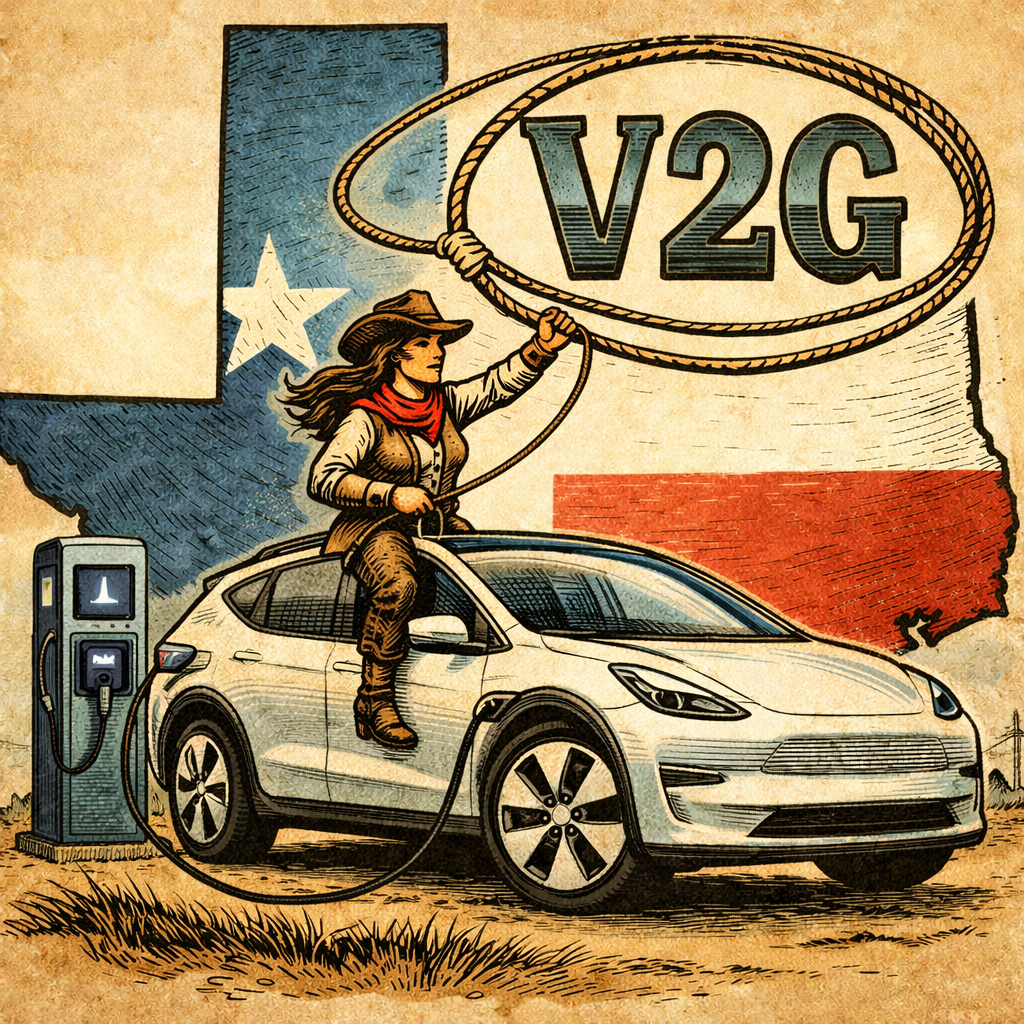
Texas: The Market Where V2G Could Scale First?
April 14, 2026
This is the third installment in V2G News’ State Profile Series, following Connecticut and California. Each state tells a different story about what it will take to move vehicle-to-grid from pilots to scale. This is not dissimilar to the early days of rooftop solar, where adoption varied widely across states based on regulatory frameworks and market structure. In Texas, the unique structure of the energy market may create the conditions for V2G to scale faster and more broadly than anywhere else in the country.
A Market Built on Energy and Price Signals
To understand Texas, you have to start with the Electric Reliability Council of Texas, or ERCOT. ERCOT manages the flow of electricity to more than 27 million customers, representing about 90 percent of the state’s electric load. In 2023, the system reached an all time peak demand of more than 85 gigawatts, a number that is expected to continue rising as population grows, manufacturing expands, and electrification accelerates.
Unlike most organized wholesale markets in the United States, ERCOT operates as an energy only market, meaning there is no forward capacity construct designed to incentivize investment in new generation resources. In capacity markets, forward payments provide a predictable revenue stream intended to support the development and retention of generation needed to meet future reliability requirements. By contrast, the energy only model relies on wholesale energy prices as the primary signaling mechanism for both new investment and ongoing operations.
In ERCOT, these signals to owners and developers of generation capacity are expressed through prices in the day-ahead and real-time markets, which can fluctuate significantly based on system conditions. While average prices are often modest, periods of system stress can produce sharp price spikes, with real-time prices exceeding $1,000 per megawatt hour during peak conditions. These events occur during a relatively small number of hours, yet they drive a disproportionate share of total system costs and play a central role in shaping long-term investment behavior.
At the same time, Texas has become the national leader in both wind and solar generation, with these resources now playing a central role in meeting rising demand. Since 2023, wind and solar have been the fastest-growing sources of electricity in ERCOT, together supplying more than one-third of total demand in 2025. Utility-scale solar in particular has expanded rapidly, with output in the first nine months of 2025 reaching roughly four times its 2021 level. This growth is increasingly reshaping net load patterns, reducing midday reliance on natural gas and shifting system needs into the evening hours.
V2G Finds—US
New Study Finds V2G Works Best Alongside Proactive Grid Investment
This analysis, published in Joule as “Proactive Grid Investment Enables V2G for 100% Adoption of Electric Vehicles in Urban Areas,” has been picked up by a number of media outlets, including Grist, signaling growing mainstream attention to the role of vehicle-to-grid (V2G) in future energy systems. At first glance, the study appears to challenge one of the core value propositions of V2G: the ability to defer or avoid costly grid infrastructure investments. Using a detailed model of the San Francisco Bay Area under a high electrification scenario, the authors confirm that V2G can reduce peak loads, mitigate transformer overloads, and lower emissions. However, they also find that these benefits are not sufficient, on their own, to fully offset the magnitude of load growth associated with widespread EV adoption. In short, V2G improves how the grid operates, but it does not eliminate the need to expand its underlying capacity.
The more counterintuitive finding is not that grid upgrades are needed, but that relying on V2G to delay those upgrades may actually increase total system costs over time. The study shows that incremental, reactive investments, made in response to near-term constraints, can lead to repeated infrastructure upgrades as demand continues to rise. By contrast, proactively upgrading the grid to meet long-term needs avoids this cycle of reinvestment and ultimately lowers total costs. In this framework, V2G delivers its greatest value when layered onto a grid that has already been built out to accommodate future demand, enabling EVs to provide flexible, distributed storage and grid services at scale. The implication is not that V2G undermines the case for avoiding infrastructure, but that its role is more complementary than substitutive: it enhances system efficiency and flexibility, rather than replacing the need for foundational grid investment.
4/7/2026
V2G Leaders Convene in Los Angeles as Industry Focus Turns to Scaling the Market
The 7th Annual V2G Business, Policy & Technology Forum, hosted by Smart Grid Observer, will bring together utilities, automakers, regulators, and technology providers in Los Angeles from April 28–30 to address the next phase of vehicle-to-grid deployment in the United States. As the market moves beyond early pilots, this year’s agenda reflects a clear shift toward execution, with sessions focused on standardization, compensation mechanisms, interoperability, and both fleet and residential applications. With participation from leading organizations across the ecosystem, the Forum continues to serve as a key venue for aligning the technical, regulatory, and commercial elements required to scale V2G.
While V2G News will not be able to attend the Spring Forum in Los Angeles. We look forward to engaging with many of these same leaders at the Fall V2G Forum in Detroit, where the conversation on scaling bidirectional charging will continue to evolve.
4/10/2026
V2G Finds—Global
New Report Maps the Path to Scaling Bidirectional Charging in Australia
A new report from the Vehicle-Grid Network, developed in partnership with Climate-KIC Australia and the UTS Institute for Sustainable Futures, provides a timely and grounded look at what it will take to scale bidirectional charging in Australia. Titled Accelerating Bidirectional Charging in Australia, the report synthesizes insights from the Vehicle-Grid Network’s inaugural industry roundtable, which brought together more than 50 stakeholders across automakers, utilities, technology providers, regulators, and researchers. The objective was not to showcase technology readiness, but to identify the structural conditions required to move V2G from pilots to early commercialization. The result is a clear message that scaling V2G is no longer primarily a technical challenge, it is a coordination challenge that spans standards, regulation, market design, and the customer experience .
The report highlights several critical insights for market development. First, automaker participation remains a key unlock, but depends on clear safety frameworks, regulatory certainty, and confidence in operating conditions. Second, the lack of alignment on technical standards and interoperability, particularly across vehicles, chargers, and communication protocols, is creating friction and slowing deployment. Third, certification and grid connection pathways remain complex and inconsistent, increasing time to market and limiting product availability. At the same time, the report underscores that the V2G value proposition is still not well defined, with limited real-world data and unclear market signals making it difficult for customers and investors to assess value. Finally, consumer trust emerges as a central theme, shaped as much by upstream technical decisions and compatibility standards as by education and outreach. The overarching takeaway is that progress will depend on coordinated action across these domains, with clear sequencing of standards, regulation, and market signals required to unlock scalable deployment.
4/9/2026
Rethinking V2G for Tropical Grids: Why Local Optimization Matters
A new study published in Nature Communications highlights how vehicle-to-grid can play a critical role in enabling large-scale solar deployment in tropical cities, but only if it is designed correctly. Using Singapore as a case study, the research shows that conventional, system-level V2G strategies can actually worsen grid stress by increasing power flows during periods of highly variable solar output driven by localized thunderstorms. In contrast, a decentralized, district-level charging approach aligns EV behavior with local grid conditions, reducing line congestion and enabling greater photovoltaic integration without costly infrastructure upgrades. The findings reinforce a key insight for scaling V2G: its value is highly context-dependent, and unlocking that value requires moving beyond centralized optimization toward more localized, system-aware control strategies.
4/7/2026
UK EV Charging Market Hits a Turning Point: Compliance, Cybersecurity, and V2G Drive 2026 Shift
New analysis from Versinetic suggests the UK EV charging market is entering a critical phase where regulatory enforcement, cybersecurity risks, and the emergence of vehicle-to-grid are reshaping industry dynamics. Stricter uptime requirements and potential fines are expected to force consolidation among operators, while cybersecurity is quickly becoming a baseline requirement for infrastructure deployment. At the same time, V2G is transitioning from pilot to early commercial reality, with bidirectional charging projected to generate meaningful revenue streams and scale beginning in 2026. The combined effect signals a maturing market where operational performance, system integrity, and the ability to capture V2G value will determine which players succeed.
4/10/2026
