In this edition of V2G News, residential V2G pioneer Frances Bell of Bidirectional Energy provides a grounded view of where residential bidirectional charging stands today. The technology works. Deployments are happening. The real challenge now is execution—getting systems installed efficiently and delivering a seamless pathway to unlock V2G value at scale.
We also break down new academic research on V2G infrastructure, with a simple takeaway: this is not just about vehicles. It is about the full system, chargers, controls, communications, and grid integration, working together as one platform.
On the global front, the UK’s move to near-instant V2G interconnection approvals is a big signal, and one the U.S. should be watching closely as it works to remove a key barrier to scale. And much more in the latest edition of V2G News!


V2G Insights
Pioneering Residential V2G: A Conversation with Frances Bell

March 31, 2026
Frances Bell, Founder and CEO, Bidirectional Energy
V2G News spoke with Frances Bell, Founder and CEO of Bidirectional Energy, about her path into the vehicle-to-grid space, the current state of residential bidirectional charging, and what it will take to move from early pilot deployments to scalable, customer-facing energy platforms. Drawing on experience across utilities, technology companies, and early-stage deployments, Bell offers a grounded view on where the industry stands today and what it will take to scale
This interview has been edited for length and clarity.
V2G News:
To start, could you describe your academic and professional background?
Bell:
I trained as an electrical engineer in undergraduate school and then focused on power systems for a master’s degree at Tufts University.
Early in my career, I developed a thesis that I wanted to make an impact on the energy system and made a deliberate decision to start at a utility, joining PG&E, because I believed that understanding how the system is regulated, operated, and designed would provide insight into where meaningful change could occur.
From there, I had the opportunity to work across the broader energy and technology ecosystem, including roles with companies like Tesla and other leading organizations in the sector, where I gained exposure to both the utility perspective and the rapidly evolving world of distributed energy and electrification.
V2G Intelligence
What It Takes to Scale V2G Infrastructure: Insights from a Recent Academic Study
March 31, 2026
Zhang, F., Tang, J., Qian, B., Xiao, Y., Lin, X., & Feng, X. (2025). V2G Charging Stations: A Comprehensive Review of Technology and Infrastructure. China Journal of Electrical Engineering (forthcoming).
Study Purpose
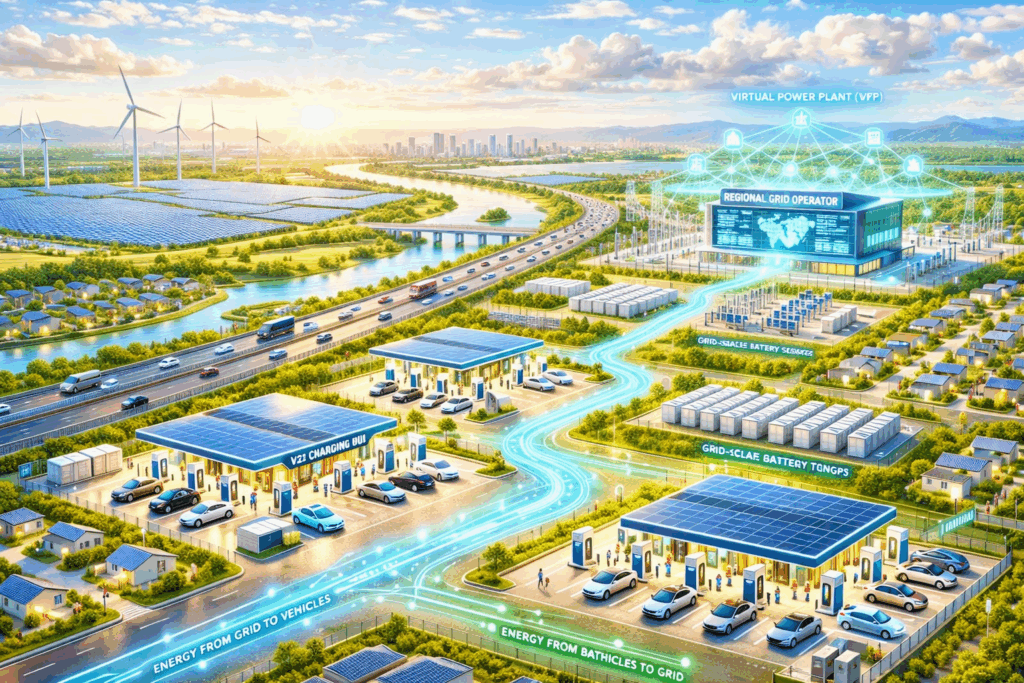
This paper takes a different approach than most V2G research. Instead of focusing on market value or system-level benefits, it examines the infrastructure that makes V2G possible, specifically the charging systems that sit between the vehicle and the grid.
The core question is practical: what does it actually take to move energy back and forth between vehicles and the grid in a way that is reliable, controllable, and scalable?
To answer that, the authors walk through how V2G systems are built and how they operate in the real world. They examine not just the vehicle, but the full system, including the charger, control software, communications, and grid interface. The result is a grounded view of V2G as an engineered system, not just a concept.
Study Method
This paper is a systematic technical review of vehicle-to-grid charging infrastructure, synthesizing prior research rather than presenting new experimental results.
The authors organize the literature around a structured framework that moves from system-level architecture to component-level design and control strategies.
V2G Finds—US
PSE and ChargeScape Launch V2H Demonstration to Advance Grid-Interactive EVs
Puget Sound Energy (PSE) and ChargeScape have launched a new demonstration in Washington State that highlights the growing role of electric vehicles as distributed energy resources, capable of supporting both households and the grid. The project will test vehicle-to-home (V2H) capabilities using bidirectional EVs such as the Ford F-150 Lightning and Kia EV9, enabling customers to use their vehicles for backup power during outages while also reducing energy costs through time-of-use rate optimization. At the same time, the program will evaluate how these vehicles can participate in demand response events to help manage peak grid conditions.
Beyond the immediate customer benefits, the demonstration is designed to generate real-world insights into interconnection, customer experience, and system integration, critical elements for scaling V2X programs more broadly. By bringing together a utility, an automaker-backed integration platform, and leading OEMs, the initiative reflects a broader industry shift toward coordinated, system-level deployment of bidirectional charging, where EVs serve not just as transportation, but as flexible assets that enhance grid reliability and resilience.
3/18/2026
Reuters: EV Batteries on Wheels Are Emerging as Home Energy Assets and Grid Resources
A new Reuters report highlights how bidirectional electric vehicles are rapidly evolving from transportation tools into flexible energy assets. With more than 630,000 bidirectional EVs already on U.S. roads, models like the Ford F-150 Lightning and Tesla Cybertruck are demonstrating real-world value by powering homes during outages and reducing energy costs through time-shifting. Studies suggest vehicle-to-home (V2H) can save owners thousands of dollars and significantly cut emissions, while early vehicle-to-grid (V2G) programs, such as those supported by General Motors and utilities, are beginning to compensate drivers for supporting the grid. However, scaling remains dependent on overcoming infrastructure, regulatory, and market barriers, including interconnection rules, compensation structures, and standardization efforts like ISO 15118. The direction is clear: as EV adoption grows, their collective battery capacity could become a cornerstone of grid flexibility, but unlocking that value will require coordinated progress across technology, policy, and program design.
3/30/2026
Autonomous EVs Could Turn V2G into a Mobile Revenue Opportunity
A recent Forbes article highlights a potential shift that could reshape how V2G infrastructure is deployed and used in the future. Rather than relying on homeowners to install expensive bidirectional chargers, future electric vehicles may be able to drive themselves to centralized V2G-enabled charging hubs, plug in, and participate in grid services on demand. In this model, EVs become mobile energy assets, capable of responding to price signals or grid needs by relocating to where value can be captured. This reduces the need for residential infrastructure while concentrating utilization at dedicated sites, improving economics and operational control.
3/25/2026
V2G Finds—Global
UK Takes a Step Toward Scalable V2G with Instant Interconnection Approvals
UK Power Networks’ move to automate approvals for V2G charger connections is a meaningful breakthrough for the industry, even if it appears incremental on the surface. Interconnection has long been one of the quiet but critical barriers to scaling bidirectional charging. Unlike standard EV chargers, V2G systems can export power back to the grid, which has historically required manual review and slowed deployment. By enabling automatic approvals for qualified V2G chargers, UKPN is effectively removing a key source of delay and uncertainty. What once took weeks can now happen in seconds, aligning V2G with other low-carbon technologies that are already moving through streamlined processes.
More importantly, this signals a shift in how utilities and network operators are beginning to view V2G. Rather than treating it as an exception that requires special handling, UKPN is starting to integrate it into standard interconnection pathways. That is a foundational step toward scale. As industry participants have pointed out, the grid was not designed to accommodate mobile, export-capable resources like electric vehicles. This change begins to close that gap. While still early and dependent on certified equipment, the approach points to a future where infrastructure, policy, and market rules evolve together. If replicated more broadly, this type of reform could play a central role in moving V2G from pilot projects to real, deployable grid resources.
3/18/2026
StarCharge Secures CEC Listing for Halo Charger, Advancing V2G Deployment in Australia
StarCharge Energy Oceania announced that its Halo 7.4 kW bidirectional charger has been listed by the Clean Energy Council, a key milestone that moves vehicle-to-grid closer to mainstream adoption in Australia. Designed for residential and light commercial use, the charger enables both charging and discharging and has already been deployed in early V2G trials, signaling growing confidence in real-world applications. The company is also working with automakers and partners to accelerate the deployment of ISO 15118-20 enabled vehicles, underscoring the importance of interoperability and ecosystem readiness. The announcement reflects a broader shift from pilot projects toward scalable deployment, with certified hardware, aligned standards, and industry collaboration emerging as critical building blocks for V2G market development.
3/30/2026
Humax Moves into Europe with V2G Chargers and Utility Partnerships
A South Korean electronics firm is making a strategic push into Europe’s EV charging market, combining certified hardware with utility partnerships to position itself for the next phase of energy integration. Humax has launched a bidirectional charger with vehicle recognition capabilities and is working with major UK energy companies, including Octopus Energy and OVO Energy, to integrate smart tariffs and energy services. The company’s UK certifications, among the most stringent in Europe, provide a foundation for expansion into markets such as Germany, France, and the Netherlands. Beyond hardware, the move signals a broader shift toward integrated charging and energy platforms, where V2G capability, software, and utility collaboration come together to turn EVs into grid-connected energy assets.
3/23/2026
Motability and Nissan Launch Strategic V2G Partnership in the UK
A new partnership between Motability Operations and Nissan signals continued momentum for vehicle-to-grid deployment in Europe, with a focus on reducing costs for EV drivers while supporting grid flexibility. Centered on the Nissan LEAF, the collaboration will explore how bidirectional charging can enable drivers to charge at low cost and export energy during peak periods, lowering overall running costs. While still in the exploratory phase, the initiative highlights growing alignment between automakers and program operators to translate V2G from pilot projects into real customer value, reinforcing the role of V2G as both an energy system resource and a driver-focused economic opportunity.
3/23/2026
